VFRDiscussion ARCHIVE / READ-ONLYREAD-ONLY

Rear Axle and bearing Inspection

14 posts Started 16 Aug 2002 Last recovered post 27 Jan 2007 Wayback Machine snapshot 18 Feb 2007

#1
I decided to check out the rear axle since my bike has 23k on it, to check for signs of bearing failure and axle wear.

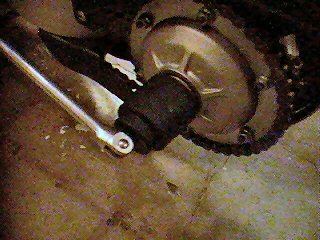
Begin by losening the main bolt
user posted image
The main bolt is a huge 46mm jobbie that is on very tight I borrowed Craigs socket to get it off, at this point you just want to get it loose, since its easiest to do with the wheel on the ground first loosen this bolt with the wheel down on the sidestand.

Remove the rear wheel

[image: user posted image]

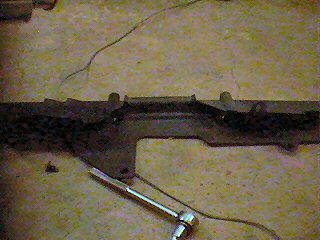
Remove the Chain Gaurd
user posted image
It is held in place by 2 screw type plastic clips, 2 hex bolts, and 2 brackets that hold the brake hoses.

[image: user posted image]
Once you get the chain gaurd off carfull not to lose the retaining backers that hold the hose brakets

[image: user posted image]

Remove the lower air gaurd

[image: user posted image]
Remove the main bolt and the washer, then loosen the pinch bolt on the top rear of the swingarm, then use the spanner from the tool kit to get enough slack in the chain to unhook it from the sprocket.
[image: user posted image]

Remove the rear hub

[image: user posted image]

Inspect the hub for rough bearings, if it turns notchy, noisy, or fits loosely then it should be replaced, put some grease on it anyhow. There is a spacer inside that you could mistake for a bearing, its just a spacer and it fits in there loosely.

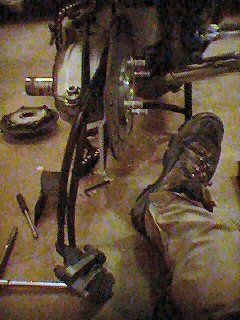
Remove the rear brake

[image: user posted image]
user posted image

Inspect the axle for scoring

[image: user posted image]
If you have a dial indicator and a v block check it for runout as well, check for damage, replace if nessisary, if not grease that puppy up , then inspect the needle bearings, if they are good repack them with grease.

[image: user posted image]

[image: user posted image]
My bearings all turned smooth and easy, they were all tight, and the needle bearings had grease, I just packed in a bit more, nothing bad to report, the axle was in good shape, I cleaned up my hub and switched the sprocket around. I also cleaned off the grime from the chain guide, since you have access to it now is the time to clean it!

What is suppose to be the SAE equivalent to the 46mm, it is 1-13/16 in. and is available at OSH for $19.95. I have not tried it yet to see if it will work though. 46mm equates to 1.811018 in. while 1-13/16 in. equates to 1.8125 in. - ULEWZ
#2
I found a 1-13/16 socket at a local tool store for $6.95 so I bought it and started to disassemble/inspect my rear bearings. The bearings looked fine, rotate smoothly, but move slightly from side to side. I also noticed an apparent extra washer between the driven sprocket and the bearing holder. It is not on any of my repair manuals. The disassembly consists of removing the rear axle nut, spring washer, (left the flange collar installed), driven sprocket, extra washer, rear axle. The questions that I have are as follows:
1. Is it ok to have slight movement from side to side in each needle bearing?
2. Does anybody else have this extra washer?

Your assistance would be greatly appreciated as my bike is currently apart.
#3
The needle bearings can be a little loose, replace if they are damaged or worn.  Its the ball bearing type that must be replaced if they fit loosly in the bearing holder.

The spacer is supposed to be there!

Try putting the axle back in see if its loose yaw or pitch. Check the axle for scoring.
#4
Thanks Miguel. I will leave the washer/spacer installed. I wonder why it doesn't show up in the repair manuals or on parts fish? All the bearings were good and there is no scoring. I lubed it up and will put it back together tomorrow. By the way, there was lube on the bearings, no scoring on the axle, and my bike has 35,000 miles on it.  :p My click type torque wrench doesn't go above 980 lb in, so I guess I will use old Betsy (deflecting arm type) and torque the crap out of the axle nut. The torque is suppose to be 141 lb ft/1692 lb in.
#5
I hope someone is watching this topic - I am trying to get the rear axle nut off and the bastard wont budge. Have unstaked it, and have tried with bike in gaer on side stand. Wont budge. Had a friend just around who sat on bike with rear brake on and it still wont budge.
Now I'm thinking, is this nut reverse thread?? Wheel rotates anticlockwise, so maybe nut should undo clockwise?? Have I just been tightening it??

PLEASE HELP !!
#6
I remember it being a lefty loosy, righty tighty standard nut! The first picture seems to indicate that anyway. I had to stomp on it with my foot!
#7
AB-oz, use an impact wrench. 46mm or 1 13/16" socket. And yes the nut turns left to loosen. I just did all that inspection / replace parts stuff with the help of Hispanicslammer's great write up. I have a low mileage 93' and my axle parts were all seized together, couldn't pull the axle out of the bearing holder and the splines would not come apart, even though the swing arm was spotless with no dirt inside. My local dealer wanted to smash it apart with a hammer, he said a few parts might get ruined. I took the swing arm et all to a machine shop to see if they could press the axle out on a press. They couldn't but they did manage to pry off the cush drive cover. I took everything back home and spent two weeks spraying every variety of anti-seize stuff on it there is. I tried heat briefly, no good. I ended up going to my friend at the locale tractor dealer and borrowing a big wheel / bearing puller, five minutes later I had the axle, bearing and spline apart. In retrospect my bearings were fine a little low on grease from the factory though. I had to file the spline groves lightly before they would fit back together and I put all new bearings in, after all that work I thought I might as well.
good luck
#8
HispanicSlammer, Aug 15 2002, 11:47 PM 
 
then inspect the needle bearings, if they are good repack them with grease.   


Thanks HS... and here's my patented method to clean both the axle and caged needle bearing if they don't pass inspection...

Once you have the bearing removed you employ a two jewelers screw drivers and carefully lift each roller from the cage...
[image: user posted image]


Give the rollers and cage a bath in gasoline... you be surprised at all the dirty deposits that are hidden
in the old grease and every nook and cranny after only 10K miles of normal operation...
[image: user posted image]


Once the bearing is really clean lay them out and inspect each roller for scoring...
[image: user posted image]


Dirty will leave a trail of deposits on the axle at point B...
[image: user posted image]


Spun in a Lathe... it's easy to remove the deposits employing a gray micro fine 3m pad...
it's soft enough that it does *not* remove any precious metal...
[image: user posted image]


Mercy... you don't have a Lathe??? well you can gain the same effect by inserting the axle in the
sprocket side bearings and spinning it with a drill and again employing a gray mirco fine 3M pad...
[image: user posted image]


At any rate... you'll end up with the deposits remove and a nice shine to the axle...
[image: user posted image]

Questions???
#9
When I opened my back axle the needle roller was fine but the pair of bearings had a rough spot. They seem to be standard Koyo #6908 sealed bearings with one seal removed from each with a plastic ring fitting in where the seals used to be. Genuine Honda bearings are very expensive so I took the bearings to my bearing supplier. My suppliers were very interested in the plastic ring; had a good look at it. They explained that the grease gets spun outwards as the bearing rotates & tramped out sideways by the balls then guided back inwards by the seals so the grease circulates from the inside to outside & back to the inside of a sealed bearing. They believe the plastic ring is there to fill the void and guide the grease back inwards as a seal would; it is shaped like two cut down seals back to back. I bought 2 bearings with metal shields (shields & seals are similar; seals actually seal better but drag slightly, shields are not as splash proof but drag less). These bearings were 70% cheaper than the Honda parts.

[image: user posted image]
Back axle bearings. NTN above Honda/Koyo below

When I flipped the shields out I found that the Honda plastic ring did not fit ? slightly too big on diameter. I turned up a ring of acetal. My bearings are NTN. I expect if I had bought Koyo bearings the Honda ring would have fitted.

If I was to do it again I would just fit the bearings with both seals (or shields) still in place. The bearings are designed to run with the seals so there can be no problem leaving them on. The only advantage I can see in the Elf/Honda system is that we can wash the bearings and repack the grease.

Try as I may I could not flip the needles out like BLS can. If you need to replace the needle roller you can use a standard INA #NK 50/25 bearing. It is 62OD, 50ID 25 wide. The ID dimension refers to the shaft it runs on as there is no inner race. The Honda bearing is a special because the rollers are slightly short & a seal is fitted inside the bearing on one side. The INA bearing has full width rollers & no seal. There is a proper separate seal fitted outside of the bearing in the Bearing Housing; the seal in the needle roller is on the inside which is in any case closed so there is no dirt from that side. If you use proper bearing grease it should stay in the bearing & you should have no problem. I suspect it too will be 70% cheaper than the Honda bearing. And have longer rollers.

EDIT: There is a hole between the arm of the SSA & the axle housing; they are interconnected. The SSA has some holes in it also so dirt can get inside the SSA (I have read of an Australian who filled his SSA with builders filler foam to keep gravel out of his SSA as he had to ride a stretch of dirt road to get to his house). So I was wrong in saying that dirt is excluded from the space between the ball & needle roller bearings on the back axel - unless you close the interconnecting hole.
#10
I have yet to tear into the rear hub assembly as yet, and I have read all the how to reply's and no mention is made on the cush drive rubbers--how do you determine if they should be replaced? I know this is subjective, how freely should the wheel assembly rotate with chain tire and wheel in place, my bike has 16K on it and it seems there is more drag than it should have.

Maybe I should go by a dealer and spin a new bike on the center stand.
#11
tooslow, Dec 5 2006, 12:33 PM
I have yet to tear into the rear hub assembly as yet, and I have read all the how to reply's and no mention is made on the cush drive rubbers--how do you determine if they should be replaced?

It's a bit subjective, but I know mine need replacing because of the amount of slop when changing gears (and from past experience with worn cush rubbers on other bikes). at 16K I doubt they need replacing though - mine has 42k miles.
What you can do to check them is with the bike on the centrestand and in gear, grab the wheel and turn it one way or the other until the chain is tight, then turn it some more. If it rotates much back and forth once the chain is tight, then the cush rubbers are tired. They're made of fairly soft rubber, so SerialTransmissionWreckers like myself, who do lots of commuting miles and use lots of engine-braking tend to wear them (and the rest of drivetrain) out very quickly.
#12
Thankyou for doing the write up,

It gives me some perspective, overall it sounds like everything was in good shape


My 06 , everything I've seen on the bike , it's been well greased, almost to a abnormal extent in comparison to other bikes.

This bike had great care in assembly IMO
#13
Ok, ripped my rear axle apart last night and a couple quick questions.
1) I don't have the bearings out of the housing yet (seals, spacers and snap rings removed). The dual ball bearings - should they be able to spin independantly of each other? Or is it supposed to be that tight of a fit that they can only move together (which is what mine is doing). And they do seem a bit stiff...like they're still new but the bike has 20k on it. Otherwise no notchiness, roughness or slop to them.
2) For those that took the bearings out, I'm assuming you didn't have the Honda "special tool" and press for removing them...Just use a hammer and brass drift?
#14
tooslow, Dec 4 2006, 05:33 PMI have yet to tear into the rear hub assembly as yet, and I have read all the how to reply's and no mention is made on the cush drive rubbers--how do you determine if they should be replaced? I know this is subjective, how freely should the wheel assembly rotate with chain tire and wheel in place, my bike has 16K on it and it seems there is more drag than it should have.

Maybe I should go by a dealer and spin a new bike on the center stand.


My bike has 16,000 also, Its very free spinning(the rear), I actually think it was abit tighter when new
End of thread · 14 posts recovered Wayback Machine snapshot 18 Feb 2007