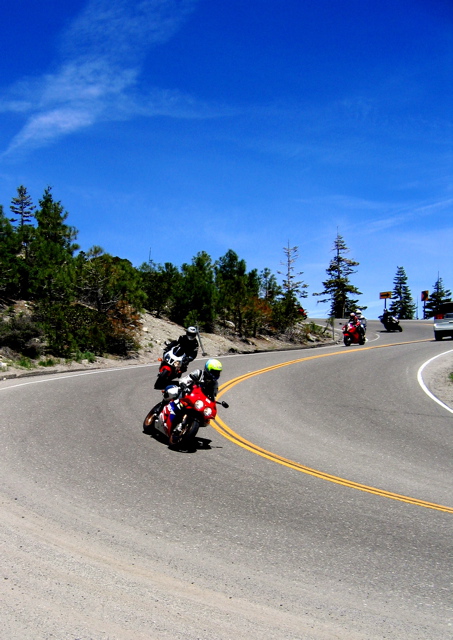
I'm in the process of breaking in a new vfr and I am also brushing up on my riding skills.... I am scheduled for the MSF course next weekend. In the meantime I'm taking it easy and respecting the power of this new machine.. I know it takes awhile to get accustomed to how my new machine handles ect, and I am not leaning the thing over. I'm letting the tire's wear in a bit.
I have read Twist of the throttle II and I'm working through Proficient Motorcycling by David L. Hough. I found T.O.T.T. very techinical and focus on the curves. I found myself kinda overwelmed by this book.. Proficient Motorcyling in my opinion is teaching me more about riding on the street and the things I might encounter. I just find it to be addressing alot of the issues I might encounter, such as stay off the plastic or painted lane indicators and turning lanes. I already Knew that but it is a great heads up...Anyway...
My main question is in both books they say brake before a turn and throttle evenly through the turn... Thats my problem. They insist that it will make you execute the turn faster and with more traction for a variety of reasons.. The theory is very sound and I totally beleive them, but I'm finding myself feeling very uncomfortable in tryin this.. I always feel as though if I give it gas I'll fly over the line and into the oncoming lane... When do you veteran riders get off the break and start to give it gas. And how do you keep the fear triggers down low enough to execute the manouver. And how do you steer into the turn? by leaning,puttin pressure on the peg or countersteering. I have been practicing countersteering and I'm starting to feel pretty comfy.. I havent had to use this is collision avoidance such as a quick C.S. one way then a quick C.S. in the opposite direction..Im starting to ramble so I'll close with those thoughts.. Any advise is very welcome...
If you're riding at a comfortable pace on the street, you don't need the brakes much at all.
As long as you're brushing up, read this too: Link to thread
Stay on the brakes until the point where you are ready to tip in to your turn. As you tip in, you add a little throttle to maintain your speed and your line through the corner. That is called "maintenance throttle". Once you see your exit line and are past the apex, start adding throttle. Practice doing all that smoothly before you try to go fast. Getting faster is a byproduct of being smooth.
The MSF will teach you everything you need to know for now. You should get plenty of practice with steady throttle control doing circles and with counter-steering execution during the course. Once you get comfortable with riding the bike and practicing all the skills learned in the MSF course, you can begin to work on more "advance" techniques. I wouldn't worry about them too much until after you take the MSF course and get some miles on the VFR under your belt. JM2�.
Sounds like stuff that will fall into place with more riding and relaxing, but I can also recommend Reg Pridmore's book "Smooth Riding" Smooth is always the key.
WFO the whole time! (IMG:style_emoticons/default/fing02.gif)
(IMG:style_emoticons/default/biggrin.gif) Good advise above, practice on a smaller bike if you have access to one! (IMG:style_emoticons/default/fing02.gif)
Outstanding people above with advanced skills providing you with what you need. MO is from a rider still growing in skill. 1/ Find an advanced and mature rider in your area and have coffee with him/her. Explain your interest and concerns. Again, ensure it's a mature and responsible person (I was lucky to have my bro start me off, with many patient race vets today) and head out to an area you are "really" familiar with, low in traffic and clean (parking lots with a pre-determined plan) and proceed to practice at a slow pace.
2/ I learnt alot from Scottinexile two years ago, about using engine compression and learning to feel your bike through corners. Applying breaks gradually before the turn (read above) then gradually increasing throttle after the apex/seeing exit to help stand the bike up. I remember learning and feeling anxious in the begining, today I ALWAYS ride at my own pace, enjoying and learning as I go.
It's a great feeling to groove through a corner; it's my therapy! Enjoy your rides and respect your bike. (IMG:style_emoticons/default/fing02.gif)
I'm no expert rider, but my technique is to downshift at least one gear and keep the rpms up a bit, otherwise I'd have to close the throttle completely or modulate with the clutch much more than I do during most turns.
I started reading "Proficient Motorcycling" but never finished it. I have the follow-up book, too. Good stuff.
BTW, MSF teaches four-fingered braking. I think to keep the throttle partly open during a turn it's usually necessary to use two-fingered braking instead. But use four-fingered braking during the class. I got caught using two fingers a few times when I took the MSF course last summer!
If you grew up riding a bicycle, you probably already intuitively use the three steering techniques you reference. It's good to practice them simply to learn how effective each is individually, but don't get caught overanalyzing your turning technique to the point you forget the other things that will keep you right side up. It will all come more naturally with more time in the saddle. As far as throttle in the turns, the maintenance throttle mentioned above is just slightly above idle which is effective enough to transfer the weight rearward and make the bike feel more stable.
It's good to see that you are trying to do things the right way. Most people seem to get in over their head and learn the hard way. Take the course, keep reading and learn from experienced riders (not wanna be racers). If you learn to do things correctly it will fall into place. It isn't always easy to learn good technique but it is very hard to "unlearn" bad habits.
okred, Apr 9 2008, 05:27 PMAnother helpful reference book is 'Sport Riding Techniques' by Nick Ienatsch. It's focused on street riding and is a fairly easy read.
+1. This is a great book that is not just for sport riding. I personaly count myself as novice rider and ever time I have read this book I have noticed my skill improve. Its an easy read and there are lots of great pics to.
okred, Apr 9 2008, 05:27 PMAnother helpful reference book is 'Sport Riding Techniques' by Nick Ienatsch. It's focused on street riding and is a fairly easy read.
+1. This is a great book that is not just for sport riding. I personaly count myself as novice rider and ever time I have read this book I have noticed my skill improve. Its an easy read and there are lots of great pics to.
(IMG:http://www.vfrdiscussion.com/forum/style_emoticons/default/%201.gif) I've read it too! Good book! (IMG:style_emoticons/default/fing02.gif)
(IMG:style_emoticons/default/+1.gif) What Sebspeed said.
Choosing the correct line is as important as anything...maybe more. Blow a line bad and recovery is very difficult if possible at all. I engine brake (or use brakes some if going "fast") before entering the turn. I set my line up in my head and with the bike before the turn, look thru the turn, take the line, get in the turn, then hit it...put overly simple.
Disclaimer: I'm slow. (IMG:style_emoticons/default/rolleyes.gif) Read, try, then you will learn.
Recommended simple book = Total Control by Lee Parks.
okred, Apr 9 2008, 02:27 PMAnother helpful reference book is 'Sport Riding Techniques' by Nick Ienatsch. It's focused on street riding and is a fairly easy read.
Another vote for the Ienatsch book.
For the new rider, it's often important to get the braking done as the corner approaches and the bike is still upright. Enter the corner at a speed acceptable for the whole arc, including the apex, and concentrate on that microapplication of maintenance throttle to keep the suspension smooth. Continuing to brake once the bike has begun leaning over will come with time, but for practicing corners now: focus on seeing an apex for what it is, and on turning in a smooth, continuous arc until it's passed, always looking where you want to go.
Look where you want to go. Train your reflexes: sometimes on empty, straight 30-40mph roads, look away out to the side for a couple seconds then look to the road again. Let your eyes catch on the first 'obstacle' you see: a paint smear, tar line, oil, small rock, etc, and pretend it's deadly. Then consciously fixate on the clear path around it. Fixate on the open path around the problem and watch the bike magically swerve to obey your thoughts.
all good posts - but bar time and good mentoring have always been my best friends. Although alot of the books mentioned are great - if I try to remember what I've read I tend to concentrate on everything that was said instead of what my basics should be. Good luck and hope you get alot of seat time in - that will be your greatest trainer.
I typically try and downshift and get my speed right before a turn ( I think setting the speed is one of most important things ). I try and keep the throttle smooth until I have hit the apex or center of the turn then add a little throttle so the back of the bike will set down.
I just took my MSF course about a month ago and being this VFR is the first bike I had with a hydraulic clutch and fuel injection and I found finding the sweet spot on the clutch was crucial in doing the course. Having the fuel injection seemed that their was no delay in the response that I was used to on the older bikes which for the course makes you learn how to use the clutch much more for the slow stuff and not rely on changing the throttle as much but learning to feather the clutch to move the bike.
I'd have to say, if wher eyou are not comfortable is a situation where you are turning off of a main street, and into a parkinglot or a housing subdivision. Then brake before the turn, to a speed that would be comfortable for you to ride through the turn into the area you have planned for a destination.
for example if you are traveling at say 40 mph down a main street, and are going to turn into the parking lot at McDonalds to take a break and get a cheese burger then make sure to signal, and apply the brakes and slow to somewhere between 5 to 10 mph to take the turn. Once you have slowed to YOUR comfortable speed continue until you are ready to initiate the turn. This means look at where you are going, turn your head and your body, and consequently the bike will follow.
You will learn all about this and have plenty of opportunities to practice this at the MSF course.
Another tip. Just something that I like to do to occasionally hone my skills, and/or just to be competitive with myself. I like to using only the clutch for power, see how slow I can go an keep the bike uprite without having to put my feet down for balance. Or sometimes I just come to a slow and controlled stop and see how long I can balance the bike before having to put my feet down. After a while of doing this you will gain some confidence and enlarge your smile.
Baileyrock, Apr 9 2008, 12:49 PMWFO the whole time! (IMG:style_emoticons/default/fing02.gif)
You tryin' ta kill him??
(IMG:style_emoticons/default/biggrin.gif) Good advise above, practice on a smaller bike if you have access to one! (IMG:style_emoticons/default/fing02.gif)
I thought that is why the MSF gave you multiple bikes, so you can trash theirs instead of yours.
The key seems to be 'practice practice practice'.. it doesn't matter what any one person tells you. You probably won't be happy until you 'feel' happy. For this you need to just keep practicing.
I've got a few good local bends that I use to gauge my own progress.. take all the advice and apply it carefully and cautiously..
Did you know that the 'contact patch', the actual area of your tyres that helps your bike grip on bends actually grows larger the deeper you go into bends? This is due to the way that modern tyres are manufactured. However, get the boots warm first! Your bike is probably more capable of cornering deeper than you are in the present time.
You'll get to a point eventually that your ability is far improved, through knowledge and experience. But don't expect it to happen overnight.
Try to rush this learning curve without 1:1 expert tuition and you might find things get a little rough!
mikenco, Apr 9 2008, 07:21 PMYour bike is probably more capable of cornering deeper than you are in the present time.
+1. My bike is more capable than I am. When I'm not leaned over enough I force myself to push the bars a bit more to corner more effectively. Trust your bike. If you have good tires (and they're warm enough) there's no reason you can't corner like a madman!
Just last weekend I finally started to feel a little more comfortable with decent lean angles. It had been a long winter and I didn't ride nearly as much early in the year as in '07, so has taken me awhile to get comfortable with hard cornering again. I'm not there yet, but I should be OK in a couple weeks.
Not to be Nosey, but I didnt see where you were from. If you wouldnt mind posting your location someone here may be close enough to do some riding with you. Just a thought.
Still working on it. Folks here have been kind and supportive. Sometimes, they put me as lead. Just to make my intentions, clear,.... Even when I don't hit the brake, (engine brake, on the oncoming curve), I'll tap the brake. Just to relay intentions. LOL. Can't believe folks will let me lead. LOL. (I'm a limit to 15ish above guy). Safety first.
WFO all the time might work on a 250, but not on the VFR. On the 954 I can't hold the throttle WFO for more than a few seconds at a time. It wants to go to Wheelieville and/or Bezerkistan. (IMG:style_emoticons/default/rolleyes.gif)
How about, Slow in, Fast out. (IMG:style_emoticons/default/fing02.gif)
I personanly would not recommend a new rider on a vfr800 , but congrats on the bike. Main reason there's so many easier rides to gain experience on. The vfr has the capablity of hurting ya, even many of the experts here have felt the rath of the vfr and pavement, some can actually still walk.
until ya have a few years of basic riding , Id avoid the devil. learn proper hang off techniques to avoid dragin hard parts and learn ride control covered at all times would be my advice
Anyway, ya have very very long venture ahead of ya, dont dive too deep (IMG:style_emoticons/default/biggrin.gif)
I imagine low-rev throttle control on a new VFR is kinda difficult for a new rider to master. Throttle response on a stock 6th Gen at small openings has an "on-off" feel, so that might make things more difficult for you than if you were learning on a smaller carbed bike. Whatever. But the first 5 or 6 replies to your post really nailed it. Your bike will have more traction and be more settled - and controllable - in the corner if you gently roll on the throttle through the corner. Get your braking done before you enter the corner and gently apply throttle through the turn. You'll see how your bike feels more planted. Again, the snatchiness of the throttle kinda surprised me on my 6th Gen when I first rode it, but it just takes a bit of getting used to - that or a PCIII with O2 eliminators and a Leo Vince exhaust!!!!
okred, Apr 9 2008, 03:27 PMAnother helpful reference book is 'Sport Riding Techniques' by Nick Ienatsch. It's focused on street riding and is a fairly easy read.
Good luck on your skill building. I like the idea of using a smaller bike at first if you possibly can. And +4 on the Nick Ienatsch book. I have read every one of the books mentioned and I think it had the most to offer, plus I have been coached by Nick and he has the word, man.
marbs34, Apr 9 2008, 06:19 PMI like to using only the clutch for power, see how slow I can go an keep the bike uprite without having to put my feet down for balance. Or sometimes I just come to a slow and controlled stop and see how long I can balance the bike before having to put my feet down. After a while of doing this you will gain some confidence and enlarge your smile.
+1 on this. Learning how to ride the bike slow can be very rewarding and hones your skills. Remember the viffer has plenty of power without using the throttle. So find a large empty parking lot and play.
gsdfriendly, Apr 9 2008, 11:27 AMWhen do you veteran riders get off the break and start to give it gas. And how do you keep the fear triggers down low enough to execute the manouver. And how do you steer into the turn?
Mercy me what brakes??? out on the perverted road my brakes are not a part of my riding plans... I prefer to establish a brakeless pace... that means to adjust corner entrance speed with throttle alone... and if I do choke and tap the brakes I grade that corner has "blown" and I give myself a good talking too...
I believe if you don't learn to judge the speed of the corner with throttle alone... you'll never learn by adding brakes... brakes make cornering too complicated... keep it simple... roll off... roll on... and once you start rolling it on... keep it on... get it right and your ride is biblical...
My steps to cornering:
1 I find the corners turn in point...
2 After reaching turn in point I shift my eyes to the apex...
3 I applied one *quick* steering input and then leave the bars alone...
4 I roll on the throttle as early as possible even before the apex... I want the bike under the rear contact patch control... the front can actually be lifted off the ground but the bike will still track around the corner on my intended line...
gsdfriendly, Apr 9 2008, 11:27 AMI always feel as though if I give it gas I'll fly over the line and into the oncoming lane... When do you veteran riders get off the break and start to give it gas. And how do you keep the fear triggers down low enough to execute the manouver. And how do you steer into the turn? by leaning,puttin pressure on the peg or countersteering. I have been practicing countersteering and I'm starting to feel pretty comfy.. I havent had to use this is collision avoidance such as a quick C.S. one way then a quick C.S. in the opposite direction..Im starting to ramble so I'll close with those thoughts.. Any advise is very welcome...
After about 3 months riding I attended the Freddie Spencer School. Probably the best thing I ever did to get a good foundation beyond what the MSF teaches. Sounds to me like you're trying to push your limits and you're doing it the right way...GRADUALLY and by asking the right questions! I am NOT an expert rider or instructor but Freddie's teachings changed my life on a bike in a BIG way. Making things safer, smoother and faster in the process. A few tips I STILL practice every ride may help with the turn confidence.
First and most important is looking through the turn. If you get worried about running off, you will look at the area you think you're going to run wide and guess what..the bike WILL follow. It's like hitting a golf ball. DON'T look at where the ball is going.. FORCE yourself to keep your head down. On a bike, force yourself to look through the turn to where you want to be. The bike will go there.
Body position is probably the next biggest for me. I LOVE the picture at the top of the "Riding Technique" thread http://www.vfrdiscussion.com/forum/index.php?showforum=48 It is the simplest way to explain proper riding position in a turn. With your weight off to the side of the bike, it will require LESS lean angle to turn the same radius. If you lean the bike and are putting your weight over the top, the bike will eventually fall down. This doesn't mean you have to hang off like Nicky or Valentino but it does require moving your butt around on the seat. Setting up for the turn early is the key to this. Get your butt moved early and do a downshift (if needed) well before the turn. Then move your head and shoulders down towards the mirror and look through the turn, it will happen in a much safer way.
Next is something I've been preaching since learning it and those who caught on are MUCH happier. Keep your weight off your arms and wrists. On a VFR this is pretty easy. (works great on my 848 and 600rr too!) By moving yourself as far forward as you can (mash your stuff into the tank) you will have an anchor point along with your feet to allow you to take all the weight off your arms and support yourself with your stomach, back and legs. Multiple benefits to this: more precise control of throttle and brake, no arm fatigue, and easier to move your upper body. There's another side effect that takes some getting used to but it really works. You DON'T countersteer. with your body in the right position and no weight on your arms, the bike will turn itself based on speed. This is where delicate control of the throttle and brake come into play. You adjust the radius of your turn with throttle and brake. Once you feel this, you will have a grin for days and not want to stop practicing it. Key to it is GENTLE braking and GENTLE throttle which cannot be accomplished if you have any weight on your arms. You need to figure out how to rock your right hand between the throttle and brake smoothly. This is not easy! My thumb wraps the throttle and allows my pointer and middle finger to rest on the brake.
Since getting my 848, I have had to force myself to do the body position stuff as the ergos are COMPLETELY different from the Honda's. So these techniques are running through my head EVERY day and every time I ride. While the books are great for getting your mind to the right place, I would HIGHLY recommend attending a performance riding school. Track time at such schools is a safer place to work on technique and having a proper instructor is the BEST money you can spend in motorcycling! Don't worry about feeling you need tons of experience to attend these schools either. There were two guys in my class who had been on a bike for less than a month! Get to one before you develop any bad habits!
Plus if you attend the Spencer school, you'll get to see how badass the VFR REALLY is!!! Freddie is amazing and part of the school you ride on the back of his VFR around the track! Best rollercoaster EVER!!!!!!!!!
As the post just before mine was being written at the same time, I agree that in a turn you don't necessarily need brake input, throttle on/off is enough. Freddie teaches trail braking which some have criticized as being too complex for beginners. I happen to love it but once again, I was taught the technique by the best in business! May not be something to try by yourself! Try the throttle only thing first. Below is my wife at the school 3 years ago! AWESOME!!!
And here's my sorry arse in '05 after three months on a motorcycle EVER! Note my horrible position...high shoulders and head, butt and body not really far enough off the bike which is leaning too much. Actually kinda dangerous. This was taken the second day of the school and reminds me what I am doing wrong!
(IMG:http://www.vfrdiscussion.com/forum/uploads/1118021848/gallery_3597_173_1019.jpeg) Rob Lean 2.jpeg
gsdfriendly, Apr 9 2008, 01:27 PMMy main question is in both books they say brake before a turn and throttle evenly through the turn... Thats my problem. They insist that it will make you execute the turn faster and with more traction for a variety of reasons.. The theory is very sound and I totally beleive them, but I'm finding myself feeling very uncomfortable in tryin this.. I always feel as though if I give it gas I'll fly over the line and into the oncoming lane... When do you veteran riders get off the break and start to give it gas. And how do you keep the fear triggers down low enough to execute the manouver. And how do you steer into the turn? by leaning,puttin pressure on the peg or countersteering. I have been practicing countersteering and I'm starting to feel pretty comfy.. I havent had to use this is collision avoidance such as a quick C.S. one way then a quick C.S. in the opposite direction..Im starting to ramble so I'll close with those thoughts.. Any advise is very welcome...
I know this may sound strange coming form a M/C instructor, but, your thinking too much. Your at the very early stages of riding and you need to work on the very basics provided by the MSF class. In time effective higher speed cornering will come. Your worried about the throttle and I can tell by your words you really don't understand the "press" yet. That is ok. Don't get in a hurry to learn this stuff. Practice the basic riding skills and concentrate more on developing good braking and swerving as you learn to really see everything out there on the road. Higher speed cornering will come in time, don't worry about it.
BusyLittleShop, Apr 10 2008, 12:18 AMMercy me what brakes??? out on the perverted road my brakes are not a part of my riding plans... I prefer to establish a brakeless pace... that means to adjust corner entrance speed with throttle alone... and if I do choke and tap the brakes I grade that corner has "blown" and I give myself a good talking too...
I believe if you don't learn to judge the speed of the corner with throttle alone... you'll never learn by adding brakes... brakes make cornering too complicated... keep it simple... roll off... roll on... and once you start rolling it on... keep it on... get it right and your ride is biblical...
Good Stuff Larry................ (IMG:style_emoticons/default/fing02.gif) This works for anyone at any pace.....leisurely riders or the cranking it group......... (IMG:style_emoticons/default/fing02.gif)
BusyLittleShop, Apr 10 2008, 12:18 AMMercy me what brakes??? out on the perverted road my brakes are not a part of my riding plans... I prefer to establish a brakeless pace... that means to adjust corner entrance speed with throttle alone... and if I do choke and tap the brakes I grade that corner has "blown" and I give myself a good talking too...
I believe if you don't learn to judge the speed of the corner with throttle alone... you'll never learn by adding brakes... brakes make cornering too complicated... keep it simple... roll off... roll on... and once you start rolling it on... keep it on... get it right and your ride is biblical...
Good Stuff Larry................ (IMG:style_emoticons/default/fing02.gif) This works for anyone at any pace.....leisurely riders or the cranking it group......... (IMG:style_emoticons/default/fing02.gif)
+1 on this entire page so far.. I know Im a new rider and havent taken eny riding courses but after reading the above posts somewhere before then trying them myself it is a world of difference to what I was doing...You can really feel the difference in the way the bike will ride n feel right off the bat..
Might I add something I do everyday and all day...
It's not how fast you go but how steady you can keep it..
start slow n work your way up.. Dont let ego or trying to stay out of another riders way by staying ahead get you in trouble.. Let them go.. In due time you will work your way up there too or to a point you are comfortable with..
The two things I notice that newbs suffer from is:
1. Not looking through the turn.
2. turning in way to early.
Two very good points. I'll just echo what others have said about riding at a pace that doesn't require braking, body positioning, and gear selection. RPMs are your friend. Keep it geared low going into a turn so that you have ample engine braking for slowing if you need to rather than hitting the brakes and upsetting the suspension. Get your weight forward and to the inside ("get on the paint") to reduce the needed lean angle. Turning in later seems a little scary at first but it really helps you not run wide on the exit .
My suggestion is to find a safe section of road that you are familiar with and start with very conservative entry speeds, practice turning in with the RPMs up a bit and smoooooothly rolling on the throttle through the turn to learn what it feels like. You'll soon see how stable it makes the bike. Bikes like to be on the gas, even if just a little. Once that feels good practice smoothly letting off the gas just a little (again with RPMs up) to get the feeling for just how much you can slow with the throttle. That is much better than having to get on the brakes mid-turn (which, however, is something you need to learn down the road for emergency situations but after you get the basics of cornering down). As Seb and Larry said, once you realize how much you can do with the throttle you'll find yourself not using the brakes much at all and still going pretty darn fast. If you have a chance to go out to a track, that's an even better place to work on the mechanics of riding. Be slow and methodical about your learning process. Learn to be smooth on the controls. Slow your hands down. Brakes and throttles aren't on-off switches.
Brown81, Apr 10 2008, 11:41 AM2. turning in way to early.
True... it's because the friendliest part of the turn is the inside... new riders make the mistake of turning the bike to early and then not turning the bike fast enough... this will give you the sensation that you are going too fast when you're not.. and if you do make it you'll find yourself wide at the exit...
My turn input is later which puts the bike more to the center of the road... (IMG:http://www.vfrdiscussion.com/forum/uploads/1207602100/med_gallery_3131_51_101795.jpg)
Larry, I'm only joking of course, but if I remember correctly, there is a picture from that same day that illustrates what happens when you run wide? (IMG:style_emoticons/default/3.gif)
End of thread · 42 posts recoveredWayback Machine snapshot 13 Apr 2008