Back story: A friend of mine wrecked this bike back in 2010, and I let him park it in my storage unit. It cranked when it was parked, but fuel was left in the tank. He recently gave it to me instead of some money he owed me, I figured it would be fun to have a project that wouldn't take my main bike off the road. And it would be a great learing experiene. I replaced all the bits damaged in the wreck, and all it would do is turn over. Fuel pump primes. I swapped out the spark plugs, and now when I turn it over it sounds like one cylinder is firing. It just won't crank. So now I am pulling the injectors to soak them in either Seafoam or denatured alcohol and hopefully clean them out. Got the air box off, but it's looking like I have to remove the throttle bodies to get to the bolts holding on the fuel rails. I am an electrical engineer, so this stuff isn't exactly my strong point. I don't want to accidentally cause a lot of extra work for myself, so I am just at a position where I don't feel comfortable going any further without seeing step by step instructions. The friend is a major VFR guy, and he recomended I bring any questions to this forum. So I am here.
Long story short, I have searched but can't find instructions on pullling the injectors on a 5th gen VFR, only a 6th gen. Which isn't helpful. Can any of you point me in the right direction? It would be most appreciated.
Need Help Removing Fuel Injectors On A 99 Vfr
50 posts Started 31 Mar 2014 Last recovered post 3 Apr 2014 Wayback Machine snapshot 12 Sep 2017
He should be along shortly, but I believe Kaldek knows the procedure cold. In the meantime, consider searching for Kaldek and fuel injector in case he's posted it previously.
That's actually the guide I found for a sixth generation. But the fifth generation fuel rails are mounted completely different, and I can not find a way to access the bolts without removing the throttle bodies.
When I sent mine out for cleaning and testing, I seem to recall removing the throttle body assembly. I think the only way to remove the bolts holding on the fuel rails is from the bottom...
That's what I was thinking. I am just nervous about removing the throttle body assembly without seeing a step by step. Worried I will end up doing something that will cause lot of work for myself that could have easily been avoided.
You could use the clymer procedure:
"Simply remove the throttle body assembly. Installation is reverse of removal"
Or
Grab the service manual from the downloads section:
http://www.vfrdiscussion.com/forum/index.php/files/file/171-98-01-honda-vfr-service-manual-optimized-bookmarked/
I remember that getting to the screws that clamp the intake rubbers to the bottom of the throttle body is a pain. Aligning and properly seating the throttle bodies in the boots wasn't that bad for me. I took the boots out and let them sit with armor all on them for a while to restore some flexibility. I also lubed the lip of the boot with rubber safe silicon grease when re-installing.
Edit: I think permatex dielectric grease would work fine. If anyone is doing this on a bike w/ O2 sensor, make sure that the grease is compatible, I know a lot of silicon products can damage them.
[video: https://www.youtube.com/embed/CNSBmBl1_qk?feature=oembed]
Try this video ..
It's a 6th gen but it's very close to the same procedure ..
This is the problem with using a VTEC procedure:
6th Gen:
[image: gallery_11118_5215_302299.jpg]
5th Gen:
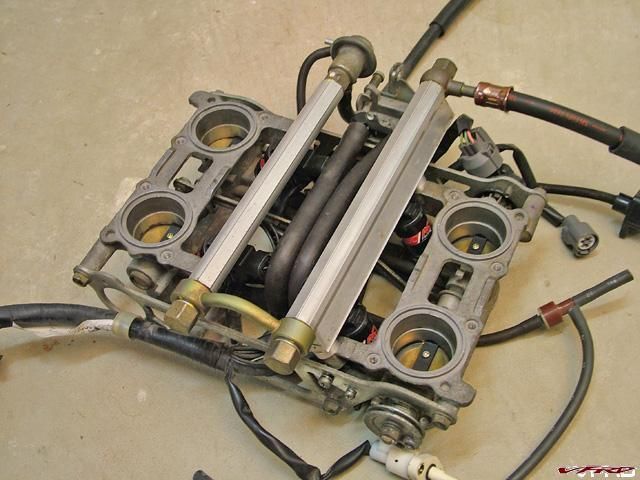
Notice that the bolts for the fuel rails are accessible from the top. This is simply not possible on a 5th gen, must flip throttle body over to access.
MadScientistYou could use the clymer procedure:
"Simply remove the throttle body assembly. Installation is reverse of removal"
Or
Grab the service manual from the downloads section:
http://www.vfrdiscussion.com/forum/index.php/files/file/171-98-01-honda-vfr-service-manual-optimized-bookmarked/
I remember that getting to the screws that clamp the intake rubbers to the bottom of the throttle body is a pain. Aligning and properly seating the throttle bodies in the boots wasn't that bad for me. I took the boots out and let them sit with armor all on them for a while to restore some flexibility. I also lubed the lip of the boot with rubber safe silicon grease when re-installing.
Edit: I think permatex dielectric grease would work fine. If anyone is doing this on a bike w/ O2 sensor, make sure that the grease is compatible, I know a lot of silicon products can damage them.
I am at work right now, but I will grab the manual tonight when I get home and see what I can learn while sitting on the couch with the kiddos. They go visit their mom tomorrow night, so maybe I will have a solid grasp of what to do by then so I can get them off and let them soak for few nights and maybe have the thing running by this weekend. Thanks!
Edited March 31, 2014 by djeffreys10Silly question, but how do you know that you have bad injectors and not something else? Did you check for spark at each cylinder? Are your plugs wet after cranking? Are all of the safety switches functioning properly? Do you have a FI warning light?
Lots of things I would check before pointing the finger at the injectors. Those are one of the last places I would look at after a crash.
Switchblade [video: https://www.youtube.com/embed/CNSBmBl1_qk?feature=oembed]Try this video ..
It's a 6th gen but it's very close to the same procedure ..
Maybe not that close !!!
YoshiHNSSilly question, but how do you know that you have bad injectors and not something else? Did you check for spark at each cylinder? Are your plugs wet after cranking? Are all of the safety switches functioning properly? Do you have a FI warning light?
Lots of things I would check before pointing the finger at the injectors. Those are one of the last places I would look at after a crash.
I am assuming they are dirty because before he stored it in my storage unit, he cranked it with me there and it fired up, idled, and reved just like nothing ever happened. He had every intention of fixing it over the next few weeks, so he didn't drain the fuel. But life happened, and about 3.5 years later I am fixing it. Since it just sat during that time with fuel, it would stand to reason that the fuel just gummed up. I have fire on the spark plugs, and they are brand new. Swapped them for good measure, since it was easy and they are cheap.
If you have $100 to spare on this project, I'll plug the place that did my injectors: http://www.witchhunter.com/
I thought I had a leaky injector so they went off to the pros for cleaning. They send back a sheet listing all the before and after test results as well as all of the old parts they replaced on the injectors. I had not specified to them any issues with the injectors, but I their pre-cleaning tests did indicate that one of the injectors was not sealing properly. Turn around time was pretty good too, about a week IIRC.
Yeah, also, removing the throttle body from those old/stiff connection boots may be difficult:
[image: gallery_2862_880_7464.jpg]
I couldn't find a good thread for 5th gen throttle body removal, but I didn't search that hard. May want to use google as there could be a good how-to on one of the other VFR forums.
While you are going through this bike, you may want to flush the coolant. Sitting for a few years might have sludged things up a bit and while you have the throttle body out, you have good access to replace the thermostat and any damaged coolant lines that run under the throttle bodies.
My bike needed a new fuel pump, not an injector cleaning, after it had sat a long time. Are you sure the fuel pump is actually pushing gas to the injectors?
I just took a look at the 5th gen factory service manual (paper copy) for the injector removal procedure and the first thing it says is "Remove the throttle body". On my 6th gen I removed the injectors by just eyeballing it - I never cracked the manual. Too bad they couldn't have made 5th gens similar.
I got a noticeable improvement in low end smoothness by cleaning the injectors on my 6th gen. The injector orifices are now so tiny that even the slightest of clogging can result in poor spray patterns. On my 6th gen I had 3 that were rated "good" and 1 "fair" (which was leaking when off), and that on (at the time) a 4 year old bike. I sent them to RC Engineering - I think they were $25 per. Great service, fast turnaround.
It doesn't take nearly as much effort to take the plugs out and make sure each one is actually sparking as it does to take the injectors out and clean them.
It does sound a little strange that all the injectors are plugged up. Are any of the plugs wet after cranking? Is there actually power getting to the injectors? I might do a quick once over of the wiring harness to make sure that mice haven't eaten any of the wiring. The fuel pump should also hum momentarily when the key is switched to the on position.
I have already drained the coolant, going to put in fresh when I get everything running. Have a new reserve bottle on the way, the old one was dry rotted. I have eyeballed it, and didn't see anywhere that the harness looked damaged. The fuel pump hums when powered on. I don't have a wiring diagram to tell me what pins to check for power on the injectors.
Oh, I did verify the spark plugs are firing. And they were a tad damp after trying to crank.
Edited April 1, 2014 by djeffreys10MadScientistIt does sound a little strange that all the injectors are plugged up. Are any of the plugs wet after cranking? Is there actually power getting to the injectors? I might do a quick once over of the wiring harness to make sure that mice haven't eaten any of the wiring. The fuel pump should also hum momentarily when the key is switched to the on position.
I don't know.....sitting for more than 3 years with fuel in it and fuel that more than likely has ethanol in it. Fuel that old is probably so "stale" by now, you couldn't use it in a zippo lighter.
STILL is a nice score though. :happy:
That fuel has been dumped out. I replaced the tank, as the old one had a huge dent in it. Replaced the ruber set and that steel wool looking thing on the fuel pump also, as the old rubber set disintegrated when I pulled the fuel pump from the old tank. I put about a gallon of fresh fuel in with a couple ounces of seafoam when I tried to start it.
Thanks, I am happy with it. And honestly, if my buddy wants it back for what I have in it when I am finished I will sell it back to him. He just didn't have anywhere to work on it, as driving to my house that often wasn't feasible (he lives about 45 minutes from me). Just the educational factor of messing with this thing has been invaluable to me. Plus, it has been pretty fun.
Well, you've got fuel (wet plugs), spark (you checked all cylinders?), and air should be a given. Only thing not covered would be compression. At this point I would bust out the starting fluid and see if I could force it to start. Once I know that it will run, then I would start chasing issues that cause poor running. Are you using the choke lever when you try to start?
Well I already have the airbox off, but I guess I could put it back on and try starter fluid. Where would I spray it on a fuel injected bike?
And I tried to start it without choking it, with choke, and while messing with the throttle.
So you have spark on all 4 cylinders (nice bright blue I'm assuming with new plugs), clean air filter, oil, fresh gas, and when you crank, all 4 plugs are a bit damp with fuel? Something is amiss.
Maybe if you could post a short video of you trying to start the bike, it might help with lads identify what the problem could be by hearing it turning over. I wonder if you have an electrical fault (fuse)? What actually happened in the crash? Where was the bike most badly damaged?
The old air filter looked dirty, but didn't look clogged. In need of changing for sure, but didn't look like it would prevent it from starting. I have a new air filter on order. I may put the airbox back on tonight and take a video of it trying to start with the old air filter before pulling the injectors, and give the spark plugs a second look for good measure. It just seemed kinda logical to me that, given that is cranked and ran well before storage, it must be the old fuel gumming up the system. But then again, something seeming logical to me has no bearing on what is actually the cause I know.
If you look in the service manual (download section) there should be a few troubleshooting tests and steps which may help you out.
Yeah, I just downloaded it via the provided link last night. My kids visit their mom tonight, so I figure I will go through those tonight when I get home from the office.
djeffreys10If you haven't removed the fuel rail...then it's quite possible there is old fuel still in the rail and or fuel line to the rail. You've got spark and fuel pump is working. Don't see how ignition timing could get off from just sitting...gotta be stale fuel.The old air filter looked dirty, but didn't look clogged. In need of changing for sure, but didn't look like it would prevent it from starting. I have a new air filter on order. I may put the airbox back on tonight and take a video of it trying to start with the old air filter before pulling the injectors, and give the spark plugs a second look for good measure. It just seemed kinda logical to me that, given that is cranked and ran well before storage, it must be the old fuel gumming up the system. But then again, something seeming logical to me has no bearing on what is actually the cause I know.
Samsung Droid Charge
JeffInFranklinTNdjeffreys10If you haven't removed the fuel rail...then it's quite possible there is old fuel still in the rail and or fuel line to the rail. You've got spark and fuel pump is working. Don't see how ignition timing could get off from just sitting...gotta be stale fuel.The old air filter looked dirty, but didn't look clogged. In need of changing for sure, but didn't look like it would prevent it from starting. I have a new air filter on order. I may put the airbox back on tonight and take a video of it trying to start with the old air filter before pulling the injectors, and give the spark plugs a second look for good measure. It just seemed kinda logical to me that, given that is cranked and ran well before storage, it must be the old fuel gumming up the system. But then again, something seeming logical to me has no bearing on what is actually the cause I know.
Samsung Droid Charge
Would old fuel not have cycled through with the countless times I have primed the it and attempted cranking it? Over the course of two days, I tried cranking it so much that I drained a brand new, completely charged battery.
If the battery or connections aren't completely up to par, you may just not have enough oomph to turn it over fast enough in it's lethargic state. I would try both priming with fresh fuel down each intake throat and jumping from a larger battery. Once you clear the cobwebs out, it will likely start on it's own the next time. If it doesn't fire with priming, you've either already flooded it beforehand, or there is in fact a problem other than the injectors.
Sounds like everyone is trying to dissuade you from removing the injectors.
I've got a restore running on 2 cylinders after sitting outside & uncovered for 10 years (and no, it's not coil related). Please, if you decide to pull the rails please take some pics for me. I'll be posting my tear-down in about a month and you'd be saving me some time I'm sure!
I'm also getting spark & fuel, just no ignition on one side (cannot recall which side) so like you, I'm thinking injectors.
B4V4Sounds like everyone is trying to dissuade you from removing the injectors.
I've got a restore running on 2 cylinders after sitting outside & uncovered for 10 years (and no, it's not coil related). Please, if you decide to pull the rails please take some pics for me. I'll be posting my tear-down in about a month and you'd be saving me some time I'm sure!
I'm also getting spark & fuel, just no ignition on one side (cannot recall which side) so like you, I'm thinking injectors.
Look at the service manual linked earlier in the thread. It has step by step instructions, with pictures. It is probably more informative than pictures from me would be.
djeffreys10I could be wrong but Im gonna say yes.JeffInFranklinTNWould old fuel not have cycled through with the countless times I have primed the it and attempted cranking it? Over the course of two days, I tried cranking it so much that I drained a brand new, completely charged battery.djeffreys10If you haven't removed the fuel rail...then it's quite possible there is old fuel still in the rail and or fuel line to the rail. You've got spark and fuel pump is working. Don't see how ignition timing could get off from just sitting...gotta be stale fuel.The old air filter looked dirty, but didn't look clogged. In need of changing for sure, but didn't look like it would prevent it from starting. I have a new air filter on order. I may put the airbox back on tonight and take a video of it trying to start with the old air filter before pulling the injectors, and give the spark plugs a second look for good measure. It just seemed kinda logical to me that, given that is cranked and ran well before storage, it must be the old fuel gumming up the system. But then again, something seeming logical to me has no bearing on what is actually the cause I know.
Samsung Droid Charge
Samsung Droid Charge
At this point, I wouldn't dissuade anything. Being in the south (I lived in Shreveport for a few years) I would say that the chances that rodents ate one of the wires is probably as likely as the injectors clogging with varnish. You can test individual injectors to see if they are hard stuck with a 9v battery and two wires, but this won't tell you anything about the quality of the spray. You can put a screwdriver up against the injector body and the handle against your ear to listen for the click of the injector.
The other possibilities I can think of are low fuel pressure, weak spark, slow cranking.
Here is the link to me trying to crank the bike. Sorry for the poor quality, it was shot with my phone. But the sound is relatively good
Well, it sounds fine. Sounds like it has plenty of juice. But can't say it narrows it down for me. When you crank, does the exhaust reek of fuel?
Not really, just puffs of grey smoke
Before changing the spark plugs, it didn't even do that much. Would turn over, but not hit at all.
That's sort of what the ST sounded like before I did an immense carb cleaning. The slow jets would clog from sitting and other things in the fuel lines.
Here's a silly thought. Fuel filter?
Haven't checked that, I'll look it up.
Damn, she wants to go on one cylinder
Unfortunately, the fuel filter is back inside the tank... I guess I would continue with your current path. Pull the tank off and swap the filter. While it is off, pop the throttle bodes off and clean the injectors. When the throttle body is out, survey the wire harness, looking for any signs of animal damage. Sounds like everything is there.
Just another thought - fuel pressure regulator? There should be a vacuum line connected to it. Pull the line off and make sure it doesn't have any fuel in it. Some people have swapped for the 43 psi regulator on the 99-00 blackbird or turbo city fuel pressure regulator (discontinued I believe), for smoother response at low throttle opening. Usually the FPR failure is a rich condition though, from what I've seen.
I just checked, it isn't the fuel pump or a clogged filter. Just checked fuel flow coming from the return line, I got just over 5 oz in just over 10 seconds. Supposed to get 5 oz in 10 seconds, so at least the pump is ruled out.
Not trying to dissuade you but if the problem is the injectors being clogged, it should start and run well when primed, if only for a moment.
True, spritz some gas down the throttle bodies before start or starting fluid will work too. If you do the starting fluid, put the airbox lid on and spray some up the snorkel.
I put the return line back on and was going to attempt to start it with the air filter off, just to see if it acted any different. Figured that may point to a clogged air filter. But, now the fuel pump is no longer running. No voltage. Shorting across the fuel cut relay still causes it to come on. I have the diagram to trace out and find the problem, but right now my nerves are shot. I'm packing it in, maybe pick back up Thursday when I'm off work. Thanks for the suggestions. When I get whatever this is found, I will start trying those.
In case anyone is interested, here is a quick update. Had to take a step backwards because, as noted before, the fuel pump stopped coming on when the ignition is turned on. Per the service manual, I verified the fuel cut relay, engine stop relay, and bank angle sensor. Also verified that, when the ignition is turned on, the engine stop relay actuates as it should (I can hear it click and touching it I can feel it actuate), allowing current to flow to the fuel control relay. As an additional step, I swapped the relays around (put the relay that was on the fuel cut relay on the engine stop relay socket). It actuated as well when the ignition is turned on. So I can say with 100% certainty it is not the relays or the bank angle sensor. Checked all fuses and found none blown. Also shorted across the fuel control relay with the ignition on, causing the fuel pump to run. As such, I can say with 100% certainty it is not the fuel pump or a fuse in the circuit. This leaves me with the ecm and the wire between it and the fuel cut relay. Either the ecm is not allowing the fuel control relay to actuate, or there is a disconnect in the wiring. As I don't have an ecm test box and test harness, I am currently trying to locate a pin out of the ecm connectors so I can test the continuity of control line for the relay, see if the ecm is actuating the relay.
Also checked the self diagnostic for kicks. It has no fault info.
I will keep this thread posted.
Edited April 3, 2014 by djeffreys10Answer me this if anyone knows. When the ignition is turned on, I have ~12V at the coil of the fuel cut relay. This is connected to the ecm, which grounds the signal allowing current to flow through the coil and the actuating the relay. The obvious answer is an open circuit between the relay and the ecm (I am aware that the ecm can open this circuit to kill the fuel pump, but occam's razor says check this before digging deeper). Does anyone know what pin this goes to on the ecm without using a test box so I can check continuity?
Ok, so you've found the service check connector (used to check codes). Locate the ecu connector that is connected to the service check connector. A brown wire runs from the service check connector to pin 1 of the ecu connector. The fuel cut relay connects to pin 5. Pin 2 is empty, so the pins go 1 (brown wire, service check), _blank_, 3, 4, 5 (fuel relay). You should verify that a brown/black wire comes into the other side of the connector at pin 5.
I can take pictures at home later if you need help.
Also, you should flex the wires while checking for continuity in case the fault is intermittent and related to stress on the wiring harness.
MadScientist...You can test individual injectors to see if they are hard stuck with a 9v battery and two wires...
Is that the voltage for a 5th gen injector? Is the 6th gen the same?
Sent from my SCH-I200 using Tapatalk
MadScientistOk, so you've found the service check connector (used to check codes). Locate the ecu connector that is connected to the service check connector. A brown wire runs from the service check connector to pin 1 of the ecu connector. The fuel cut relay connects to pin 5. Pin 2 is empty, so the pins go 1 (brown wire, service check), _blank_, 3, 4, 5 (fuel relay). You should verify that a brown/black wire comes into the other side of the connector at pin 5.
I can take pictures at home later if you need help.
Also, you should flex the wires while checking for continuity in case the fault is intermittent and related to stress on the wiring harness.
Awesome! My kids are now home, but I will try to steal some time later to check the continuity between the relay and pin 5. Thanks!
Rush2112MadScientist...You can test individual injectors to see if they are hard stuck with a 9v battery and two wires...
Is that the voltage for a 5th gen injector? Is the 6th gen the same?
Sent from my SCH-I200 using Tapatalk
Unless I am mistaken, I think the voltage used to actuate the injectors is 3.5v. But a 9v will do it, just prolly don't want to do anything more than a quick shot to verify that it actuates for fear of burning up the coil. I don't know how robust the coil is in there when it comes to withstanding the current from that. Or you could run two C or D batteries in series to get 3v, which should do the job if they aren't stuck.
Snuck out while the kids were playing. I definitely have intermitten connectivity at best at pin 5. I was even able to fiddle with the wire right at the pin and once or twice get the pump to come on. I guess I need to figure out how to pull that wire and re-crimp it in that socket.
Now I am wondering how well the rest of the connections are at the pins. I wonder if a similar issue is what was causing the bike to only try and run on one cylinder.
Edited April 3, 2014 by djeffreys10 End of thread · 50 posts recovered Wayback Machine snapshot 12 Sep 2017