VFRDiscussion ARCHIVE / READ-ONLYREAD-ONLY

92' Vfr750 Clutch Slip

33 posts Started 7 Apr 2014 Last recovered post 18 Apr 2014 Wayback Machine snapshot 18 Sep 2015

#1
Hey fellas.

Just picked up a 1992 VFR750. Unfortunately on the weekend ride the clutch started slipping. However it only slips when the power comes on in first and second. (Above 6000rpm)

It doesn't however slip under high load conditions (top gear. Full throttle up a hill) that you'd normally associate with a worn clutch.

Could it be the wrong oil from the previous owner? Or is it time for a new clutch? Is it hard to replace (I quite mechanically minded).

Cheers!!
#2

It's most likely the slave cylinder - open your clutch master cylinder, and if the fluid looks like mud I'd put money on the slave piston being stuck halfway down the bore. Which means the clutch never fully engages, so it slips, but usually once the bike is hot and the oil thins out.

It WILL kill the clutch if you don't sort it out immediately.

BTW I found a pic of you last week :goofy:

[image: 4cfd1b84b58114a496b8eac4f205279637180544]


#3

Technically speaking a wet clutch in good working order is not about
to slip no matter what oil the owner selects... what is confusing the
issue is the fact that all motorcycle wet clutches will reach a point
in their life and start to slip... have you notice that no one
complains about clutch slip when new... its about the 27K to 57K range
that contaminants build up to point where the clutch may begin to
loose its grip most noted during a WFO (Wide Fooking Open)throttle
burst... in error the oil could be blamed but technically speaking its
really the condition of the clutch plates...
 

I've been using 10/30 Energy Conserving Mobil 1 since 98 in
Mr.RC45 with no clutch slipping due to oil being certified
10% slipperier than non EC oil... and it's a bike with a tall
first gear good for 90mph that's known to incinerate clutch
plates...

Quote SportRider
Can synthetic oils cause my clutch to slip?

"To answer this in one word: No. Clutch slippage is caused by
many things, but the use of synthetic oil alone is usually
not the culprit. The truth is that some bikes seem to suffer
clutch slippage no matter what oil goes in them, while others
run fine with any oil. This is most likely caused by factors
other than the oil, such as the spring pressure, age and
clutch plate materials".


Quote Mark Junge, Vesrah's Racing representative

"He said that in his years of engine work he has yet to see a
slipping clutch that could be pinned on synthetic motor oil.
Junge felt that nearly every time the clutch was marginal or
had worn springs, the new oil just revealed a problem that
already existed."

Clutch plates don't wear out rather they start to slip because they
get glazed over and contaminated...


It's a fact that all motorcycle wet clutches will reach a point in
their life and begin slipping... the first signs happen during WFO
throttle (Wide Fooking Open)... Don't be surprised if you tear a part
the clutch pack and note that the plate thickness is well within
specifications listed in the shop manual... What you will notice is
the glazed appearance on the surface on the friction plates...


You can ante up $240.00 in new clutch parts or you have the option of
investing in some sweat equity... deglazing clutch plates ain't
nothing new... no sir... back in the 70s it use to be part of every
savvy rider's maintenance plan... and for some reason that all change
during the 90s... why fix what you can buy new is the what you hear
now a days... but if your interested in making your clutch bite good
as new then roll up your sleeves and read on... if not get back on the
couch...

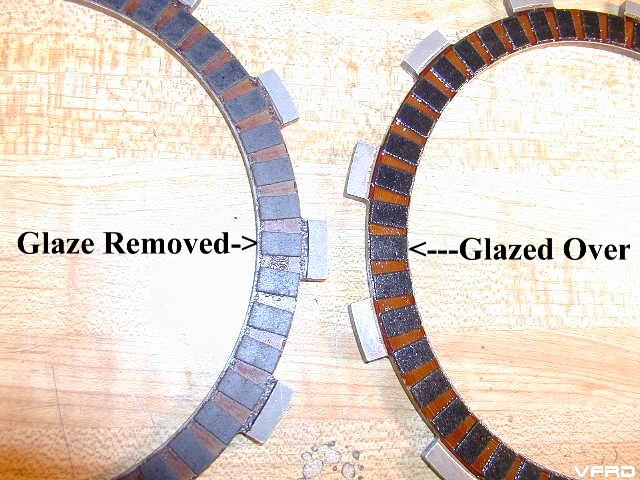
Inspect the friction plates for glazing... make sure you have plenty
of material to work with... the VFR manual states clutch thickness
in thousands of an inch... I don't a manual handy or I'd list the numbers

First removed the contaminants with something like Acetone... then lay
each plate over a 600 grit black dry emory paper and rotate in a
circle... you're just busting the glaze... don't get carried away
remove too much material... You should end up with a friction plate
looks dull like a new one as opposed to a shinny glazed one... recheck
thickness...

gallery_3131_51_129667.jpg


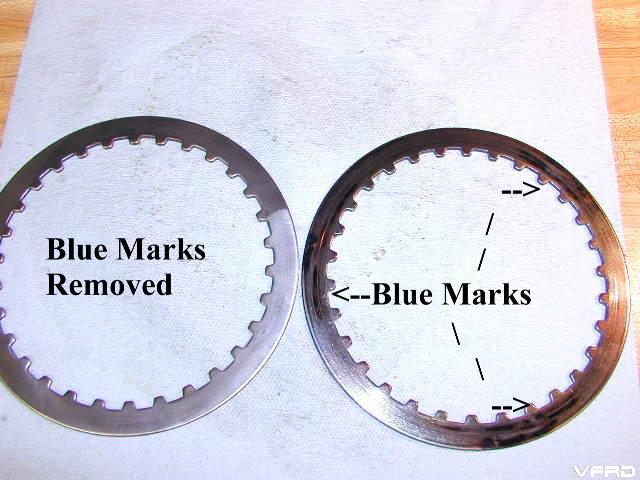
Next check the pressure plates for bluing caused by localized heat...
make sure they are not warped... the manual does not state a thickness
range... now removed the contaminants with something like Acetone
and wire wheeled them to erased the blue and also to generally scuff
up the surface... you should end up with a dull surface free of Blue
marks...
gallery_3131_51_40098.jpg


Questions???


#4

It's most likely the slave cylinder - open your clutch master cylinder, and if the fluid looks like mud I'd put money on the slave piston being stuck halfway down the bore. Which means the clutch never fully engages, so it slips, but usually once the bike is hot and the oil thins out.
 
It WILL kill the clutch if you don't sort it out immediately.
 
BTW I found a pic of you last week :goofy:
 
[image: 4cfd1b84b58114a496b8eac4f205279637180544]


Just checked fluid and while it's not crystal clear, it's far from being mud.

Nice tutorial on the clutch plates I'll have a look. Is there a tutorial on how to remove the clutch???
#5

Nice tutorial on the clutch plates I'll have a look. Is there a tutorial on how to remove the clutch???

yes!! its called a manual. :comp13:

. download it   from the "downloads" at the top of the screen :beer:


#6

In  the  30+  years  of  riding  mc  never  had a clutch  to  fail.  Lucky  I  guess ...


#7

Nice tutorial on the clutch plates I'll have a look. Is there a tutorial on how to remove the clutch???

You'll find a pdf of the factory service manual in the files section.
In short: put bike on sidestand, remove RHS lower fairing, remove RHS clutch cover, remove pressure plate and clutch springs (5 bolts), take out clutch plates. The RHS clutch cover gasket will very likely get damaged when removeing the cover so before you start working on your clutch make sure you have a spare gasket.
#8

[image: Capture.JPG]

keep an eye on the dowel pins (#4)

And where I point the arrow, this gear is on a pin/axle that will fall out freely....

Donot ask me how I know...


Then you contact Sebspeed for one of these...

[image: olie2.jpg]

:beer:


#9


Nice tutorial on the clutch plates I'll have a look. Is there a tutorial on how to remove the clutch???

I forgot to mention before removing the clutch cover have a new gasket ready in case the old one is

destroyed... also you can lay the bike on its side so you don't have to drain the oil...

[image: ClutchFix4.JPG]


#10

"  Dont  ask  me  how  I  know "

Classic   !!!!


#11


Nice tutorial on the clutch plates I'll have a look. Is there a tutorial on how to remove the clutch???

I forgot to mention before removing the clutch cover have a new gasket ready in case the old one is destroyed...

or use this.

.[image: ultagrey_zps57342fe6.jpg]


#12


Nice tutorial on the clutch plates I'll have a look. Is there a tutorial on how to remove the clutch???

I forgot to mention before removing the clutch cover have a new gasket ready in case the old one is destroyed...

or use this.

.[image: ultagrey_zps57342fe6.jpg]

That won't work because the thickness of the gasket establishes a critical space so the starter gears do not bind...


#13

The reason I ask about difficulty is in the manual I saw mention on "special tools" (maybe I didn't have enough coffee and mis-read). Smart cookies on forums usually know neat little tricks around these things. :D

Thanks for all the response. A new clutch kit from David Silver Spares is only about $110 or something like that. So I'll order that sometime this week. 


#14

I swear i have noticed this before on my 5th gen. First couple short rides of the season (and this season) no slippage. Now i change oil as normal and now some sporatic upper R's slipping. And always seems once the oil gets some miles it goes away. Can't see it being clutch fluid as my first rides were at colder temps, but since its never been flushed cant say its a fact. Need to keep track of engine temp, may mostly be happening before things are warm, but like i said no issue before oil change.


#15

The reason I ask about difficulty is in the manual I saw mention on "special tools" (maybe I didn't have enough coffee and mis-read). Smart cookies on forums usually know neat little tricks around these things. :D

Thanks for all the response. A new clutch kit from David Silver Spares is only about $110 or something like that. So I'll order that sometime this week. 

Your 92 is straight forward but your VFR400 is another story you'll need the special tool to break torque and to retorque the clutch nut (5)... the tool are not hard to find on Ebay... if you notice your clutch sports a racing slipper clutch... the order of assembly is very important to get right... also if you choose after market clutch plates make sure they are the same thickness as stock or the diaphragm springs (8) may not add up enough pressure to pervent slipping...

[image: VFR400Clutch2.pdf_Page_26.jpg]


#16

I swear i have noticed this before on my 5th gen. First couple short rides of the season (and this season) no slippage. Now i change oil as normal and now some sporatic upper R's slipping. And always seems once the oil gets some miles it goes away. Can't see it being clutch fluid as my first rides were at colder temps, but since its never been flushed cant say its a fact. Need to keep track of engine temp, may mostly be happening before things are warm, but like i said no issue before oil change.

You never mentioned the miles on the clutch??? I fix slipping clutches with proper maintenance and not with an oil change because oil is never the prime culprit... its a minor player... just not prime...


#17


Nice tutorial on the clutch plates I'll have a look. Is there a tutorial on how to remove the clutch???

I forgot to mention before removing the clutch cover have a new gasket ready in case the old one is destroyed...

or use this.

.[image: ultagrey_zps57342fe6.jpg]

That won't work because the thickness of the gasket establishes a critical space so the starter gears do not bind...

whoops

 i use this to "repair ' the broken gasket both sides and presto.. no leaks. and i have just placed this on with no gasket. .. and had my boss listen for any noise.. and nada.. that was 10 years ago..and its still fine. :happy:


#18

I swear i have noticed this before on my 5th gen. First couple short rides of the season (and this season) no slippage. Now i change oil as normal and now some sporatic upper R's slipping. And always seems once the oil gets some miles it goes away. Can't see it being clutch fluid as my first rides were at colder temps, but since its never been flushed cant say its a fact. Need to keep track of engine temp, may mostly be happening before things are warm, but like i said no issue before oil change.

You never mentioned the miles on the clutch??? I fix slipping clutches with proper maintenance and not with an oil change because oil is never the prime culprit... its a minor player... just not prime...

20k miles. I'm not saying my goal of the oil change was to fix the slippage, just seems to happen after fresh oil. But maybe the easiest thing before splitting cases would be the clutch fluid change. Just using a mighty vac for that?


#19

I swear i have noticed this before on my 5th gen. First couple short rides of the season (and this season) no slippage. Now i change oil as normal and now some sporatic upper R's slipping. And always seems once the oil gets some miles it goes away. Can't see it being clutch fluid as my first rides were at colder temps, but since its never been flushed cant say its a fact. Need to keep track of engine temp, may mostly be happening before things are warm, but like i said no issue before oil change.

You never mentioned the miles on the clutch??? I fix slipping clutches with proper maintenance and not with an oil change because oil is never the prime culprit... its a minor player... just not prime...

20k miles. I'm not saying my goal of the oil change was to fix the slippage, just seems to happen after fresh oil. But maybe the easiest thing before splitting cases would be the clutch fluid change. Just using a mighty vac for that?

What  ?   did  I  miss  something  did  someone  re engineer  the VFR  tranny ..

Motor  oil  and  tranny oil  same  hole   !!!


And  clutch  ....


#20

The reason I ask about difficulty is in the manual I saw mention on "special tools" (maybe I didn't have enough coffee and mis-read). Smart cookies on forums usually know neat little tricks around these things. :D

Thanks for all the response. A new clutch kit from David Silver Spares is only about $110 or something like that. So I'll order that sometime this week. 

Your 92 is straight forward but your VFR400 is another story you'll need the special tool to break torque and to retorque the clutch nut (5)... the tool are not hard to find on Ebay... if you notice your clutch sports a racing slipper clutch... the order of assembly is very important to get right... also if you choose after market clutch plates make sure they are the same thickness as stock or the diaphragm springs (8) may not add up enough pressure to pervent slipping...

[image: attachicon.gif]VFR400Clutch2.pdf_Page_26.jpg

Excellent!!

So my '92 750  won't need any special tools to do the job. Thanks for that :)

Don't have the 400 any more :( That was a great track bike


#21

I flushed the clutch fluid, holy smegma batman! I was stunned at the crap that needed to be sucked outta the reservoir itself. Who knows on how good the bleed was, going riding tomorrow will see if its airless and releases any different affecting said slippage.


#22

I wouldn't be ordering clutchpacks etc. until I'd cleaned up the slave cylinder assembly and tested it - it's extremely common for the piston to stick in the bore due to corrosion. It happened to me... and had I caught it in time I would not have needed to replace my clutch as well. Could save you some money and time to do that.

I went with a Barnett kevlar clutch and heavy duty springs, it worked great - it hooked up so well it felt like the bike had picked up a few hp.

If you do the clutch, check the basket tangs for damage, and clean them up if required - new clutch basket is AUD$600 or so.


#23

I know may slave weeps a bit over time, sure it getting close to some rework there. Those hd springs increase lever pull?


#24

I didn't notice any extra effort for clutch lever pull, no. And the bike went from launching nicely - pleasantly, is probably the word - to really pulling hard and skipping the front wheel off the ground with full-noise launches. Bags of fun :beer:

I've read of people fitting three HD springs and two stock springs with the idea that it will reduce clutch lever effort, but that seems pointless to me. Keeping the hydraulic system serviced will probably make more difference to lever effort than anything else you could do.

The only 'gotcha' I can remember with clutch replacement is to ensure that the judder spring goes in with the correct orientation - that's the big washer-like ring that is pressed with the face at an angle (can't thing of any other way to describe it but looks like it was cut out of a steel cone).


#25

I wouldn't be ordering clutchpacks etc. until I'd cleaned up the slave cylinder assembly and tested it - it's extremely common for the piston to stick in the bore due to corrosion. It happened to me... and had I caught it in time I would not have needed to replace my clutch as well. Could save you some money and time to do that.

I went with a Barnett kevlar clutch and heavy duty springs, it worked great - it hooked up so well it felt like the bike had picked up a few hp.

If you do the clutch, check the basket tangs for damage, and clean them up if required - new clutch basket is AUD$600 or so.

I shall. Any tutorials on here for a "how to"?


#26

Also my hydraulic pressure feels fine. With the malfunctioning slave cylinder did the lever feel give you any clues as to what was going on?


#27

Ok, not sure i can "feel" any difference at the lever, and i did not quite have a chance to jump on it as cold as normal but i could not detect the issue after the clutch fluid flush. Not sure how a mushy lever would feel, but i would venture to say i did not introduce air in the process. Don't let just the brown fluid fool ya, i couldn't believe the shmegma down that reservoir. Another ride planned Friday, will see. 


#28
Also my hydraulic pressure feels fine. With the malfunctioning slave cylinder did the lever feel give you any clues as to what was going on?

Not one iota - lever 'feel' was totally normal. But I started to get clutch slip, and it got progressively worse until the bike was basically un-rideable once hot. I ended up doing the clutch replacement at my parents place, because that's where I was heading the day it reached terminal point :mad:

Because the piston will stick halfway along its bore, the only physical change you could notice is the master reservoir being a tad low, as not all of the fluid is returning to it when the clutch is engaged. Not easy to notice with a steel master cylinder.

Ok, not sure i can "feel" any difference at the lever, and i did not quite have a chance to jump on it as cold as normal but i could not detect the issue after the clutch fluid flush. Not sure how a mushy lever would feel, but i would venture to say i did not introduce air in the process. Don't let just the brown fluid fool ya, i couldn't believe the shmegma down that reservoir. Another ride planned Friday, will see. 

When you flushed the clutch fluid - did you do it from the master to where the line meets the slave? That will leave a lot of crud in the slave itself (that's where it gets into the system in the first place, it's a very hot and dirty environment for a hydraulic assembly to live).

There's two options to really flush it - one is to pull the slave off and pump the lever so the piston is pumped out of its bore and into a bucket.

The other way is how I did it - I was pretty sure I had a piston not fully retracting, but to pump it out would mean no proof of this - so what I did instead was to drain the master reservoir (and remove the little metal widget that sits over the outlet in the bottom of the reservoir), cover it with old towels, and then use a c-clamp to wind the piston back into the bore. Sure enough I got major resistance, then bam! it pushed through the sticking point and back to where it belonged.

The towels caught the explosive ejection of fluid up top...

Then I used old brake fluid (sitting on the shelf too long, hydroscopic) to refill the reservoir, and pumped the piston out of the bore.

You can put a new seal kit through it, they are cheap, but I just cleaned up the bore and piston and reassembled with fresh fluid, no leaks, no further problems.
#29
Also my hydraulic pressure feels fine. With the malfunctioning slave cylinder did the lever feel give you any clues as to what was going on?

Not one iota - lever 'feel' was totally normal. But I started to get clutch slip, and it got progressively worse until the bike was basically un-rideable once hot. I ended up doing the clutch replacement at my parents place, because that's where I was heading the day it reached terminal point :mad:

Because the piston will stick halfway along its bore, the only physical change you could notice is the master reservoir being a tad low, as not all of the fluid is returning to it when the clutch is engaged. Not easy to notice with a steel master cylinder.

Ok, not sure i can "feel" any difference at the lever, and i did not quite have a chance to jump on it as cold as normal but i could not detect the issue after the clutch fluid flush. Not sure how a mushy lever would feel, but i would venture to say i did not introduce air in the process. Don't let just the brown fluid fool ya, i couldn't believe the shmegma down that reservoir. Another ride planned Friday, will see. 

When you flushed the clutch fluid - did you do it from the master to where the line meets the slave? That will leave a lot of crud in the slave itself (that's where it gets into the system in the first place, it's a very hot and dirty environment for a hydraulic assembly to live).

There's two options to really flush it - one is to pull the slave off and pump the lever so the piston is pumped out of its bore and into a bucket.

The other way is how I did it - I was pretty sure I had a piston not fully retracting, but to pump it out would mean no proof of this - so what I did instead was to drain the master reservoir (and remove the little metal widget that sits over the outlet in the bottom of the reservoir), cover it with old towels, and then use a c-clamp to wind the piston back into the bore. Sure enough I got major resistance, then bam! it pushed through the sticking point and back to where it belonged.

The towels caught the explosive ejection of fluid up top...

Then I used old brake fluid (sitting on the shelf too long, hydroscopic) to refill the reservoir, and pumped the piston out of the bore.

You can put a new seal kit through it, they are cheap, but I just cleaned up the bore and piston and reassembled with fresh fluid, no leaks, no further problems.

Thanks dude. I had a poke around today, no leaks around the master or slave. I'll have a ride tomorrow and see what it's like. The level in the master was just about bang on too, but I popped a smidge more in it. 

Clutch plates may well be the cause too because when taking off when hot it tends to judder a bit when it takes up, or is a sure fire way of telling it's the slave?

Thanks for your feedback. Very helpful


#30

Yeah guess i did the half assed way pulling new fluid down from the cleaned reservoir thru the bleeder. Didn't want to disassemble further w/o the other gaskets or slave parts. Would expect the clean fluid to tint up if more crap loosens.


#31
Also my hydraulic pressure feels fine. With the malfunctioning slave cylinder did the lever feel give you any clues as to what was going on?

Not one iota - lever 'feel' was totally normal. But I started to get clutch slip, and it got progressively worse until the bike was basically un-rideable once hot. I ended up doing the clutch replacement at my parents place, because that's where I was heading the day it reached terminal point :mad:

Because the piston will stick halfway along its bore, the only physical change you could notice is the master reservoir being a tad low, as not all of the fluid is returning to it when the clutch is engaged. Not easy to notice with a steel master cylinder.

Ok, not sure i can "feel" any difference at the lever, and i did not quite have a chance to jump on it as cold as normal but i could not detect the issue after the clutch fluid flush. Not sure how a mushy lever would feel, but i would venture to say i did not introduce air in the process. Don't let just the brown fluid fool ya, i couldn't believe the shmegma down that reservoir. Another ride planned Friday, will see. 

When you flushed the clutch fluid - did you do it from the master to where the line meets the slave? That will leave a lot of crud in the slave itself (that's where it gets into the system in the first place, it's a very hot and dirty environment for a hydraulic assembly to live).

There's two options to really flush it - one is to pull the slave off and pump the lever so the piston is pumped out of its bore and into a bucket.

The other way is how I did it - I was pretty sure I had a piston not fully retracting, but to pump it out would mean no proof of this - so what I did instead was to drain the master reservoir (and remove the little metal widget that sits over the outlet in the bottom of the reservoir), cover it with old towels, and then use a c-clamp to wind the piston back into the bore. Sure enough I got major resistance, then bam! it pushed through the sticking point and back to where it belonged.

The towels caught the explosive ejection of fluid up top...

Then I used old brake fluid (sitting on the shelf too long, hydroscopic) to refill the reservoir, and pumped the piston out of the bore.

You can put a new seal kit through it, they are cheap, but I just cleaned up the bore and piston and reassembled with fresh fluid, no leaks, no further problems.

What you described here almost sounds like a brake caliper piston getting stuck beyond a ridge cause of pads worn to far, like clutch pack worn further from norm. I assume the is no way to hone the slave side where the piston resides? I suppose it could be the dirt causing the ridge which is why blasting thru it breaking the crap lip free.


#32

I am a firm believer in 'process of elimination', not so much to save money, but to save time - I am a lazy SOB and always look for the easiest way to solve a problem :cool:

I think you guys are on your way to sorting your respective issues.

Braaap, judder is not something I'm familiar with, regarding my clutch issues. It could be that you do have a totally shagged clutchpack, but the drivetrain itself may be a culprit as well - chain and rear cush drive. The cush drive is not known for being a problem with Viffers, but someone always has to go first...

VFR350, you don't really need the gaskets for the slave and front sprocket cover - they are really only there to stop spooge from seeping through over time. And as I said you can get away with cleaning up the slave without replacing o-rings/seals, but given the low cost and easy availability of the kit, you might as well do it right.

One further thought - clutch fluid is brake fluid - does the DOT rating affect how the clutch works? I have no idea... I just use whatever brake fluid is specced for the bike (DOT4 IIRC).


What you described here almost sounds like a brake caliper piston getting stuck beyond a ridge cause of pads worn to far, like clutch pack worn further from norm. I assume the is no way to hone the slave side where the piston resides? I suppose it could be the dirt causing the ridge which is why blasting thru it breaking the crap lip free.

Yep just like that. The piston won't fully retract because corrosion does indeed form a 'ridge' or lip, and therefore the clutch actuator rod never fully retracts, and the clutch never fully closes/engages.

I just cleaned mine out with wet and dry, 1500 or so, same on the piston. It's a clutch, you can get away with a quick and dirty fix. I am not so cavalier when it comes to brakes :ph34r:


#33

It slipped on a cold start again but not near as bad before the flush. Ordered seals, i'll clean the slave up like you said, chande the coolant while i'm at it.


End of thread · 33 posts recovered Wayback Machine snapshot 18 Sep 2015