It was suggested not to wire directly to battery.
I just bought a volt gauge, and it has 20" wire's (red/black)........ Where is a good place to connect (solder) them?........... Monk
[image: View Post]Monk, on Jun 3 2009, 07:19 PM, said:
It was suggested not to wire directly to battery.
I just bought a volt gauge, and it has 20" wire's (red/black)........ Where is a good place to connect (solder) them?........... Monk
Howdy Mr. Monk,
The tail light wire is easiest to get to. If it was me, I would just tap it with a water resistant plug.
I run my volt meter off the wiring harness I built for my radar detector, so it is switched by hand. I did that instead of hacking the bikes wiring harness.
Remember, there is more than one way to skin a cat...
Mac
Anyplace you have 12V power is fine. You may wire it to ignition switched power, e.g. tailight, or license plate light which will turn off with your key, or, you may wire it directly to the battery with your own switch inline on either the power or ground wire. The second way would allow you to see the voltage before turning the bike on, very handy, but it also allows you to make a mistake and leave it on, it uses very little power and would take a long time to prevent the bike from starting. Ground it anywhere on the frame or any ground wire.
Hope this helps.
If it's an LED gauge I would wire it up to a switched circuit (only on when bike is on). If it's an LCD guage you could wire it up to either a switched or unswitched (hot all the time) circuit (LCD draws very little). The advantage of an LCD meter wired to a unswitched circuit is you can monitor at any time, the bikes battery voltage (even when it's charging). This will help give you a heads up when your battery maintainer is going bad.
Also, gauge really needs to be at least water resistant or better yet water proof.
Good luck.
ki-speed (Mark)
Would wiring it directly to the battery give a slightly different reading from if you wire it dowstream trough the wiring harnesses, ignition switch and maybe even relays, which the tailight wires might be. Would there be a little bit of voltage loss through the wiring???
Beck
95 VFR
[image: View Post]Monk, on Jun 3 2009, 07:19 PM, said:
It was suggested not to wire directly to battery.
Why not?
[image: View Post]Beck, on Jun 3 2009, 11:34 PM, said:
Would wiring it directly to the battery give a slightly different reading from if you wire it dowstream trough the wiring harnesses, ignition switch and maybe even relays, which the tailight wires might be. Would there be a little bit of voltage loss through the wiring???
Beck
95 VFR
My opinion is it really doesn't matter, since you will be using it for comparison (one ride to another) rather than diagnostics. Provided your system is up to snuff, what the meter actually displays is not as important as the differences it displays over time.
[image: View Post]03vfrrider, on Jun 3 2009, 07:46 PM, said:
[image: View Post]Beck, on Jun 3 2009, 11:34 PM, said:
Would wiring it directly to the battery give a slightly different reading from if you wire it dowstream trough the wiring harnesses, ignition switch and maybe even relays, which the tailight wires might be. Would there be a little bit of voltage loss through the wiring???
Beck
95 VFR
My opinion is it really doesn't matter, since you will be using it for comparison (one ride to another) rather than diagnostics. Provided your system is up to snuff, what the meter actually displays is not as important as the differences it displays over time.
This is similar to the Speedo....yes the reading will remain steady, but doing the conversion isn't always easy. I would suggest running it from a relayed source to the battery. The Taillight can have 1.5 volts of loss by the time power gets there, as I found when I wired in LED's for my Trunk, and configured them for 13.5 volts not 12....they don't come on unless the engine is running now. Tapping into the Red/Black wire from the ignition switch directly would give a better reading, and would be easier for those 20" wires to reach.
What kind of meter did you buy?
[image: View Post]Beck, on Jun 3 2009, 08:34 PM, said:
Would wiring it directly to the battery give a slightly different reading from if you wire it dowstream trough the wiring harnesses, ignition switch and maybe even relays, which the tailight wires might be. Would there be a little bit of voltage loss through the wiring???
Beck
95 VFR
A slight voltage loss and a current loss will occur due to increased resistance (think friction) in a particular length of wire at some point "downstream" of the battery. With our bikes though, it will be extremely little. The wires' gauge is too low and the length of wires are not long enough. IMO.
[image: View Post]Tightwad, on Jun 3 2009, 08:53 PM, said:
The Taillight can have 1.5 volts of loss by the time power gets there, as I found when I wired in LED's for my Trunk, and configured them for 13.5 volts not 12....
1.5 Volts? Thats over 12% loss. Something doesn't seem right with that. Even taking into account the vast amount of cheap connectors honda uses that seems way outta whack.
Would wiring it directly to the battery give a slightly different reading from if you wire it dowstream trough the wiring harnesses, ignition switch and maybe even relays, which the tailight wires might be. Would there be a little bit of voltage loss through the wiring???
Beck
95 VFR
My opinion is it really doesn't matter, since you will be using it for comparison (one ride to another) rather than diagnostics. Provided your system is up to snuff, what the meter actually displays is not as important as the differences it displays over time.
This is similar to the Speedo....yes the reading will remain steady, but doing the conversion isn't always easy. I would suggest running it from a relayed source to the battery. The Taillight can have 1.5 volts of loss by the time power gets there, as I found when I wired in LED's for my Trunk, and configured them for 13.5 volts not 12....they don't come on unless the engine is running now. Tapping into the Red/Black wire from the ignition switch directly would give a better reading, and would be easier for those 20" wires to reach.
What kind of meter did you buy?
Kuryakyn LED Battery Gauge
http://www.customdyn...s_and_Chargers_
If it's an LED gauge I would wire it up to a switched circuit (only on when bike is on). If it's an LCD guage you could wire it up to either a switched or unswitched (hot all the time) circuit (LCD draws very little). The advantage of an LCD meter wired to a unswitched circuit is you can monitor at any time, the bikes battery voltage (even when it's charging). This will help give you a heads up when your battery maintainer is going bad.
Also, gauge really needs to be at least water resistant or better yet water proof.
Good luck.
ki-speed (Mark)
Isn't that backwards? I thought LED draws far less power than LCD. If you look at today's TVs the new ones are going LED and touting the reduction in power usage.
Tapping into the Red/Black wire from the ignition switch directly would give a better reading, and would be easier for those 20" wires to reach.What kind of meter did you buy?
So if I tap directly to the (R/B wires) ignition switch...... Will I be good to go without relays and other such stuff?..... If so, should I, solder, or use some kind of wire-to-wire connecter?...... Monk
It was suggested not to wire directly to battery.
Why not?
Let the bike sit for a week and you'll know why.
Attach the + lead to a hot wire (duh) but many of them in the upper wiring harness near or around the gauges will typically give you a flickering reading when you activate the turnsignals. If that matters to you. Also, it will read about .5 to .7 volts lower, in my experience, than when read from the battery. You can attach to the battery with a keyed relay, avoid the drain, and get a more accurate reading. You can get the relays (typically 20amp or so) at radioshack or similar.
Currently I have a marine analog unit hooked up to the wiring harness (seen here):
[image: Posted Image] but I'll be switching to a datel digital meter with relay wired to the battery.
IMO: a voltmeter is the best single mod you can do on a VFR/bike.
Tapping into the Red/Black wire from the ignition switch directly would give a better reading, and would be easier for those 20" wires to reach.What kind of meter did you buy?
So if I tap directly to the (R/B wires) ignition switch...... Will I be good to go without relays and other such stuff?..... If so, should I, solder, or use some kind of wire-to-wire connecter?...... Monk
Monk, don't tap your actual ignition wire, it will work, but you don't want to introduce potential problems on that wire. Instead tap an ignition switched wire.
If you don't want to be able to turn it on with the bike off, then the best way is to do as fotomoto suggests. Use a standard 20 amp 12V relay. Wire the relay to the battery (+ to +) (- to - or the frame) Then tap into your license plate light for the signal wire to turn the relay on. Then wire the voltmeter to the relay (1 wire on the switched output of the relay, the other wire will share either power or ground of the relay depending on if you wired switched ground or switched power). Wire tie the relay somewhere nice and covered. Personally, I solder all wire to wire connections...
Kuryakyn LED Battery Gauge
http://www.customdyn...s_and_Chargers_[image: Posted Image]
DSC00147.JPG [image: Posted Image]
DSC00146.JPG OK....... Battery gauge installed, And by the way it's waterproof and has a dimmer eye to auto dim in the dark.
I kept all the mods in one area (as in pic next to water bottle).... I used the power wire from the cluster plug going to my hot wire leading to my left handlebar elec.'s as my switch wire with relay and spliced into my gps power wire to battery..... So now my gps and my battery gauge are hot when key's on, but not when off.
Everything was done with the shortest amount of wiring all in one area.
Thank you all for getting me going in the right direction. I used your information to tell the "Audio tech" I took my bike to what I'd like done............... I did not do this install project "He did"..... With all the electric crap I hear about, I didn't want to risk causing an electric hazard that I didn't have in the first place......... Monk
Correction to my last post.... The volt gauge is water resistance, not proof...... but a little silicone will fix that...I ran some silicone around the only edge that has a seam so now it's water proof.....[image: Posted Image]
DSC00150.JPG
I wired my idiot light up to the aux fuse box (relay cont).
[image: Posted Image]
I have an LCD voltmeter, it's wired directly to the battery, never had a flat bettery ever.
The voltmeter draws about the same as the clock.
I have an LCD voltmeter, it's wired directly to the battery, never had a flat bettery ever.
The voltmeter draws about the same as the clock.
+1
I like being able to watch the battery voltage when the bike is turned off and has been sitting for awhile in the garage. Especially in the winter. The downside is that you can't see the display at night (no backlighting).
I have an LCD voltmeter, it's wired directly to the battery, never had a flat bettery ever.
The voltmeter draws about the same as the clock.
A voltmeter has very high input impedance (>1Meg Ohm) and will only put a very small load on the system. Think about it. If the voltmeter was drawing a lot of current it would be load on the system and would cause a large voltage drop across it and thus turning a instrument into a load.
If you wire it through and auxiliary fuse box is there any reason you would get inaccurate readings?
If you wire it through and auxiliary fuse box is there any reason you would get inaccurate readings?
You should connect it over a relay to get more accurate reading. Here is a diagram.
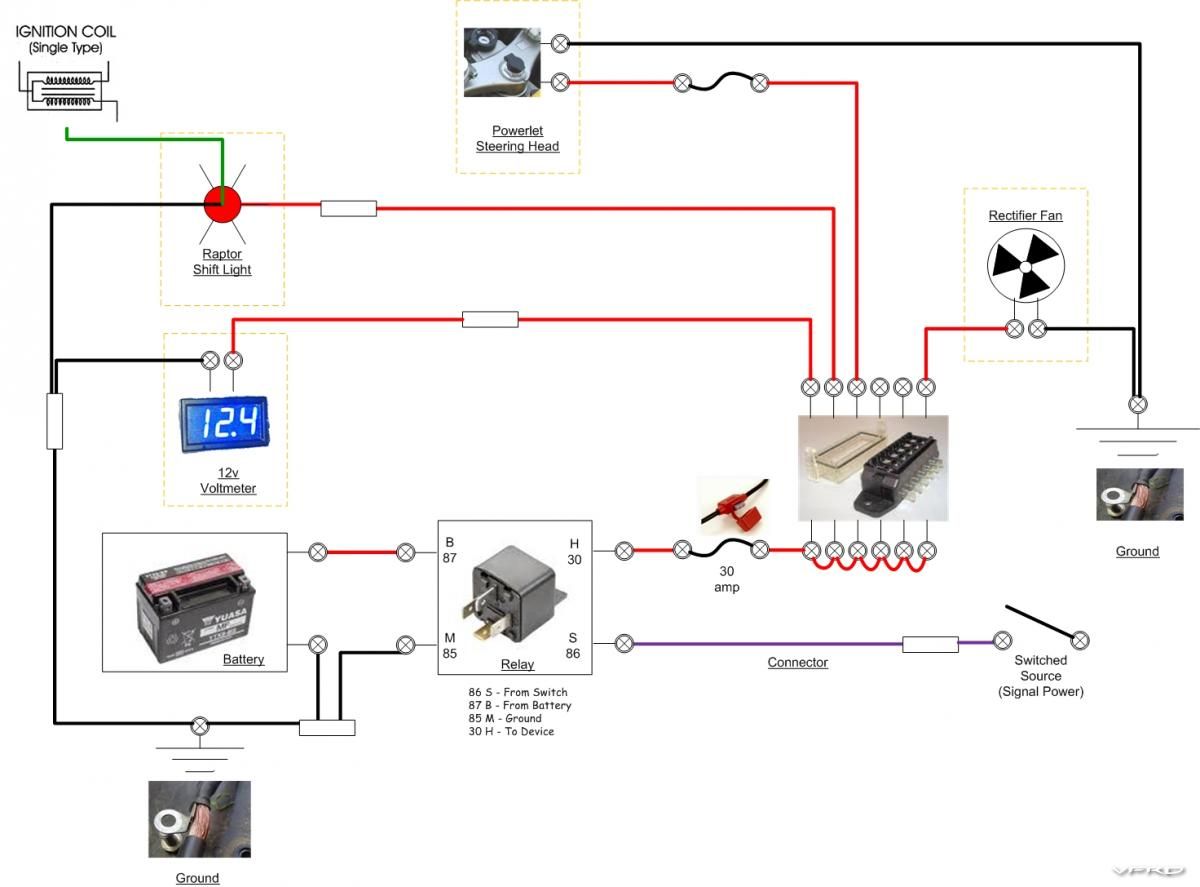 VFR800 Aux Fuse Box.jpg
Bumping back to life:
Monk,
How is your voltmeter holding up to the elements after you "water proofed" it? Also, how did you mount the guage - did you use velcro, 3M Dual Lock or the like? Would you buy the same gauge again? I definitely need a voltmeter and saw this same unit at a local shop this weekend. Lots to choose from out there, but this doesn't have to cross the border to get here. Thanks for your help - from a displaced Virginia boy.
That looks real nice Monk, you did good.
Interesting thread.
I recently purchased one of these:
Signal Dynamics LED I've been contemplating the best way to wire it up. I can wire it straight to the battery and it won't drain, huh?
Bumping back to life:
Monk,
How is your voltmeter holding up to the elements after you "water proofed" it? Also, how did you mount the guage - did you use velcro, 3M Dual Lock or the like? Would you buy the same gauge again? I definitely need a voltmeter and saw this same unit at a local shop this weekend. Lots to choose from out there, but this doesn't have to cross the border to get here. Thanks for your help - from a displaced Virginia boy.
Two sided tape, doesn't leak.
Where I put it is easy to see while riding.According to mine it reads 2 greens while riding normal .... Hi-beams will will make the 2nd green flicker while riding..... Heated vest will make it drop to one green while idling(so if I'm longer than a stop and go I'll cut the vest off, might not need to but why not).
I've checked my battery against the lights with my multimeter and it let me know one light is in the low to mid 13's ... 2 lights are high 13 to low 14's..........Hope this helps.
To clarify.... LED meters and indicators draw significantly more current than an LCD meter. If you prefer to monitor the voltage with the bike off, you should use an LCD type meter, however these types do not use backlighting, so they are difficult or impossible to use at night.
If you choose an LED type meter like the Kuryakyn or the Datel these should be connected so they go off with the key. Make no mistake, an LED meter will discharge the battery enough to create a no start condition if the bike sits longer than a week or two.
Garry
Sounds very usable MOnk
I have mine on the tail light circuit as I dont have a separate tailight anymore on my VFR, after installing a lens under the brake light housing many years ago. Only thing is, I don't think the tail light circuit gives the most accurate readings, as I suspect that it could be downstream of or linked up other systems in the electrical harness in some way, so I think it would be best if you can hook it up as close to direct to the battery as possible, like maybe the ignition switch circuit hot wire.
Beck
95 VFR
The reason to not wire directly to the battery is to protect the bike. If you have a short on the positive side then you have a very good heater element. As in a fire will most probably ensue. Look at something fused. Check the gauge of the wire, the thinner it is the smaller the fuse. AN 18 gauge wire on a 20 amp fuse can glow bright red before the fuse blows. On a small wire look for a 2 or 5 amp circuit at the highest. Do not destroy your bike with crappy wiring.
I have mine on the tail light circuit as I dont have a separate tailight anymore on my VFR, after installing a lens under the brake light housing many years ago. Only thing is, I don't think the tail light circuit gives the most accurate readings, as I suspect that it could be downstream of or linked up other systems in the electrical harness in some way, so I think it would be best if you can hook it up as close to direct to the battery as possible, like maybe the ignition switch circuit hot wire.
Beck
95 VFR
Yes, anything but a relayed connection will show a voltage drop. It is super simple to install a relay, so why not?
The reason to not wire directly to the battery is to protect the bike. If you have a short on the positive side then you have a very good heater element. As in a fire will most probably ensue. Look at something fused. Check the gauge of the wire, the thinner it is the smaller the fuse. AN 18 gauge wire on a 20 amp fuse can glow bright red before the fuse blows. On a small wire look for a 2 or 5 amp circuit at the highest. Do not destroy your bike with crappy wiring.
I wish Mother Honda was listening when she was building some of the pas generations of VFR... Sigh.
this is mine and works great volts and gear indicator all in one
[image: DSC_0048.JPG]
DSC_0048.JPG
I like that gear indicator. One of the nice little features that I liked from the old 650 Nighthawk. Here's mine. I like simple dial meters and with a 4-pin flat trailer plug, I can switch between battery through the tender pigtail or switched through tail light. I just leave it on the tail lights as now I know that for my bike they read about 0.5 volt lower. I'm going to be doing some wiring over the winter, so I'll probably add a relay and leave it at that.
[image: volt.JPG]
[image: volt wire.JPG]
I have mine on the tail light circuit as I dont have a separate tailight anymore on my VFR, after installing a lens under the brake light housing many years ago. Only thing is, I don't think the tail light circuit gives the most accurate readings, as I suspect that it could be downstream of or linked up other systems in the electrical harness in some way, so I think it would be best if you can hook it up as close to direct to the battery as possible, like maybe the ignition switch circuit hot wire. Beck 95 VFR
Yes, anything but a relayed connection will show a voltage drop. It is super simple to install a relay, so why not?
Ooooh noooo NOT ANOTHER RELAY!??......... I wonder if I could just wire it parallel to my Symtec grip heaters from the relay that powers it? But I bet there will be a voltage drop when I turn them on though.....
Beck
95 VFR
Dutchy - I think you want the light blue wire...it will be the same color for license plate light.
Voltage drop with a voltmeter isn't an issue as long as you know what the drop is...compare voltage at wire being used to that of the battery to know what that value is...then add it back mentally.
Voltage drop with a voltmeter isn't an issue as long as you know what the drop is...compare voltage at wire being used to that of the battery to know what that value is...then add it back mentally.
Oooooh Nooooo!,.....not another thing to think about while riding!....... :blink: :rolleyes: :happy:
Beck
95 VFR
Voltage drop with a voltmeter isn't an issue as long as you know what the drop is...compare voltage at wire being used to that of the battery to know what that value is...then add it back mentally.
Oooooh Nooooo!,.....not another thing to think about while riding!....... :blink: :rolleyes: :happy:
Beck
95 VFR
I already have to make the 8% speedo adjustment in my head...a bit more math wouldn't kill me...of course mine reads correctly so I don't have to chance it...
Cheers Tightwad :beer:
Darkness has fallen over the land here and with the bike parked outside, I will make the switch tomorrow.
The battery had drained, after a few hours on the Optimate, she fired right up...
So the ground of the relay and the ground of the powerlet cable, can they go straight to the minus on the battery?
Update: it was the brown wire allright.....
I had used one of these clip-on thingies to tap into the wire, but the mantle on the wire was not penetrated by the metal thingie. The gauge much thicker than the little brown wire....
so all is well now, works a treat. We have amazing weather for the weekend so................................ will be riding tomorrow
certainly they can.
this thread reminded me that I had a meter in one of my boxes of junk, so I threw it at the dashboard and it stuck
[image: Posted Image]
End of thread · 42 posts recovered Wayback Machine snapshot 9 Apr 2013
![[image: Posted Image]](http://i211.photobucket.com/albums/bb70/fotomotovfr/IMG_9564.jpg)
![[image: Posted Image]](http://inlinethumb46.webshots.com/40365/2460855570099738507S600x600Q85.jpg)
![[image: Posted Image]](http://i299.photobucket.com/albums/mm313/timmythecop/007-6.jpg)