Where have you people put power sockets? I'm thinking the USB kind, but it may be better to get a normal one. I just don't see that there is a ton of space for one. I'm sure you all have figured out some great solutions.
Power socket locations???
27 posts Started 28 Nov 2016 Last recovered post 2 Jun 2017 Wayback Machine snapshot 24 Aug 2017
Depends on the purpose.. for GPS/smartphone, I put it close to the handlebars.
For heated jacket/liner/gear, I put it next to the tank, next to my left inner thigh for easy access of temperature adjustment on-the-fly.
I got an Oxford twin USB socket, cut a slightly too small rectangular hole in the cover and rammed a cable in there. Placed the socket on the left of the bike just rear of the Reg/Rec and ran the cable to the bars. When not in use, i can just tuck it under the tank and it stays dry, even in heavy rain.
I used a USB extension cable so i have options without rewiring.
As for taking power; I chose poorly - I took a positive off the rear lights. It blows a bulb when i use it. I'll be taking positive from the back of the starter relay when i get around to fixing it. Though i'll probably run a heavy guage to a multi connector block so that i can run whatever other stuff off of it in future. More for neatness and a clean install, really.
This would be for phone/GPS usage. I was hoping to see about getting it nicely integrated into the upper fairing somehow I just don't think there is much room for it. I also was hoping to make it not involve the side fairings so I could take them off with out to much mucking about.
Well, if you want it doing properly etc...
You COULD go the route of fitting the pos/neg of the USB socket to the battery, and then routing it as i described.
Upside is that the only bodywork you really need to move is the seat, and maybe lift the tank for a neater routing.
Downside is that the USB socket is constantly on. Doesn't draw much at all, but if you leave it for weeks at a time? Yeah.
Yeah that would seem to be the best for weather and cleanest install.
Headstock, through the black plastic cap. You can mount the sat nav holder onto the 2 tank bolts.
I like that idea! Is there a kit for it or something that you know of?
RAM Mounts do a tank-bolt mount. I'm sorry but I don't have the serial number, but it shouldn't be too difficult to find on their website.
As for the power cable....you need a length with a waterproof connector to sit on the headstock and battery connectors at the other end (or route it via a switched power source - I'm not an electrician, sorry). Then a short connecting cable from the headstock to the sat nag.
I simply drilled a hole through the plastic cap and fed the cable through before I soldered the end.
Worked beautifully.
14 minutes ago, SkidsRAM Mounts do a tank-bolt mount.
RAM-B-149ZU
6 minutes ago, thtannerRAM-B-149ZU
That looks like the one, but you can discard the semi-circle clamp and simply bolt the mount onto the tank bolt holes.
Speaking of RAM mounts; I think this is a better option, certainly less obtrusive when not in use.
1 hour ago, SkidsThat looks like the one, but you can discard the semi-circle clamp and simply bolt the mount onto the tank bolt holes.
Yup! Here's how I have mine setup.
[video: https://www.youtube.com/embed/zeRtbbkYKjo?feature=oembed]Remove the plastic cap on the steering head and insert one of these.
My GPS is a Garmin Zumo and comes with a permanent mount. Has a harness that that runs from the battery and even includes an extra USB lead that you can charge your phone from so you can keep getting those real time Bluetooth updates to the GPS or recharge your helmet Bluetooth. Listening to Music, Pandora or Spotify while on the move tends to drain a lot of battery.
It would be nice if there was a USB socket that fit in to head stock. Great set ups everyone, thanks for sharing.
Thtanner your socket is mint!
Epyon007, 11/29/2016 at 7:09 PMIt would be nice if there was a USB socket that fit in to head stock. Great set ups everyone, thanks for sharing.
Thtanner your socket is mint!
They do make ones that fit into the head stock, you are talking about the steering head hole right? Search for it, I think several makers of that type.
Art
hellindustries, 29/11/2016 at 7:18 PMSpeaking of RAM mounts; I think this is a better option, certainly less obtrusive when not in use.
That's a beautiful thing. It's a shame the cable can't be routed through the headstock as well with this option...unless you drill a hole in it's stem, which may weaken the mounting arrangement.
Sticking a relay into the circuit is a good idea too. It's very simple, and all you need is a mini 12v automotive relay, some wire, and a few electrical connectors (crimps are ok, but soldered are much better).
The main issue that people have is finding the right sort of feed to switch the relay on (ignition live), thereby allowing the load to draw power from the battery. If your lights are on all the time, whether you turn them on manually or they come on automatically, then the rear light wire is probably a good one to use for the relay switching, but NOT as the source of the power for the applicance itself; the licence plate/number plate light is also a fairly sensible one too. This arrangement also allows for the circuit to be fused as well, which is obviously a good thing.
If you get yourself such a relay, the numbering is common, therefore the load can be connected up thus:
30 = battery +ve terminal (preferably with in-line fuse)
87 = load (heated grips, sat nav etc) +ve
85 = ignition or switched live (e.g. rear lights)
86 = battery -ve terminal
The load/appliance will need to be earthed to somewhere on the frame/block as well, or directly to the battery -ve terminal.
Disconnecting the battery before doing this is a sensible idea too.
Loftust,
I would like to mount up auxiliary led driving lights, and a USB port to switched power. How would I go about this? The relay would have those numbers on them? Would I need relays for both of these?
Art
You'd be better off finding a small fused power block that has switched power via a relay. WireMyBike should still have some available on their website that fit under the seat. That way you only have one relay, and one connection to the battery.
5 hours ago, KevCarverYou'd be better off finding a small fused power block that has switched power via a relay. WireMyBike should still have some available on their website that fit under the seat. That way you only have one relay, and one connection to the battery.
That looks like a nice unit. So I see it has 4 circuits. I actually have 3 things I would like to install on both of my bikes, Hawk GT and VFR800. Voltmeter, USB port, and led auxiliary driving lights. I can just hardwire these into once circuit each and have one left over? How do I install the block into the bike? I don't see a manual I can review.
Art
It's super easy. Just need to wire the positive side of the block to the battery +, and I like to ground the - to the frame rather than the battery. Just my preference. Works either way. The relay will have a trigger wire. That can be tapped into the tag light wire pretty easily. All that does is open the relay. Once the relay is open the fuse block will be drawing power off the battery.
The fuse block will only provide positive power to each of the circuits you install, and you will have to provide fuses appropriate to each accessory. Volt meter will require very low amps, aux lighting a bit more. I'm sure the lighting packing will tell you how many amps they draw. USB will also be very low. Generally phone chargers are 2.1 amp max. GPS may be more, again it should be in the instructions provided with the unit. Or folks here will know.
For the grounds, again I like the frame. Anything in the front of the bike will require a wire to the fuse block for the positive power, but the ground can be bolted to the front of the frame to avoid having to run another wire to the battery.
I've got the same fuse block on my '99 and it fits fine under the seat just to the rear of the battery, and I tapped the tag light for the relay trigger. Be sure to put a sticker or something on the top of the fuse cover to label what each circuit is.
Quick tip for the battery terminals: Stick a bit of foam rubber under the captured nut on each terminal. Ear plugs work great for this. That ensures the nut is always at the top of the terminal. Sometimes with a couple ring terminals for accessories the bolt won't reach far enough to engage the nut. That ends up being a major PITA!
Kev,
Can I see your farkle setup and how you setup things? The led auxiliary lighting says they only draw .75 amps for the pair. The harness for the lights already have a 5 amp fuse. USB port I have has a 7.5 amp fuse inline. Would I need a fuse for the voltmeter, if so what should I get?
Art
I think I used a 3a for the voltmeter. Not sure there is a smaller one. It's probably actually well under 1a draw.
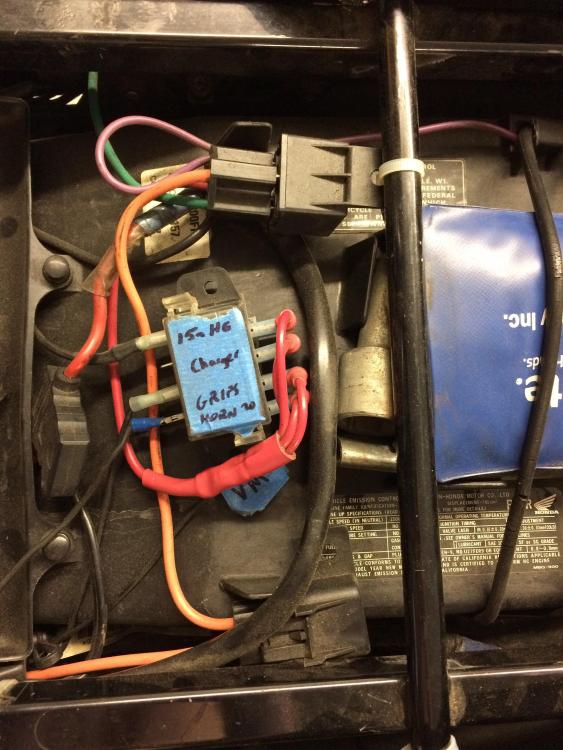
You can see my fuse block between the battery tray to the left and seat rail on right. The relay is above it. There is a purple trigger wire from the relay to the tag light. Main power from the relay to the battery through a supplied 30a fuse on the orange wire. Power out of the relay to the fuse block is red and splits into 4. Green ground wire is bolted to the rear subframe. I've only got circuits for heated gear, heated grips, and air horn. I never remounted my voltmeter after I rebuilt the bike a few years ago because the stator rewind and FH012 reg/rec never gives me any trouble. I had a cheap 2.1a USB charger wired up and stuck up under the front fairing. I tried to use it one time after it was installed for over a year and it was already broken. That's why I have one circuit labelled "Charger" but nothing plugged into it. I do still have a wire for a voltmeter running from the front fairing to the fuse block, just in case I ever decide to remount it.
The other red wire and fuse holder in the pic is the DC power out of the R/R. It's got a black sheathing on it until it passes under the relay, then it's red coming from there. It's not related or connected to the fuse block or relay.
Positive is through a 30a direct to the battery and negative is grounded to the frame. I bypassed the main harness for power from the R/R and eliminated the dodgy connections. I'm also on record as being against the VFRness for that very reason. It adds more connections but without improving on the quality of the connectors. But that's a whole other thread...
Although Kevin's awesome installation above is probably one of the best I have seen, I'm a fan of the Eastern Beaver fuse block. There are different options for switched / unswitched power. I went all switched for my needs. Unlike traditional blocks, it is small and weatherproof so you can mount it virtually anywhere and don't need to take up valuable storage space under the seat. I don't have one on the VFR, but loved it so much on my K12S that its now on the CB500X.
http://www.easternbeaver.com/Main/Wiring_Kits/Fuseboxes/3_Circuit/3CS-Sealed/3cs-sealed.html
31 minutes ago, 007Although Kevin's awesome installation above is probably one of the best I have seen, I'm a fan of the Eastern Beaver fuse block. There are different options for switched / unswitched power. I went all switched for my needs. Unlike traditional blocks, it is small and weatherproof so you can mount it virtually anywhere and don't need to take up valuable storage space under the seat. I don't have one on the VFR, but loved it so much on my K12S that its now on the CB500X.
http://www.easternbeaver.com/Main/Wiring_Kits/Fuseboxes/3_Circuit/3CS-Sealed/3cs-sealed.html
If you like that compact size and are good with DIY, I have this (that was a lot less $$) in my toolbox waiting for the next bike I need to wire up.
But don't worry, WireMyBike's fuse block has a water/dust sealed cover over the fuses. On the 5th Gen there is plenty of room for the bigger fuse block. It fits under the main seat where I've never needed to store anything anyway.
Also, you can find multi packs of fuses at any auto parts store or WalMart, etc.
Kev,
Thank you for posting, I am going to figure out my options. Yeah Eastern Beaver is on the pricey side there.
Art
EDIT: I don't want to remove this post yet, but I have had some major issues with this USB charger, when connected, at random when I try to start the bike, the bike will just die, the headlamp went out, and the clock etc will reset, as if the battery is dead or a fuse is gone. I disconnected the unit and reconnected the battery and everything started as normal. I'm not sure if it's a defective unit or not.
2nd EDIT:
I'm fairly certain at this point that it was not the charger that caused my problems but RR issues rearing their head when I fixed my overheating issues and the fans started working.
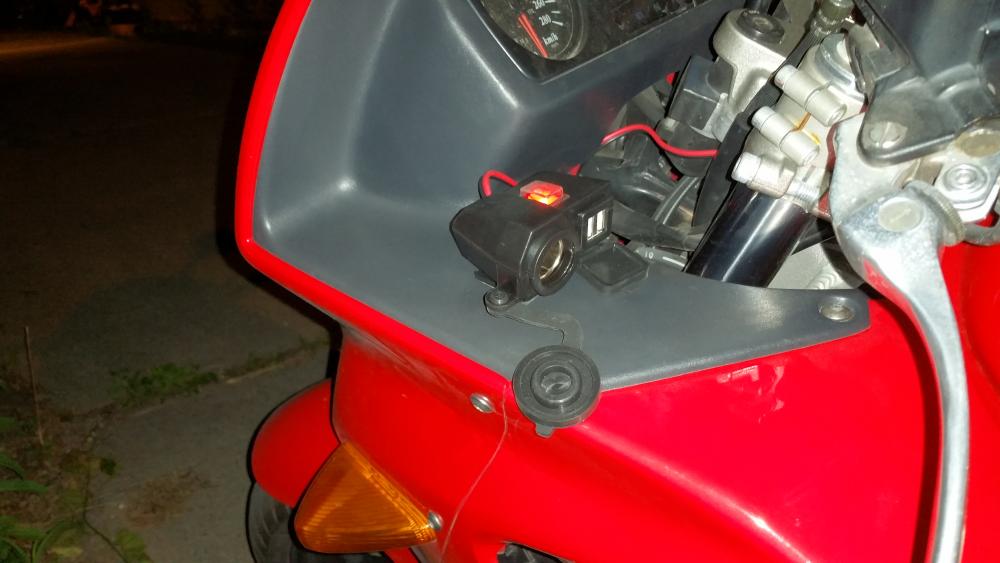
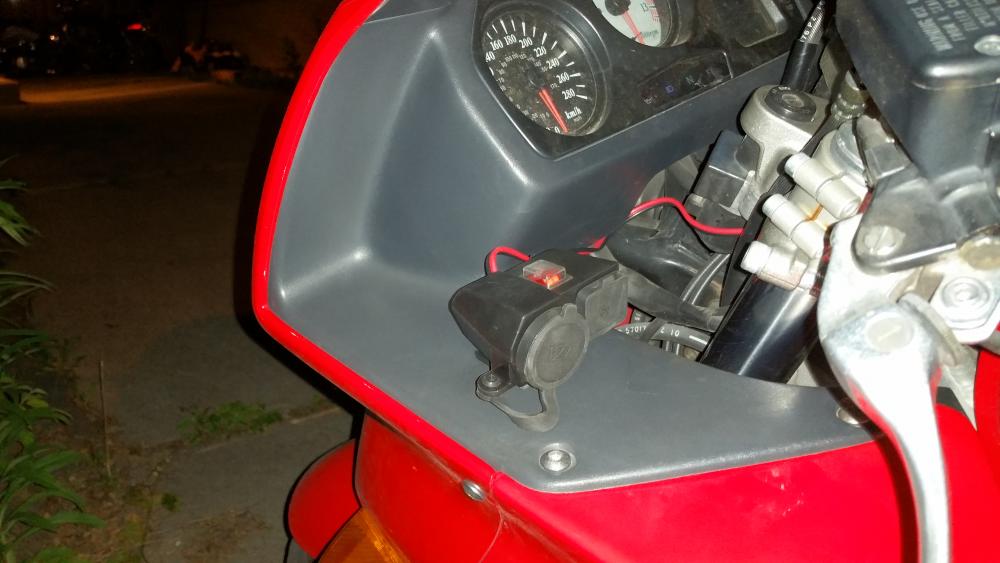
I know I'm a bit late here, but I just finished installing a unit that has a 12v, 2x USB (with a switch so they don't constantly draw), inline fuse and connects directly to the battery.
Picked it up off of Amazon (Canadian Link) https://www.amazon.ca/gp/product/B00OGYUGHI/ref=oh_aui_detailpage_o03_s00?ie=UTF8&psc=1
It came with a bar mount and a 3m adhesive pad, it slides onto the mount and locks on with a tab.
I stuck it on the left flat spot on near the instrument panel (black plastic).
I will be grabbing a sticky overlapping loop for cable management, but it has just enough slack around the bars that it does not interfere, and I routed it along the metal lines on the left side of the bike, under the tank, inside the frame and then up around the right side of the battery (the black lead is shorter, if you do the same might want to consider the right side of that black cowl).
End of thread · 27 posts recovered Wayback Machine snapshot 24 Aug 2017