How much mileage have you gotten out of your original chain?
I'm at about 16,000 miles and the links are getting tight. Before you ask, I'm regular about lubing the chain with the 3m teflon stuff and its adjusted correctly.
How much mileage have you gotten out of your original chain?
I'm at about 16,000 miles and the links are getting tight. Before you ask, I'm regular about lubing the chain with the 3m teflon stuff and its adjusted correctly.
I think I got maybe 20,000 miles but it was getting rusty and developed a corroded link. Also by that time the bike was around 13 years old so it was time.
Sent from my SM-G920V using Tapatalk
The answer has a lot of "it depends on..." in it. My chains usually last around 26 to 28K miles which is exceptional and I thrash my bikes in twistys pretty hard. That's the only place I ride. All I do is run them looser than Honda recommends by a little bit, I don't use any heavy waxy chain lube ever, I do often use what Honda recommends.....rear end lube, and I do use Honda branded chain lube now and then. The thinner chain lubes don't last as long but they don't attract as much dirt and crap in my experience. I've adjusted my chain once in close to 11K miles and it was only a slight adjustment. I loosened the adjustment as it came from the dealer new and it was adjusted to Honda specs. Tight, dirty chains wear out fast. I always wipe the crud off my chains before lubing them and only clean them with any chain cleaner or brake cleaner once in a while. Wiping a dirty chain of grit before lubing has a lot to do with my high mileage I think. I really don't clean them very often..... FWIW.
I had mine replaced at the 16k mile service. Ridden all year round, through all weathers, and generally I'm pretty good at keeping it clean and properly lubed, but not religious about it. Would have expected nearer 20k before replacement though.
I once managed to get 23k miles out of a chain on a GSX650F. That's my personal record so far, I think.
17k at the moment have only had to adjust it 3 times since I bought the bike. Loads of wear left on it.
Did 36,700k's before replacing the original, regular lube and tensioned checked and like Fink above only required minor adjustment a few times. Fitted an EK525ZVX3124 (124 link so had to cut 14 links off) nice gold colour to match the wheels!
Cheers.
I get roughly 20K miles out of a chain. I change the sprockets every 3-4 chains, when the teeth look rounded or curved. I inspect/adjust tension and lube routinely.
A few years ago, as an experiment, I installed a chain and ignored it, only adjusting it once or twice near the end of its life. I still got about 20K miles.
Paul in SoCal
30,000 miles on a 2008 factory chain, changed just because but it could have went another 8000-10,000 miles.
Started using RemOil to clean and lube with absolutely the BEST clean and lube stuff ever invented.
Thanks for your experience gentlemen.
Mileage is a loose standard because wear depends on so many variables...
A more accurate standard of chain wear is after the 3rd adjustment because that
is undeniable evidence that the factory installed grease is beginning to
fail to lube the critical pin roller junction hidden behind the X ring... the
length of the chain is growing because of this metal to metal wear... I can
not call a chain serviceable that is grinding metal... it's like saying that a
dry bearing that runs ruff is acceptable... the net result is another 2 to
3% drop in RWHP as more energy is lost grinding metal behind the X
ring...
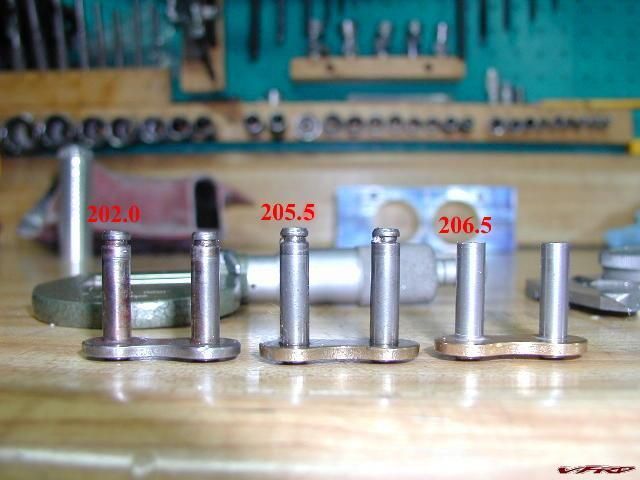
This is what we don't see behind the X rings... metal to metal wear
every time we adjust the chain that eats into our engine's available
HP... a new pin measures 206.5 and wears down to 205.5 at the 8K mile
mark... looks good to the naked eye but multiply that 1 thousand of an
inch times 108 links and you have 108 thousands of an inch wear or
about the range of the green marks provided by Honda's wear gauge...
202.8 show the very visible wear at the 12K mile mark... the pins are
turning red from extreme heat of grinding dry metal... a chain in this
condition may consume up to 6 to 8% of our RWHP... not to mention it
may snap into and cause case damage...
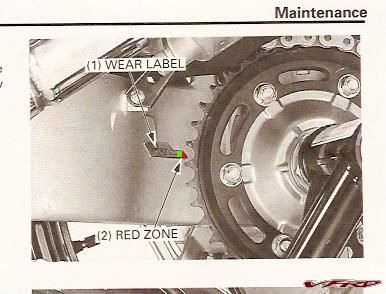
Honda sticker provided a handy guide to monitor chain wear... stay with
in the green and you'll be looking for a new chain and sprockets at the 8 to
10K mile mark...
What we are lubing are external roller and between the roller and the
sprockets (red area in my drawing)... we are not lubing the X rings
nor behind the X rings so any oil applied in that effort is a waste
and will only fling off...
My 2014 is just coming up to its 24,000 mile service, original chain still fine with plenty of adjustment left and no tight spots.
8 hours ago, fatshoutyblokeMy 2014 is just coming up to its 24,000 mile service, original chain still fine with plenty of adjustment left and no tight spots.
Ditto at 21,700 miles (34,884 km).
@BusyLittleShop
Excuse the simplistic question. So we should be applying chain lube at the "back" of the motorcycle , where the chain is in contact with the rear sprocket?
13 hours ago, lazyeye@BusyLittleShop
Excuse the simplistic question. So we should be applying chain lube at the "back" of the motorcycle , where the chain is in contact with the rear sprocket?
I prefer Motul chain paste allied to the inside of the chain...
I believe it's the smartest product on the market and the right solution
everyone has been looking to *properly* lube their chain and sprockets
because it brushes a layer of white grease like from the factory that
clings with no flings... Motul Chain Paste... squeeze the white grease
from the tube and load the brush...
[image: imageproxy.php?img=http%3A%2F%2Fi1036.ph]
[image: imageproxy.php?img=http%3A%2F%2Fi1036.ph]
Clings and no Flings...
[image: imageproxy.php?img=http%3A%2F%2Fi1036.ph]
Good looking stuff
just checked my bike and I do not have the 'Honda wear sticker' on my bike cannot see a residue of a sticker ever being there,did all bikes have one fitted??,I use Wurth chain spray and have only done 125 miles on the bike since I bought it,the chain is a DID ZVMX and had recently been fitted with new sprockets by the previous owner
Scottbot ... Yes they all had a sticker, mines fallen off recently, I guess that comes with using an adhesive that soluble in most chain lube
BSL ... I used to use that until I discovered it was water soluble
According to the Motul chain paste technical sheet, it is water resistant. But the line I like best is "Specially recommended for very fast bikes."
[image: 4ec8cf71316ca864169bda605d574f87.jpg]
Used this on my oem chain since I bought my bike with 1800 miles--- lasted 30,000 miles and was still good when replaced
New chain has 15,000 miles and still looks new with minimal stretching.
Sent from my iPhone using Tapatalk
10 minutes ago, auggiusAccording to the Motul chain paste technical sheet, it is water resistant. But the line I like best is "Specially recommended for very fast bikes."
The marketing folks had nothing to do with that line :cool:
auggius, 7/22/2017 at 3:04 PMAccording to the Motul chain paste technical sheet, it is water resistant. But the line I like best is "Specially recommended for very fast bikes."
Darn! I have a tube of the Motul that I was going to start using after my my stock of Maxima Chain Wax was depleted...
I changed my chain at 58,900 miles.
4 hours ago, Egg on LeggsI changed my chain at 58,900 miles.
Yeah, but what did you change it at the first time? LOL
8 hours ago, FJ12RyderYeah, but what did you change it at the first time? LOL
Seriously, that was the original chain as fitted by some Japanese chap in the Honda factory.
I did buy an original manufacturer chain and sprocket set at around 20,000 miles but that had sat in my spares cupboard for 12 years before I fitted it. The longevity is undoubtedly down to the Scottoiler and my slightly generous setting of it.
BusyLittleShop, 7/20/2017 at 2:05 PMMileage is a loose standard because wear depends on so many variables...
A more accurate standard of chain wear is after the 3rd adjustment because that
is undeniable evidence that the factory installed grease is beginning to
fail to lube the critical pin roller junction hidden behind the X ring... the
length of the chain is growing because of this metal to metal wear... I can
not call a chain serviceable that is grinding metal... it's like saying that a
dry bearing that runs ruff is acceptable... the net result is another 2 to
3% drop in RWHP as more energy is lost grinding metal behind the X
ring...This is what we don't see behind the X rings... metal to metal wear
every time we adjust the chain that eats into our engine's available
HP... a new pin measures 206.5 and wears down to 205.5 at the 8K mile
mark... looks good to the naked eye but multiply that 1 thousand of an
inch times 108 links and you have 108 thousands of an inch wear or
about the range of the green marks provided by Honda's wear gauge...
202.8 show the very visible wear at the 12K mile mark... the pins are
turning red from extreme heat of grinding dry metal... a chain in this
condition may consume up to 6 to 8% of our RWHP... not to mention it
may snap into and cause case damage...
Honda sticker provided a handy guide to monitor chain wear... stay with
in the green and you'll be looking for a new chain and sprockets at the 8 to
10K mile mark...
What we are lubing are external roller and between the roller and the
sprockets (red area in my drawing)... we are not lubing the X rings
nor behind the X rings so any oil applied in that effort is a waste
and will only fling off...
Why does a ScottOiler allow chains to reach such high mileage? Eggs on Leggs has one and several guys on the old FJ list got huge mileage using them. Seems like if they didn't do at least a little oiling
of the pins the mileage wouldn't be much different than just spray chain lube.
Maybe he'd already lost a LOT of hp by the time he changed it.
What BLS is saying is that we should be careful what we use as the indicator of when a chain has reached its end of life. I've always used run out of adjustment but I can see now that is incorrect.
Trouble is, my Honda-fitted wear sticker is currently lying on the floor of my garage so how do I now tell when my chain needs replacing?
I've checked my chain this weekend and it's slack on the rear sprocket with 13500 miles on the clock. It needed a fair bit of adjustment too and it wasn't long ago since I last adjusted it. Time for a new one I think. I use Wruth dry chain lube and ride all year round in the awful British weather!
Got 15k on it, well past the green zone on the sticker. I don't trust it 100% because I'm doubting it was placed within any tight specifications, but I'm still going with it. I've been putting it off for several thousand miles, though, with lots of WOT through first and second, a handful of runs to 130-140, and lots of rain with no problems yet.
FJ12Ryder, 7/23/2017 at 11:03 AMWhy does a ScottOiler allow chains to reach such high mileage? Eggs on Leggs has one and several guys on the old FJ list got huge mileage using them. Seems like if they didn't do at least a little oiling
of the pins the mileage wouldn't be much different than just spray chain lube.
Mr.Scott's auto oiler reliably coats the chain like an leaky counter
shaft seal but technically speaking no amount of external oil will
reach the critical pin and roller junction... not even a little
oiling... because an X ring held in tension is an effective seal just
like your fork seals are... the only worth one can expect is the fact
that if you coat the chain in enough oil the running temp is lower
where the factory installed grease has a chance to live longer...
Mr.Scott's auto oiler was designed for non standard chains back in the
60s for London Motorcycle Couriers... this is before "O" or "X"
ring chains were invented... so if you ran a non X ring chain then I
would agree Mr. Scott's oiler is a reliable substitute for that
prescribed manual lubrication because oil would have a chance to
migrate to the critical pin and roller junction...
Take cam chains... we expect our cam chains to last the life of the
engine because the critical pin and roller junction enjoys a
continuous oil supply... death for a cam chain is to install X rings
which would effectively seal off the path of any external oil reaching
the critical pin and roller junction... an X ring cam chain would not
last the life of the engine and would required replacement about as
often as our drive chains even though it labors in a hail storm of
fresh hot oil...
FACT
If you adjust your chain at all it is due to the factory installed grease is
beginning to fail and metal to metal wear behind the X ring at the critical
pin and roller junction is happening and no amount of external oil will
reverse this wear... After the 3rd adjustment the amount of metal to metal
wear is plain chain abuse...
[image: ForkSealDiagram.jpg]
Whilst I can see the point about the inner pin, the inner and outer roller are not protected by an O ring.
from the scottoiler website.
https://www.scottoiler.com/uk/how-it-works/chainlubrication101.html
I don't usually find any reason to disagree with BLS, but I think he missed the most important positive point of the Scottoiler. I think the great advantage of a Scottoiler is that it is easy to use. This leads to frequent oiling. This regular, constant wash of oil over the chain will flush off grit and debris leading to a cleaner chain from a mechanical point of view (but not an aesthetic point of view). This is grit that could otherwise abrade or cut a sealing ring.
I don't use a Scottoiler so I don't have a vested interest. I'm the guy that points the car wash wand at the chain while it circulates in first gear at idle and puts on whatever product has recently captured my interest or is cheaply available. Even with my meticulous chain maintenance regimen, I still get ~20,000 miles out of a chain.
1 hour ago, BusyLittleShop
Mr.Scott's auto oiler reliably coats the chain like an leaky counter
shaft seal but technically speaking no amount of external oil will
reach the critical pin and roller junction... not even a little
oiling... because an X ring held in tension is an effective seal just
like your fork seals are... the only worth one can expect is the fact
that if you coat the chain in enough oil the running temp is lower
where the factory installed grease has a chance to live longer...Mr.Scott's auto oiler was designed for non standard chains back in the
60s for London Motorcycle Couriers... this is before "O" or "X"
ring chains were invented... so if you ran a non X ring chain then I
would agree Mr. Scott's oiler is a reliable substitute for that
prescribed manual lubrication because oil would have a chance to
migrate to the critical pin and roller junction...Take cam chains we know cam chains don't wear out at all like drive
chains because the cam chain's critical pin and roller junction have
continuous oil supply... now if we install an X ring chain in place of
the non X ring cam chain it would begin wearing at the critical pin
and roller junction about as often as the drive chain even though it
operates in a hail storm of fresh hot oil because no oil will migrate
behind the X ring and extend the life of the critical pin and roller
junction... wear will happen and the cam chain length will grow...FACT
If you adjust your chain at all it is due to the factory installed grease is
beginning to fail and metal to metal wear behind the X ring at the critical
pin and roller junction is happening and no amount of external oil will
reverse this wear... After the 3rd adjustment the amount of metal to metal
wear is plain chain abuse...
[image: ForkSealDiagram.jpg]
That's pretty much a non answer. Why do the X-ring, O-ring chains last so long with a ScottOiler? I agree that the ScottOiler came about before
O-ring chains, but they last longer with a ScottOiler. If they didn't you'd run out of adjustment in 58,000 miles.
5 hours ago, FJ12RyderWhy do the X-ring, O-ring chains last so long with a ScottOiler?
The running oil leak lowers the operating temp where the factory
installed grease has a chance to live longer before the first
adjustment... but the fact remains adjustment is taking up the slack
cause by metal to metal wear at the critical pin and roller junction
because the factory installed grease is beginning to fail... you can
submerge the chain into a sea of oil and not one molecule will migrate
pass the effective X ring seals to reverse this metal to metal wear...
You can say the "chain last longer" but you can not say there was no
metal to metal wear going on at the critical pin and roller junction
during the first adjustment...
Bit like the difference between running fully synth and semi synth .
Was advised to stay away from chain wax in the summer (it collects grit) and dry lube in the winter (it washes off too easily). Decided this required too much in the way of thinking, especially given the UK seasonal weather patterns (ie - none) so just went for the ordinary stuff - mucky but it does what I want it to. So I go for the 'fling and forget' method. Lube the chain once a week (around every 700 miles) and clean the crap off the wheels when it gets to the 'hard to turn right' stage of build up :rolleyes:
9 hours ago, BusyLittleShopThe running oil leak lowers the operating temp where the factory
installed grease has a chance to live longer before the first
adjustment... but the fact remains adjustment is taking up the slack
cause by metal to metal wear at the critical pin and roller junction
because the factory installed grease is beginning to fail... you can
submerge the chain into a sea of oil and not one molecule will migrate
pass the effective X ring seals to reverse this metal to metal wear...You can say the "chain last longer" but you can not say there was no
metal to metal wear going on at the critical pin and roller junction
during the first adjustment...
An O-ring seal is a good seal, with a major caveat: it no longer seals so well when the O-ring has aged and it starts to flatten out. When that happens you
no longer have as good a seal as when it was new. When the O-ring reaches this stage perhaps the ScottOiler keeps the pin wear at a slower rate, and some
oil actually gets past the deteriorated O-ring.
Sorry, but I just can't see O-rings never deteriorating enough to allow oil past the seal. We used O-ring seals a ton where I retired from and they had to be replaced
because they would start to leak as the O-ring flattened out and lost its "tension" against the sealing surface. I have removed a couple drive chains and noticed that
the O-rings were seriously flattened and/or distorted.
I guess we'll just have to agree to disagree. :beer:
On Sunday I very carefully cleaned, let dry, and re-lubed my chain. The links are definitely stiff, like a worn out chain, except that the chain hasn't stretched past the Honda Good/No Good sticker. I have a new one on order so hopefully I won't be down too long. I'm going to try the Motul lube/brush thing on the next one.
Thank you all for commenting. I've been doing this for a while, but there's always something to be done better.
24K on my OEM chain, one adjustment since new. I lube every 200 miles with Honda Lube with Moly. Sometimes I wipe the chain off and sometimes I don't. Sprockets look good too.
Now, rear tires are another matter- I am lucky to get 3800-4000 miles from a sport-touring rear.
I spend a lot of time in the canyons, and am not shy about giving it the stick.
8 hours ago, FJ12RyderSorry, but I just can't see O-rings never deteriorating enough to allow oil past the seal.
No problem...
Technically speaking the old rubber O rings are no longer employed by
chain manufactures and the reasons are:
1)Poor Resistance to Drying Out (as you pointed out)
2)High Drag
3)Sealed at only 2 points
4)No Reservoirs of Lube
Currently we have the X rings designed out of the new fluoroelastomer
product known commercially as Viton or Kalrez and reasons are:
1)Excellent Resistance to Drying Out
2)Low Drag
3)Seals at 4 points
4)Grooved Reservoirs of Factory installed Grease
What that means for us is the fact Viton or Kalrez X rings will be
100% serviceable far beyond a chain's first adjustment mileage point
where metal to metal wear begins to happen at the critical pin and
roller junction...
For an Auto Oiler to be cost effective first remove the X rings so the
oil has a chance to reach the critical pin and roller junction... next
enclose the drive train to isolate the oil fling from coating your
prize in muck...
Yeah, we used a lot of those too, but we called them quad rings. They do seal better than O-rings.
There was some question about the location and/or appearance of the chain wear sticker so here's a pic...
[image: IMG_3134.JPG]
Well since this topic got me thinking, as I was all ready looking at 520 options, which I will do when the time comes. But in the mean time I'll follow Larrys lead. Good stuff, think it's my new to go to slippery stuff. Only small hassle is getting the secondary chain debris catcher out of the way to be able to apply it like it suppose to be. Fixed that by replacing the 8mm socket head with button head.
[image: DSCF1126.JPG]
Shinigami, 7/24/2017 at 2:21 PM24K on my OEM chain, one adjustment since new. I lube every 200 miles with Honda Lube with Moly. Sometimes I wipe the chain off and sometimes I don't. Sprockets look good too.
Now, rear tires are another matter- I am lucky to get 3800-4000 miles from a sport-touring rear.
I spend a lot of time in the canyons, and am not shy about giving it the stick.
I've read and seen pics of K&N oil filters lubing rear tires very well.....if you survive the lube event.....
On a more serious note, I too like the low viscosity Honda Moly chain lube. IMHO, thick waxy chain lubes attract and hold sand and grit which is not chain friendly.
Hmmmm. . . 32k miles on the Sprint chain. weekly oil with 10W/40. Yup it flings off but I have lots of it to spare and so far I've not had any problems. It's last MOT the Chain adjustment got mentioned but not chain wear.
It's going to get changed as soon as I get the other bike back on the road.
BusyLittleShop, 20/07/2017 at 8:05 PMMileage is a loose standard because wear depends on so many variables...
A more accurate standard of chain wear is after the 3rd adjustment because that
is undeniable evidence that the factory installed grease is beginning to
fail to lube the critical pin roller junction hidden behind the X ring... the
length of the chain is growing because of this metal to metal wear... I can
not call a chain serviceable that is grinding metal... it's like saying that a
dry bearing that runs ruff is acceptable... the net result is another 2 to
3% drop in RWHP as more energy is lost grinding metal behind the X
ring...This is what we don't see behind the X rings... metal to metal wear
every time we adjust the chain that eats into our engine's available
HP... a new pin measures 206.5 and wears down to 205.5 at the 8K mile
mark... looks good to the naked eye but multiply that 1 thousand of an
inch times 108 links and you have 108 thousands of an inch wear or
about the range of the green marks provided by Honda's wear gauge...
202.8 show the very visible wear at the 12K mile mark... the pins are
turning red from extreme heat of grinding dry metal... a chain in this
condition may consume up to 6 to 8% of our RWHP... not to mention it
may snap into and cause case damage...
Honda sticker provided a handy guide to monitor chain wear... stay with
in the green and you'll be looking for a new chain and sprockets at the 8 to
10K mile mark...
What we are lubing are external roller and between the roller and the
sprockets (red area in my drawing)... we are not lubing the X rings
nor behind the X rings so any oil applied in that effort is a waste
and will only fling off...
BLS - you've convinced me you know a lot more than I do so what sort of chain/sprocket maintenance routine would you recommend please?
The Honda wear sticker fell off my '15 800X the other week. :mad:
Internal wear on chains is as per Larry's posts, but he missed a trick, the pin & the bearing wear, so those measurements should be doubled from what you see on the pin. Further more the bearing becomes oblong as it wears as does the pin in the opposite dimension.
It's these components that decide how long your chain is & thus the apparent wear.
External lubrication only lubes the roller on the outside of each chain link end bearing. The dirt & wear on these determines the slip load wear on the sprockets & the tension on the inner pin is increased when these rollers do NOT slip into the teeth of the sprocket. Thus scot oiler etc by keeping the rollers lubed at the same level ALL of the time, means the dynamic loads applied to the inner pins/bearings are reduced, thus extending the life of the chain. You have to view the WHOLE thing, not anyone component of the chain, even though only one point shows the wear that increases the chains length & thus its service life.
Since most larger bikes have rivetted master links, then the old remove, cleaned & measure rarely gets done, because you need to sacrifice a link every time. Most people claiming extreme mileage will find their chain was worn out long ago if they checked them when they removed them. The simple test is the full bend test, that anyone can do. On a clean flat surface roll your new chain out flat in the same plane as it fits on the bike i.e. rollers horizontal. Now hold one end & bend the chain sideways with a light pressure & mark where the other end stops, it won't bend far. This is the NEW chain inner pin/bearing clearance. Now do the same beside it with the old chain, you will find it bends a LONG way further than the new chain, that is the wear since new you have added.
Now if you put a rod (screw driver etc) through the end links & pull the chains taught, you will see the extra length of the old chain. IIRC the recommended stretch in a roller chain is around 3% (or 25mm for 530x108) best is 1.5% (12.5mm) or less, the maximum would be 33mm but that's bad. More details here https://www.diamondchain.com/understanding-wear-life/
The manufacturers try to make all links the same, but its rarely the case, so one part of a chain can be worn out whilst the rest is well within spec, if you are really keen, you can break chains & keep the good parts & link them to make a part worn chain, not that I'd recommend it though ;(
As always YMMV
15,000 on a 520 super light steal sprocket and chain, sprocketcenter is the best I've found
[image: IMG_1966.jpg]
[image: IMG_1970.JPG]
The old standard way of trying to pull the chain off the rear sprocket still stands as the single simplest check on chain wear, if it moves it's finished
14 hours ago, ThumbsThe old standard way of trying to pull the chain off the rear sprocket still stands as the single simplest check on chain wear, if it moves it's finished
Hear hear.
About time somebody mentioned measuring stretch! Honda sticker is as useful as a ruler on cnc part. Idk the number for our chains, but a measurement of ten link pins, pulled taut, in gear is the surest way to tell when to replace.
I dunno about all this. I just replace my chain when I think it needs to be replaced. I know the average mileage for me, when that happens for reasons I can only speculate on.
Skids, 8/10/2017 at 2:44 AMBLS - you've convinced me you know a lot more than I do so what sort of chain/sprocket maintenance routine would you recommend please?
The Honda wear sticker fell off my '15 800X the other week. :mad:
Mr.RC45's interval is timed to every fill up... I employ a rag and gas to remove the grit and grime... I lube with Motual chain paste... I replace chain and sprockets after the 3rd adjustment which is about 8K to 10K miles... chains are a pain... belt spells relief...
Just to dive on to the end of a thread about chains, I need a new one.
Normally this doesn't cause me much trouble but for some reason, Honda appear to be keeping this all a bit hush hush.
Can anyone tell me what the standard chain/ sprocket set-up should be? So far, I think I've established it's a 110 link chain with a 43 tooth rear carrier but it all goes horribly wrong after that :rolleyes:
I'm happy with the standard gearing so nothing odd required...
This has the stock info as well as the 520 kit I put on my 8th gen.
5 minutes ago, DriverDaveThis has the stock info as well as the 520 kit I put on my 8th gen.
Lovely, thanks Dave :smile:
525 chain, 16 tooth front and 43 tooth rear carrier for anyone just wandering by!
Thumbs The old standard way of trying to pull the chain off the rear sprocket still stands as the single simplest check on chain wear, if it moves it's finishedOn all of my bikes, pulling a new chain from the rear sprocket at the 3 o'clock position results in a small amount of movement. I always thought that the rule of thumb was that if you pull and can see any part of the teeth, it's time to replace.
Dustin, 12/27/2017 at 12:33 PMOn all of my bikes, pulling a new chain from the rear sprocket at the 3 o'clock position results in a small amount of movement. I always thought that the rule of thumb was that if you pull and can see any part of the teeth, it's time to replace.
A more accurate rule of thumb is to plan on replacing chain and sprockets after the 3rd adjustment because now there is undeniable evidence of metal to metal wear is real due to the factory installed grease failing to properly lube the critical pin and roll junction...
If your sprocket teeth look worn down smooth like some hillybillys teeth what never seed no durn dentist,
you might need a new chain and sprocket set. :tongue:
That was my CBR954 some years ago. No wonder it was surging. :goofy:
BusyLittleShopYou say that but you also suggest lubing the chain at every fill up. Great advice for the Sunday cruiser but not suitable for the commuter or long distance tourer.A more accurate rule of thumb is to plan on replacing chain and sprockets after the 3rd adjustment because now there is undeniable evidence of metal to metal wear is real due to the factory installed grease failing to properly lube the critical pin and roll junction...
It's good food for thought but unrealistic for some.
16 hours ago, DustinYou say that but you also suggest lubing the chain at every fill up. Great advice for the Sunday cruiser but not suitable for the commuter or long distance tourer.
It's good food for thought but unrealistic for some.
It's not unrealistic at all.
You park the bike to fill up, so pull your can of lube out of the box/luggage/tank bag/rucksack etc and lube it. Or buy a Cobbra and lube as you pull away.
I commute-lube once a week, clean once a month.
I cleaned and lubed once a month at best and changed the OE chain at about 20k, riding in all weather conditions. This was certainly neglectful, but I think it shows a quality chain is a lot more durable than some think.
Sent from my iPhone using Tapatalk
Skids, 30/12/2017 at 1:26 PMIt's not unrealistic at all.
You park the bike to fill up, so pull your can of lube out of the box/luggage/tank bag/rucksack etc and lube it. Or buy a Cobbra and lube as you pull away.
It is definitely unrealistic for me when I'm travelling the height of the UK every day for a week on some long road trip in North America. On trips like that, I would do my chain every night at the hotel but I have a chain oiler now which has been worth every penny.
Brand of Oiler? Using cameleon myself, mixed results but almost good enough to make me consider the investment for my other bikes that DO have a centerstand
22 minutes ago, airwalkBrand of Oiler? Using cameleon myself, mixed results but almost good enough to make me consider the investment for my other bikes that DO have a centerstand
I've got the Pro-Oiler which is electronic and uses a GPS-driven control module. I am very happy with it.
Auto Oilers were invented before the O ring chain... they were never designed to extend the life of our modern X ring chains...
BusyLittleShop Auto Oilers were invented before the O ring chain... they were never designed to extend the life of our modern X ring chains...It sure does wonders to keep my chain clean and free of rust in winter. :)
20k without a constant stream of oil. Nice, for sure, but I'm pretty happy with my results without.
Sent from my iPhone using Tapatalk
Katie, 12/27/2017 at 5:12 PMLovely, thanks Dave :smile:
525 chain, 16 tooth front and 43 tooth rear carrier for anyone just wandering by!
Only one garage open over Xmas and my chain's tight spot had reached a dire level so have had a 520 chain put on with the existing sprockets. The garage didn't think the sprockets were worth changing so, working on the basis that no garage likes to turn money away, I went with the chain change only for the first time ever!
12 hours ago, DustinIt is definitely unrealistic for me when I'm travelling the height of the UK every day for a week on some long road trip in North America. On trips like that, I would do my chain every night at the hotel but I have a chain oiler now which has been worth every penny.
Agreed chain oilers are worth their weight in gold tho on a tour. That must be some going to clock up just under 800 miles in a day, per day on a tour. :wink:
9 hours ago, BusyLittleShopAuto Oilers were invented before the O ring chain... they were never designed to extend the life of our modern X ring chains...
No they were designed to keep the chain clean as well as to lubricate the o ring.
Katie
Only one garage open over Xmas and my chain's tight spot had reached a dire level so have had a 520 chain put on with the existing sprockets. The garage didn't think the sprockets were worth changing so, working on the basis that no garage likes to turn money away, I went with the chain change only for the first time ever!
VFR4Lee, 12/29/2017 at 6:02 PMIf your sprocket teeth look worn down smooth like some hillybillys teeth what never seed no durn dentist,
you might need a new chain and sprocket set. :tongue:
That was my CBR954 some years ago. No wonder it was surging. :goofy:
Reminds me of my RC51 when it's chain was getting near it's end of life, that bike would surge at low rpm's like crazy and was very hard on chains lol! I dont think I'll have those same issues with my RC79 now :)
10 hours ago, finkNo they were designed to keep the chain clean as well as to lubricate the o ring.
Negative... the original designer wanted keep his chain lube during his days as a London Bike Courier besides have you notice a wet chain allows more muck to stick than a dry chain???
3 minutes ago, BusyLittleShophave you notice a wet chain allows more muck to stick than a dry chain???
No, I haven't, my wet chain is always clean. :)
20 hours ago, Dustin20 hours ago, BusyLittleShop Auto Oilers were invented before the O ring chain... they were never designed to extend the life of our modern X ring chains...It sure does wonders to keep my chain clean and free of rust in winter. :)
Hondas are noted for their oil tight engines and an auto oiler defeats years of learned engineering with an aftermarket running oil leak in the name of rust prevention... oh the humanity of it all...
34 minutes ago, BusyLittleShopan auto oiler defeats years of learned engineering with an aftermarket running oil leak in the name of rust prevention...
No
5 hours ago, BusyLittleShopNegative... the original designer wanted keep his chain lube during his days as a London Bike Courier besides have you notice a wet chain allows more muck to stick than a dry chain???
Negative...... the oil used in a chain oiler is lighter and is as such that it is supposed to be flung off, hence cleaning and lubing the chain. Unlike spray on which is anti fling properties where all the crap is stuck to the chain.
Have been fortunate enough to be able to run two bikes together and did the with and without oiler. The chain with the oiler needed less adjustment, was much cleaner and lasted longer, much longer than the chain lube bike. Both flung but the chain spray one was much harder to clean.
10 hours ago, jhenley17
Are the sprockets also 520? That'd be my only concern. Otherwise, at 20k, I couldn't find any signs of wear on my stock sprockets and would have left them if I hadn't been looking for shorter overall gearing. I replaced with steel (I see no need for and don't understand why people use aluminum on street bikes) and expect to be able to use the same sprockets when my new chain wears out.
Sent from my iPhone using Tapatalk
No difference on the sprockets, for 520 or 525 according to various suppliers on the interweb? The 525 is just a bit heavier and for a more powerful bike although, again according to suppliers, chain technology has surpassed the original differences
That's interesting, I wouldn't have thought a 525 and 520 sprocket were the same. I agree, thought, that a 520 chain is just fine for a 100-HP bike.
Sent from my iPhone using Tapatalk
Ummmm... No, there is a physical difference between 520, 525 and 530 chains. All three have the same pitch (distance between pins, in this case 5/8") and roller diameter (0.4"), but the widths between the side plates on these chains are all different: 520 = 1/4"; 525 = 5/16"; 530 = 3/8" So, a larger chain will physically fit onto smaller sprockets (not that you would want to do that--it would have 1/16" extra side-play), but, I would have thought, not the other way 'round. So if a shop fit a chain with 6.35mm between the side plates onto sprockets designed for a chain with 7.94mm between the side plates, I'd be complaining--as well as amazed it fit at all.
Ciao,
13 hours ago, finkNegative...... the oil used in a chain oiler is lighter and is as such that it is supposed to be flung off, hence cleaning and lubing the chain.
You may believe your chain is clean but wipe it with a white rag and solvent and see the road grime and lube mix (red area) you're missing... Chains are a pain but an Auto Oiler running oil leak makes a mess on your bike in excess oil "flung off" with 0.0 benefit to the critical pin and roller junction which dictates chain life... like you say, lighter lube is supposed to be flung off... unfortunately it can't help flinging off on your tire, your brake, your wheel, your bags, A modern X ring chain never needs a running oil leak to give good service...
What we are actually lubing are the external roller and between the roller and the sprockets (red area in my drawing)... we are not lubing the X rings
nor behind the X rings so any oil applied in that effort is wasted fling off...
It’s cleaner than a chain where spray on has been used.
The Red chain lube area is required to “clean and lubricate “the external part of the X or O ring. As I’m sure you will agree the external part of the seal needs to be lubed and cooled in order to prevent its degradation. Spray on also makes a mess and is much harder to remove in comparison.
he seal(s) retaining the lubrication for one or more rollers fails. Typical causes include: abrasion (such as sand rubbing between the seal and one of the plates); friction (heat generated by inadequate lubrication external to the seals as the plates rub against them); weathering and age (seal dries out, cracks), or other stresses (such as chemical exposure to naphtha or other harsh chemicals).
The primary way to keep this kind of failure from occurring is to keep the chain (and thus the seals) free of sand, dirt and other contaminants via regular cleaning, and to keep it lubricated appropriately externally as well (to minimize the friction at the seal/plate interface, and to help keep the seals in good shape).
I agree with JZH...
Chain Pitch and width are in 8ths of an inch... between the 520 and
525 and 530 there is no difference in roller dia or pin dia or tensile
strength... the difference is only in the roller width...the greater
the roller width the longer the chain last with the factory installed
grease sealed behind the oil rings...
[image: ChainSpecs.jpg]
59 minutes ago, BusyLittleShopWhat we are actually lubing are the external roller and between the roller and the sprockets (red area in my drawing)... we are not lubing the X rings
nor behind the X rings so any oil applied in that effort is wasted fling off...
I don't think anybody here has ever claimed that a chain oiler lubes behind the rings or anything like that. Like I've said before, the running oil leak I installed provides me with a palpable benefit for the riding I do in the climate I live.
If I rode a garage queen and lived in a dust bowl like you, I'm certain I wouldn't use a chain oiler either.
6 hours ago, finkAs I’m sure you will agree the external part of the seal needs to be lubed and cooled in order to prevent its degradation.
I don't agree because my actual experiments show that our X ring
(industry standard) can be all wet on the outside (red area) but all
dry on the inside because the chains plates hold the X ring in tension
which is an effective seal like our fork seals, caliper seals, and dip
stick... if we just drop oil on X ring while it is held in tension by
the plates that oil will not creep to lube it... it has no where to go
except to be flung off onto our bike...
So your going against what the manufacturers are stating then..
The X rings are lubed (as in are not bone dry) prior to the construction of the chain (which also like any other seal needs to be "wet" prior to installation in order for it to be effective). The external lube is to help clean the chain and to lubricate the external part of the X/O ring (parts open to the air) not the internal parts.
As I'm sure you will agree the chain gets hot whilst in use. In order for it to maintain its integrity, or that of its sealing components those components need to be lubricated 1 to reduce friction , 2 to reduce any heat produced by the friction there is. This is done internally by the grease used upon construction, but also must be done externally by external methods as recommended by the manufacturers, by initially using gear oil decades ago, which has since progressed onto spray on lubes and chain oilers.
DID Chains
1.5 to 2 TImes Longer Wear Resistance
(Compared with Normal O-Ring)
The X-Ring’s four contact points greatly increase its sealing performance. This keeps the dirt out and the lubrication in much better than any other O-Ring. X-Rings have the greatest wear resistance of any other type of O-Ring or Non-O-Ring chain.
Afam Chains
To extend the life of your chain you have to lubricate your chain regularly. This depends on the driving conditions, your chain should never run dry. In dry driving conditions lubricate after 500 to 600 km. Do not use too sticky grease but a good fluid and penetrating lubricant. Lubricate all moving parts and do not forget to lubricate along the X-rings.
Can you give us some more insight to your experiments show us some more of your data and workings?
My personal experimentation was two bikes with new chains and sprockets running same route, one with oiler and other with chain lube. Results were that over near enough same mileage (18K miles) covered the bike using propriety Chain Lube at the recommended mileage had to have its chain adjusted more frequently and took much longer to clean than the one using a Scottoiler set correctly. The chain lube needed a chemical cleaner, compared to soap and water and occasional spray of WD40 of the chain oiler.
Dustin, 1/2/2018 at 3:05 PMIf I rode a garage queen and lived in a dust bowl like you, I'm certain I wouldn't use a chain oiler either.
I do and I do for you kids and this is the thanks I receive???
Mercy Dustin does this look like I ride a garage queen or live in a dust bowl???
[image: RC45OilPressGauge.JPG]
[image: MrRC45TahoeBendyBits05.jpg]
fink, 1/3/2018 at 9:08 AMCan you give us some more insight to your experiments show us some more of your data and workings
It's an easy experiment anyone can duplicate... lube chain... run bike... bust master link apart and note how
the chains plates hold the X ring in tension and make an effective 4 point seal and any external oil does not creep
beyond the 4 points to lube it...
1 hour ago, BusyLittleShopIt's an easy experiment anyone can duplicate... lube chain... run bike... bust master link apart and note how
the chains plates hold the X ring in tension and make an effective 4 point seal and any external oil does not creep
beyond the 4 points to lube it...
Have you read the rest of the post?
It says exactly what you have said there..
Phew... so, what brand of tires does everyone like... :tongue:
1 hour ago, MarveliciousPhew... so, what brand of tires does everyone like... :tongue:
Don’t forget to ask which is the best oil.
must be winter :)
Sudden influx of non 8th gen visitors, Hi there. :cheerleader: Must be like watching shite drying on your pages if your interested in what’s going on over here and thats the sum total of your contribution to the discussion. :tongue: :comp13: . :biggrin:
Keep it on the black stuff boys. :wheel:
You can try, but you can't hide a VFR-related technical discussion from me, mate...
Ciao,
13 hours ago, finkSudden influx of non 8th gen visitors, Hi there. :cheerleader: Must be like watching shite drying on your pages if your interested in what’s going on over here and thats the sum total of your contribution to the discussion. :tongue: :comp13: . :biggrin:
Keep it on the black stuff boys. :wheel:
They're only jealous m8. :goofy:
13 hours ago, finkMust be like watching shite drying on your pages if your interested in what’s going on over here and thats the sum total of your contribution to the discussion. :tongue: :comp13: . :biggrin:
Watch wher yer pointin yer submarine ye fanny; this is VFRD :tongue: :beer: :goofy:
And oh remember, they called me clever Dutch bastid cloggy in South Queensferry (just across from the naval docks where they build the HMS Q E) :goofy:
![[image: Related image]](http://www.brownells.com/userdocs/products/p_768500100_1.jpg)
![[image: 14746956046_fb75bdf189.jpg]](https://farm3.staticflickr.com/2897/14746956046_fb75bdf189.jpg)
![[image: 4ec8cf71316ca864169bda605d574f87.jpg]](http://uploads.tapatalk-cdn.com/20170722/4ec8cf71316ca864169bda605d574f87.jpg)
![[image: 968.jpg]](http://www.motonetro.ro/files/sortiment/968.jpg)