Hi, this is my '98 5th gen VFR 800 FI. I bought this bike one year ago with 27500 km on the clock. The bike was like new - not a single scratch or rust spot. Went through a very long series of small issues (R/R, connectors, etc) caused by the long inactivity of the bike. Now they are all solved, except one - the gas mileage! It is pretty bad, around 14 km/l (33 mpg) riding in "mixed" mode (around 5000 rpm with some high speed launch). The exhaust always smell a bit rich, the bike runs well though. I did the usual snorkel / flapper mods, went through a lot of discussions, somebody says it's a normal mileage for a pre-cat bike, somebody other says i should clean / synchronize the injectors, but my mechanic says that everything is OK on my bike. I would like to know if the bike mileage is normal and if it can be improved without buying a Power Commander. BTW, it is true that US bikes from the same year have a different ECU? Maybe they have a better gas mileage? Thanks!
Poor fuel economy - Have you checked the state of your air filter.? Are you running Ethanol added fuel? Check for any vacumm leaks. Possible fuel pressure regulator issue. Assume you don't have any flashing Fi codes? Make sure your Thermostat is working correctly, bike is reaching normal operating temp.
No dragging brakes?
If you don't have the full Service Manual you can download it from this site at the forum home page.
Hi, air filter has been replaced, no dragging brakes, the bike works well but i never checked the fuel pressure regulator. I had some FI issues caused by bad connectors and/or ground connector. Now it' OK and i have also poured a whole can of injector cleaner in the tank. The gas mileage was always the same - never seen a real improvement. JZH, i live in Bari, South Italy. Quite far from the classic "motor valleys" in the North, but we have nice roads here too 🙂
I told you on Facebook, you are chasing ghosts. Early 5th gens aren't as gas mileage friendly as newer generations.
You describe pretty normal mileage for a 98-99. Sync those throttle bodies (mainly just good maintenance item to do for smoother riding), can take the injectors out and have them cleaned and flow tested, and check the FPR just in case.
The 6th gen got better gas mileage, and the 8th gen gets even better.
Mine has had ~32-38mpg since 1199 miles on the ODO. I manage 44mpg on the 8th gen. Wife gets 48mpg on her 8th gen, softer on the throttle and weighs less.
Rider weight and luggage also factor in. Heck, so does tire pressure. Rolling resistance goes up a ton even if psi is down by 5-10.
3 hours ago, thtanner
Mine has had ~32-38mpg since 1199 miles on the ODO.
FWIW, my 6th gen is very similar during the cold and wet months with mixed city and highway commuting. In summer when doing mostly longer rides away from cities, I see 40-44.
1998 VFR 44-45 mpg on E0, ~40-42 mpg on E10, 87 octane, very consistent mpg for the last 70K miles. And yes they smell like they are running rich, sorta like a mid 60's muscle car🙂
Here's a bit of information that hasn't been mentioned yet in this thread: the 5th Generation VFRs breath pretty heavily through their crankase ventilation system, which dumps the oily blowby gases into the bike's airbox. As a result of this the intake valves can end up with a good bit of carbon build-up on them. If you're going to take off the throttle body, for something like getting at and replacing the thermostat or to remove the injectors to send out for cleaning, you should look at the intake valves to see just how much carbon is stuck on them.
Both of my two 5th Gen VFRs are low-mileage but both of them have a good bit of carbon build-up on the intake valves. I'm currently looking into various ways of cleaning them up.
Another possible cause of fueling problems is a fuel pressure regulator that is beginning to fail.
I have a '98 as well- bought new. I have never gotten good has mileage but don't really care. It's a motorcycle and I ride it fast. I also weigh around 230 lbs. Last summer I did a mileage comparison between using the Power Commander and without (running non-ethanol 92 octane gas). The difference was small. The PC gave me a bit better gas mileage and certainly better fueling. The actual numbers are posted on this site. My only mods are the PC, K&N air filter, and a Vance & Hines titanium pipe. Ride and enjoy!
I usually get 40-45 MPG riding the mountains of North Ga. you mention you tried the Power Commander. Do you have a PC3 or PC5? I have a PC5 and it's driving me insane. I cannot get the bike to run decently witht he PC5 on line. (1998 VFR800). What Map are you using? Would like to pick your brain if you're running a PC5. Thanks.
I have a PC 3. Got the map from a fellow on this site. If you search there are guys who have uploaded maps for the PC's either here or on the other VFR blog. I just tried the one that closely matched the mods I had on the bike. David
My experience so far has been with '00's and '01's so I cannot comment on mileage but my current '01 came with a Staintune and an PC2. Low rpm's were snatch-free and the machine felt faster but gas mileage was at least 10% less than I'd gotten on three previous 00 - 01's. Sold the can and PC, went back to stock and mileage returned to 50's and better. Easily.
And I cannot remember where I learned this but I believe the K&N filters are bad news. I replaced the K&N mine came with. The OEM air filters have always worked well for me. I believe the K&Ns restrict air flow.
I have a 99 (no cat) with a bit over 100,000km on it. It has well-balanced throttle bodies, well-maintained K&N filter, new plugs, correctly working thermostat ( usually sits at 78-80C except in traffic) and in-spec valves. I typically see 270-290km before the last fuel bar starts flashing, and that equates to 16-17 km/L. I thought that was a bit low and have replaced the FPR but that made no difference. It is pretty sensitive to riding style, lots of point and squirt will see that drop, and highway droning would make it a bit higher (but less fun).
With PC5 running autotune, bosch 3 bar FPR, large airbox/dual trumpet mod, and Micron slip on I average about 40 mpg with about 60% of mileage on interstates and 40% stop and go city.
I had poor economy several years ago that was resolved with replacement of the leaky stock fuel pressure regulator and injector cleaning. At the state of mods on your bike, I was averaging closer to 44 mpg.
eheh, that's a good question....I'm a big guy, but my weight was the same on my previous ZZR 600. As Thtanner said, i'm chasing ghosts...i can't really cope with the fact that there are other bikes from the same years that have an higher mileage. I bought the viffer also for long travels and that fuel hunger really pisses me off, actually it prevents me from embarking more often in long journeys. You know, average price in Italy is 1.60 Euro per liter.
Yesterday i checked out the average 5th gen mileage on Fuelly, and apparently US bikes have a lower consumption than EU bikes. I even thought to install a US/California ECU. Apparently i got 10 km more after pouring a can of injector cleaner in the tank. Will try to buy another can and/or to manually clean the injector.
Wow, if only we had lower gas prices, i could live with that.
By the way, doing "the usual snorkel-flapper mods" isn't really a great idea.
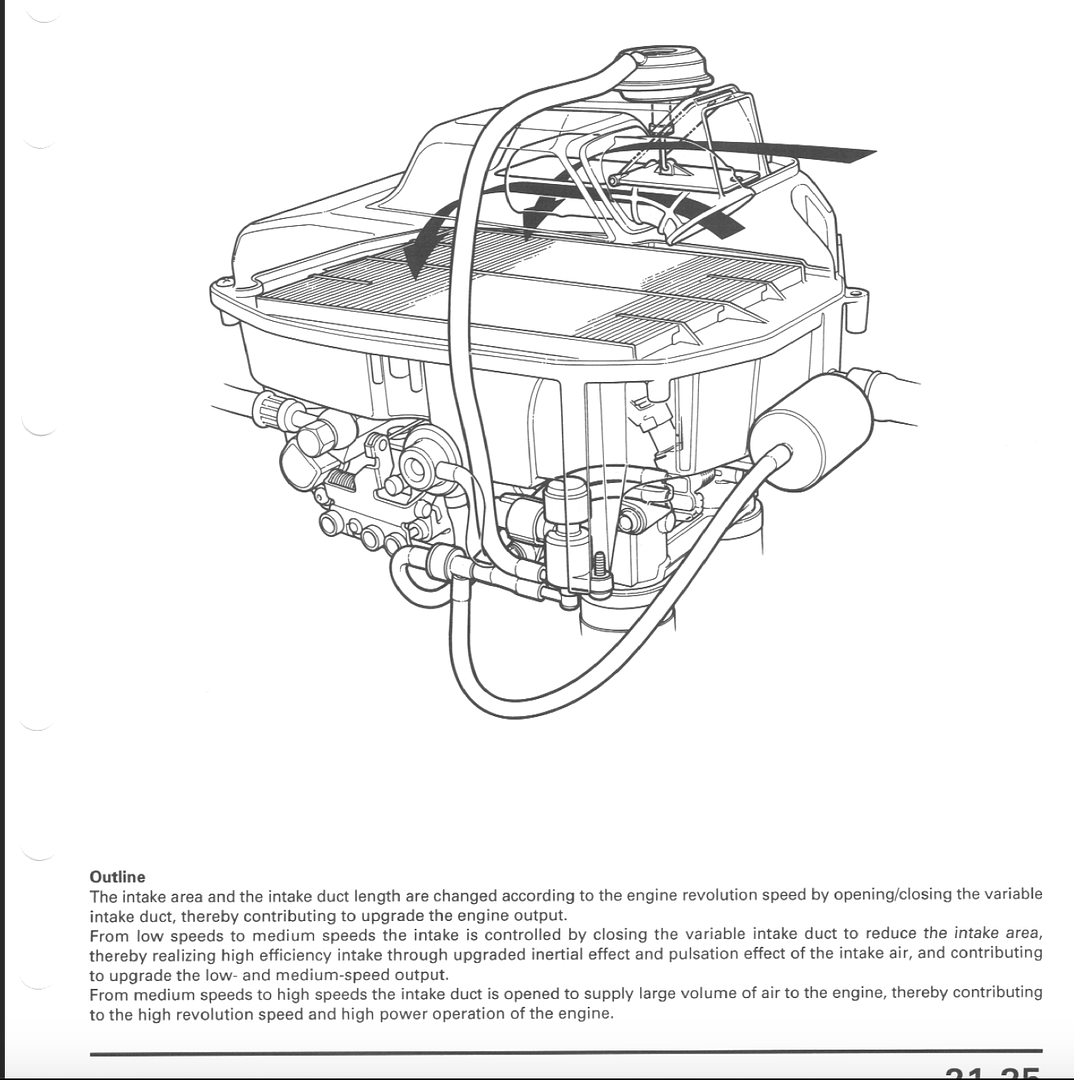
Yeah, there's a lot of back-and-forth argument on this subject but I can tell you that 99% of the guys (maybe even 100%) who argue in favor of this modification have not read Chapter 21 of the 1998-2001 Honda VFR800FI Interceptor Service Manual, which is entitled, "Technical Features".
If you were to carefully read (and understand) the information Honda has provided in this chapter you would realize that disabling the flapper valve and messing with the snorkel is a counterproductive effort. I'm not going to try and explain the whole situation here in this post to your forum thread, but the most important piece of information contained within Chapter 21 is that the VFR800 ECU runs in two different modes, depending on "demand" (which is closely, but not completely, related to throttle position). In conditions of low demand the ECU makes its fueling decisions primarily based on information provided by the Manifold Absolute Pressure Sensor, and in conditions of high demand the ECU makes its fueling decisions primarily based on information provided by the Throttle Position Sensor.
Now I'll leave it to you to carefully read and understand the Chapter 21 information and by doing so come to an understanding of why the snorkel and flapper are installed on the engine (and why the Honda engineers programmed the flapper to open and close when it does).
By the way, doing "the usual snorkel-flapper mods" isn't really a great idea.
Yeah, there's a lot of back-and-forth argument on this subject but I can tell you that 99% of the guys (maybe even 100%) who argue in favor of this modification have not read Chapter 21 of the 1998-2001 Honda VFR800FI Interceptor Service Manual, which is entitled, "Technical Features".
If you were to carefully read (and understand) the information Honda has provided in this chapter you would realize that disabling the flapper valve and messing with the snorkel is a counterproductive effort. I'm not going to try and explain the whole situation here in this post to your forum thread, but the most important piece of information contained within Chapter 21 is that the VFR800 ECU runs in two different modes, depending on "demand" (which is closely, but not completely, related to throttle position). In conditions of low demand the ECU makes its fueling decisions primarily based on information provided by the Manifold Absolute Pressure Sensor, and in conditions of high demand the ECU makes its fueling decisions primarily based on information provided by the Throttle Position Sensor.
Now I'll leave it to you to carefully read and understand the Chapter 21 information and by doing so come to an understanding of why the snorkel and flapper are installed on the engine (and why the Honda engineers programmed the flapper to open and close when it does).
I second everything you posted.
GreginDenver, 12/28/2018 at 6:09 PM
Both of my two 5th Gen VFRs are low-mileage but both of them have a good bit of carbon build-up on the intake valves. I'm currently looking into various ways of cleaning them up.
Seafoam direct into the TB and a smoke show should help clean them up. Always impresses the neighbors when your vehicle becomes a smoke machine /s
I hadn't read the pertinent pages mentioned above, so I got the ol' HSM out and read them. I don't think "counterproductive" is necessarily correct.
I also haven't disconnected the snorkel and flapper, just because I've never bothered. From what I read the benefits of the snorkel is very minimal
since it is saying that restricting air flow slightly at low speeds will help the smoothness of the power output at slow speeds. So if you remove the
snorkel and "flapper lid" or "variable intake duct", you may cause the low rpm response/power output to not be as efficient. But looking at the
difference between the snorkel and the "variable intake duct", the difference is pretty minor all in all.
To me it's similar to putting a free flowing intake on an engine: you lose some low end, but gain it back, and then some more, at the top end. It's pretty
To me it's similar to putting a free flowing intake on an engine: you lose some low end, but gain it back, and then some more, at the top end. It's pretty
much a non-issue IMO.
Okay, just in case I'm missing something here:
You're saying that performing a mod to make the flapper valve stay open during low Rpm/low "demand" situations (instead of closing as it was designed to do) somehow delivers more horsepower in the higher RPM/high "demand" conditions (during which the flapper was always programmed to be open anyway)?
Yeah, that's about it. Removing the flapper valve and snorkel, which is what several of the modifications basically
consist of, gets rid of any obstructions to air flow into the airbox. With fewer obstructions to the airflow into the
airbox, you could get more air flowing at higher rpm's, possibly resulting in more power at higher rpm's.
IMO regardless of the verbiage in the HSM, Honda did the snorkel and flapper valve to help lessen intake noise, and
touted it as a "good thing" for power. Maybe, maybe not.
Personally I don't think it makes much difference either way...which of course is why I've never messed with it.
You're not getting me (can't tell if you're doing it on purpose or by accident), but let me be clear: I'm completely disagreeing with you on this subject.
Once again, reading Chapter 21 of the Service Manual will completely debunk everything you (seem to) believe about Flapper Valve and Snorkel modifications.
I'm totally willing to discuss this situation in depth, issue-by-issue, if you would like.
My 2000 has 97K miles...I'm 245lbs, ride with full bags and get 40-42mpg in touring mode.. On gas in the twisties 32-36mpg.
That seems to agree with what I'd expect. The reason I don't really know is I've made it a habit to never check my mileage when I'm having a fun time carving up the twisties.
There is no point in spoiling the fun with practibility. Your Mileage May (And Probably Should) Vary. :wheel:
The big one is still to come. I believe that a circuit of Australia is about 14000km. But the first job is to restore an RF600R (barn find) for the girlfriend to ride. Her old GS500 was reliable but couldn't keep up!
I had an RF900 for 18 years, they are a good solid machine but a little uninspiring next to a V4. Have a look at the emulsion tubes in the carbs, mine wore oval over 50,000km and the fuel economy went to crap (plus fowled plugs at low revs) but it was an easy fix.
I had an RF900 for 18 years, they are a good solid machine but a little uninspiring next to a V4. Have a look at the emulsion tubes in the carbs, mine wore oval over 50,000km and the fuel economy went to crap (plus fowled plugs at low revs) but it was an easy fix.
Gotcha on that, thanks Terry. I spent 12hrs cleaning the carb rack just to make it run and I still have some issues with it. Damn bike has standed me twice, flooding on deceleration. I have dropped the needles one stop and it got better. I now have an optimised needle and jet kit on order hopefully this will set things right along with a heap more time in the ultrasonic bath and some new carb seals. I will check those tubes again when I get back into the carbs. The bike is for my girl, its got a low seat for its size, good for her... I like making old things new again, so its good for me too! Needless to say her mum hates it?
You can't please all the people all the time. (A Blue Gen5 VFR pleases me!)
Gotcha on that, thanks Terry. I spent 12hrs cleaning the carb rack just to make it run and I still have some issues with it. Damn bike has standed me twice, flooding on deceleration. I have dropped the needles one stop and it got better. I now have an optimised needle and jet kit on order hopefully this will set things right along with a heap more time in the ultrasonic bath and some new carb seals. I will check those tubes again when I get back into the carbs. The bike is for my girl, its got a low seat for its size, good for her... I like making old things new again, so its good for me too! Needless to say her mum hates it?
You can't please all the people all the time. (A Blue Gen5 VFR pleases me!)
Factorypro do a good info page for CV carb setup, and are where I bought the emulsion tubes for my 900. You should be able to pull the carb tops off and the slides out, and just look at the brass tubes in the carb floor. The tubes can be replaced from inside the float chamber.
Hi, sorry for not replying immediately to this interesting debate.
Well, what can i say...When i did the flapper mod, i got an immediate advantage at very low rpms (under 3500 rpm, so to say). The V4 is not the smoothest engine at those rpms anyway, but now it's much better. Don't know why it behaves in this way, it should be the opposite (open flapper valve = roughest behavior at low rpm), but currently i will keep the flapper mod.
Snorkel mod - just a matter of better noise 😉
Gas mileage? It's always the same - bad. You go slow, you go fast, it seems that the injection system was originally set to always squirt as much gas as possible in the cylinders, regardless of the conditions. I drove my bike for half tank at hilarious city speed (3000-4000 rpm) and the result was always the same , a miserable 235 km (146 miles) from a full tank, excluding reserve.
Just yesterday i heard another 800 Fi owner - he had one non-catalyzed (1998) and one with catalyzer (2001). Well , he said exactly the same things - the '98 has a better punch at midrange but has crap mileage and runs always quite rich (the exhaust is always a bit blackened after some hundreds of km).
Fuelly mainly shows results from US bikes, the few non-US bikes have worse result about gas mileage. Exactly for this reason, i would like to know if there is some differences between the 1998-1999 Italian-European ECU and the USA one.
AFAIK, there is NO difference between the US 48 state ECU's & the rest of the world for the 98/99 models. There is a possible difference for the 00/01 models as in Europe we got HECS-3 emissions kit for Euro2 compliance (not sure =if that was included in US models) & HISS ignition chip system for theft prevention.
Synchronising your starter valves correctly improves the smoothness of the engine everywhere, especially cleans up the free revving nature of the engine. Gas mileage is hard to improve on the VFR its its one bad point. But on a stock setup 00/01 model you should get 200 miles from a tank, hits reserve around 185, even when ridden in a spirited fashion. When cruised you should get 200 before reserve. My tuned up version hits reserve around 160ish miles, but has reached 180+ when cruised on a eurotour through the Alps.
AFAIK, there is NO difference between the US 48 state ECU's & the rest of the world for the 98/99 models. There is a possible difference for the 00/01 models as in Europe we got HECS-3 emissions kit for Euro2 compliance (not sure =if that was included in US models) & HISS ignition chip system for theft prevention.
Synchronising your starter valves correctly improves the smoothness of the engine everywhere, especially cleans up the free revving nature of the engine. Gas mileage is hard to improve on the VFR its its one bad point. But on a stock setup 00/01 model you should get 200 miles from a tank, hits reserve around 185, even when ridden in a spirited fashion. When cruised you should get 200 before reserve. My tuned up version hits reserve around 160ish miles, but has reached 180+ when cruised on a eurotour through the Alps.
As said, it seems that every '98 owner in Italy gets bad mileage, regardless of the injectors conditions or the speed. Y2K catalyzed models are known for having a MUCH lower fuel consumption. The bike runs great anyway.
I have installed a Power Commander unit on my bike....but it's not a modern one. It's quite a old piece of vintage electronic, being a PC II, made in 1999-2000 (found a new old stock one, still with sealed box, for one hundreds euros). The box itself is quite self-explaining about the age of the item:
The installation is very easy - just unplug the original harness, and plug the PC II betweem ECU and original connector (no additional plugs are present on this old device). It sits quite well under the seat, but it was not possible to hide the connectors in a less invasive position. The plastic hooks under the seat are perfect to fit the wire properly.
After a bit of struggling with adapters (the thing has a serial port!) and with unusable software, i finally managed to install the proper files and to connect the PC II to my notebook. I have installed a map previously tested by a member of the Italian VFR club, and now the bike can run for almost 280 km until the res light - that's a gain of 40 km. Performances are almost unchanged, just a slight loss of stamina and smoothness at low rpm. Now the bike stays in the range of 16 km/l (almost 38 mpg), and that's an acceptable mileage, albeit not impressive for sure. Now it's a VFR-BNSO (Very Frequent refuelling, But Not So Often).
I regularly use Seafoam in all my vehicles. The objective is to keep the intake valves free from oily deposits as best I can, without the flapper/PAIR mods. Yes, I'd love to witness the intake honk derived from said disablement of the former and latter, but I just don't want to queer the set up unless there is a gob of increased bhp/torque to be had. Since there doesn't appear to be, I'm leaving it alone. To each his own, except for Seafoam. Use it regularly, and you and your mill will be *happy*. Just my opinion which means nothing to anyone but me.
It sounds like you're just gonna double, triple and quadruple down on your "noisy intake" idea. And not only that, you're gonna go all conspiracy theory (Honda doesn't want us to know this stuff... black-helicopters, chem-trails).
And you're doing this in spite of the fact that Honda very plainly explains (in Chapter 21) that the VFR800 airbox is not restrictive at all. I mean look, read, understand... here it is in plain black and white:
BS. The air box is VERY restrictive. Check out my threads & mods which prove it empirically, rather than the rants of some armchair warrior.
Honda like everyone else has to comply with noise & emissions regs. The 98/99 models had a lower emissions standard applied & gas was cheaper then. But 33mpg (I assume Imperial MPG =4.546L) is bad. I get that from my much more powerful VFR when ridden hard. The guy is not riding that hard.
Back to the OP’s issue. Downloaded maps are garbage. Fuel injectors have very different deliveries, so a custom map is the only way to ensure a consistent Air Fuel Ratio & to see how your engine fuelling is performing as stock before a remap. The 5th gen single pintle injectors are simple devices & not prone to blocking unless left for long periods unused.
BS. The air box is VERY restrictive. Check out my threads & mods which prove it empirically, rather than the rants of some armchair warrior.
Once again, the 5th Gen VFR air box has 2 intake paths for a very good reason: from idle to about 7,000 RPM the rubber snorkel provides a level of airflow which causes the air box achieve a resonate frequency in that RPM range. When the air box hits a resonate frequency it boosts intake efficiency, which boosts torque in that rev range.
After about 7,000 RPM the 5th Gen air box opens up the flapper. This changes the resonate frequency equation, moving the air box resonance point to the upper end of the engine's rev-range.
Also, the 5th Gen VFR's rubber snorkel intake is long, which is exactly what you want for the lower end of an engine's RPM range. The Flapper side of the air box intake is short, which is exactly what you want for the upper end of an engine's RPM range.
As others have pointed out, the 5th Gen air box acted in a similar way to the VTEC system in the later generations of the VFR (this also explains why the dual-path air box was dropped in the VTEC versions).
OK, so you obviously believe in the helmholtz resonance theory that manufacturers espouse to convince people that they have not restricted your engine to meet noise & emission regs etc.
The VFR air box is to small, it’s the wrong shape & wrong material to create a helmholtz reasonance or any meaningful frequency effect. My dyno charts show no losses anywhere with a gutted big air box, with the filter moved to the top & the factory intakes eliminated, that adds about 3L to the intake area volume. Just by moving the filter to the top of the air box it added 5hp to my engine ! So you will have a hard time convincing anyone that the factory setup is best.
try keeping your delusions to yourself, unless you have empiracle evidence to back it up.
No need to be harsh here Mohawk. Honda didn't make something this complex on a whim. They had to have some reasoning behind it, else they'd never have dome something requiring that many parts.
And your data isn't exactly apples to apples. Your larger airbox with a substantially greater volume doesn't have the compromises that Honda were trying to work with. I'm guessing they chose the airbox based on what they could cram under the tank with accessibility for maintenance, manufacturing concerns, fit to the throttlebody, and all of that associated stuff -- maybe including emissions and noise. But they aren't "restricting" anything. They just did what they did within the parameters they had to work with.
I haven't seen this -- are there direct dyno comparisons from a stock airbox with and without the flapper and snorkel mods? Those charts might be interesting to see.
And just interesting. Not to fight about, just to see because it is interesting to know how something like yanking the snorkel really affects intake. Most of us aren't going to go to the effort you did. One of the joys of your experimenting is that I can see what the difference is when you make a dual path intake or something ridiculous like that, and how it really works, but that's all a cumulative comparison that includes previous mods on your bike.
Airboxes are like a capacitor in the hydraulic system. Changes in volume affect how they work, regardless of how restrictive they might be. I won't be able to get into it because I'm wholly unqualified to explain it and want to make that clear. There are a lot of voodoo magic elements to them, as well. But a significantly larger volume creates a slower change from state to state so an un-snorkeled larger capacity box is not a fair comparison.
And, I think the point here, aren't we talking about lower than average mileage? Not all VFRs have shit mileage, this bike gets 10mpg lower than some other folks with stock bikes
Sorry didn’t mean to be harsh but bs is bs. There are direct comparisons with dyno numbers that shows no noticeable difference between stock & de-flapped. But that is with NO fuelling mods. When fuelling is modified to suit, then the de-flapped version makes more power higher up, with no losses.
Are there charts for this? It would be an interesting experiment to see the results from. And I find it odd that a deflapped would make more power. With the flapper open it's pretty much the same short path. Seems counterintuitive to me.
I'll be honest, part of the reason I got the my bike tuning on my rapidbike was to see how things changed the sensor data. But the other part was so I didn't have to worry about the fussy fuel mapping BS, which really is voodoo magic. Or tedious, which gets expensive if you don't have unlimited dyno time available to you. Just like that, if I shove a dB killer in my can for someplace like LagunaSeca, or my air cleaner starts to get dirty, I will still get a good mixture, without thinking about anything.