Been trying to figure out the Best to use. I know there are many out there. 4T, 6T, Honda Pro, etc... Just wanting to know what others use.
What is your oil?
61 posts Started 16 Sep 2019 Last recovered post 12 Oct 2019 Wayback Machine snapshot 24 Feb 2020
i use Castrol power 1, a 10/40 4t, and change every 6 months regardless of mileage, which is usually a lot as i do a 60 round trip commute 5 days a week
Same here I do about a 80 mile round trip 4 times a week one day In the car. I only ask because I see so many out here. manual said GN4 Honda (that's straight motor oil not even synthetic) I hear some like it because runs smoother. (Ill assume they mean less vibration?)
Castrol 10W/30 fully synthetic
Technically speaking anyone of the 3 brands will meet and exceed your mileage expectations...
Like I've stated before... I'm using auto oil SN in my homolgated
race bike with a tall first gear good for 90mph... I literally
incinerate my clutch in WFO launches on the street or track... I don't
ride in moderation and yet no clutch slip issues due to oil... so
because of low cost and high availability I pick Mobil 1 5w30 SN but
any SN auto 30 grade will do...
Because Mobil owns 80% of the market they offer many 5w30... I only know about one mark YES...
[image: full-45634-35915-shopping5.jpg]
I use amsoil
My first VFR, a 2001 I bought in 2006 with 4,xxx miles on it, lasted until it had 104,xxx when I departed Minneapolis for T-Mac in NC. Before I left I changed the oil intending to send a sample, taken from the middle of the empting stream, to have it analyzed. Procrastination led to my not sending it in right away. I never made it to T-Mac (f'n hooved forest rat Intercepted me in Urbana, IL). When I got back on my feet I decided to send the sample to inform of my oil change regime. The report is in my pics. Better than average wear. Last editorial comment: Nice Bike.
My habit was to change every 7,000 - 10,000 miles. I used the Honda Pro GN4 for every one except for one using Mobil One. So I reasoned, why spend more and cause more oil to be made and disposed of.
I stopped counting mileage accumulated on my VFR's at 190,000. And that was a couple of years ago. Virtually all on regular dyno juice.
Honda's engineering of these machines is indeed remarkable.
Shell advance AX7 10/40 semi synthetic here.
I buys it cos it's good...and cheap
2015vfr, 9/19/2019 at 7:50 AMI use amsoil
I've used Amsoil oil too but not after I heard a Amsoil rep state in this video that Mobil 1 is the base oil
to all their synthetics that means 90% of Amsoil is Mobil 1... too fact check this claim I submitted a virgin
oil sample to Blackstone labs...
http://www.youtube.com/watch?v=E_iN_IJpSIU
Here are virgin oil samples of $12.95 a quart Amsoil motorcycle specific
10W30 and $4.89 a quart Mobil 1 Auto Oil 5W30... listed in parts per million are
minor differences in the additive package you're paying for...
[image: AmsoilMC10w30NoAddress.jpeg]
[image: MobilOne5w30SN.jpg]
I use motul
I do too!
Whatever Honda/dealer put in it when it was new. I'm the second owner, it only has 1,000 miles...and 400 of them miles from me in the past 2 weeks since I bought it. Itz getting an oil change tomorrow.
I LOVE oil threads! So much passion....
My Subaru specifies synthetic
https://www.idrivesafely.com/defensive-driving/trending/synthetic-oil-vs-conventional-oil
My Concours C10 shifted better if I upped the viscosity from 10-40 to 20w-50...
My VFR might just be the smoothest shifting bike I have ever owned in 54 years. I am feeding it 10-30 GN4. It seems to like it. The oil heats up to 150 degrees F after five minutes of riding and two minutes of idling to bring the coolant up to 190 degrees. That means that during the terrible Spokane Winter months I can go ride a bit and get the oil temp up easily to purge the water out...a 15 min. ride with a bit of idling should do it.... got no complaints. I have three bikes and this one will get ridden 3K-5K a year, and I will change the oil in the Spring and in the Fall. I am 70. My bike will live longer than I will....you cant ask for more than that......
1 hour ago, CoyoteChrisI LOVE oil threads! So much passion....
Don't love oil threads! :wacko: It's all been thrashed to death, and ends up going nowhere! :beatdeadhorse: Dino semi synth, versus full synth, car oil versus motorcycle specific Blah blaaah :comp13:
Just use whatever you like, PROVIDED it meets or exceeds the spec laid out in manufacturers Owners Manual and follow the recommended Oil and Filter change interval. As always, and especially with OIL.......YMMV. :wheel:
Dare I say it...as a comment I do only use Motorcycle specific oil due to Clutch, Gearbox, Engine all in one!
3 hours ago, GrumDon't love oil threads! :wacko: It's all been thrashed to death, and ends up going nowhere! :beatdeadhorse: Dino semi synth, versus full synth, car oil versus motorcycle specific Blah blaaah :comp13:
Just use whatever you like, PROVIDED it meets or exceeds the spec laid out in manufacturers Owners Manual and follow the recommended Oil and Filter change interval. As always, and especially with OIL.......YMMV. :wheel:
Dare I say it...as a comment I do only use Motorcycle specific oil due to Clutch, Gearbox, Engine all in one!
What he said! :beer:
The courier Stan Wilson claims he ran two VFR 750 engines for 400,000 miles each. He is said to have used normal car engine oil (before JASO and "slipper oil"). The first engine is supposed to have blown a head gasket at the time of its death. I have no idea if these claims are true - they come from an article in "Bike" (in 2005 as I recall)
If an engine can sustrain life for 400,000 miles then I guess it is fair to say the oil must have done its job well.
Maybe some additive with a fancy marketing name can add, say, 1% more miles (less wear) but who really cares if the engine runs 404.000 - the bike would have been sold, crashed or scrapped years ago anyway.
The additive could also add more power without messing with the clutch. For the VFR 750 a power increase of 1% could be offset by "leaning the body mass of the rider" by 5%. Btw less mass would put less strain on the engine. For myself, a 5-10% body weight reduction would definitely be the better solution 🙂
Even for the newest VFR 800, Honda recommends oil with API spec SG (or better). SG was made obsolete about 1994. For the old 4th gen, Honda also recommends SG - so for about 25 years, Honda's recommendation have not changed or moved forward. So I guess Stan Wilson could run a brand new VFR engine the same way as he did back then (as long as oil is JASO MA) and still get several hundred thousand of miles...
These days, a new factor is sneaking in. Pollution and environment. I don't know how much pollution comes from oil passing into the exhaust - I think it is very small numbers based on the fact that I never need to top oil between changes - it stays on max. But more miles on the same oil would be better for the environment (and the wallet).
I too want to do the best for my engine, and I also get sucked into the oil dilemma choice and fancy marketing from manufacturers. E.g. "nano tech additives reduces wear"... right, I need that oil - it must be really good for my old 4th gen. Then I remind myself of Stan! The funny thing is nobody hardly ever document how much less wear. We are easy pray 🙂.
So my stand is that it does really not matter which oil is used - any oil meeting the SG spec will do. I get good discount on Castrol, so I use Power 1 (semi-synthetic).
Note: it was not until 1969 BWM introduced oil filters on their motorcycle engines - before then they used a rather primitive system (known as slingers) to catch larger particles. And more frequent oil changes than these days. You have to take the whole engine apart to replace the slingers as they sit on the crankshaft inside of the bearings. I know, you can't compare, but you have the same "which is the best oil" or "you need this oil to protect your engine" discussions these days on any vintage BMW forums. Back in the day where marketing was not as developed as today, I doubt anyone thought much about it.
I'm very scientific about which oil I use (not). I just use Amsoil motorcycle 10w-40 because, through experience, for some reason I don't care about, I know the bike shifts better with it than others (like Mobil 1) and the engine is much much quieter with synthetic than dino. I use motorcycle specific because Honda recommends it. They know more than anyone else what their design is made for. I use 10w-40 because when Honda switched to 10w-30 recommendations it was strictly due to alleged mileage increases. They didn't change anything else in the engine and I run the hell out of it in the mountains. No, I don't like their multi-level marketing but just don't care. It works, the bike shifts best for me using it and I don't worry about it.
Rotella T6 5-6k miles. IMHO Kind dose not matter change it on time every time and thats all that matters.
I've been using lucas 10-30, but anything that meets jaso2 is fine. I use rotella in my 94 magna.
Extra virgin fresh squeezed unicorn urine for me... nothing else will do.
I have a suspicion that the need to avoid the friction modifiers in automotive grade oils has become a non-issue over time. I'm guessing clutch materials have improved to the point where it just doesn't matter anymore... though I have no data to support this suspicion.
22 minutes ago, MarveliciousExtra virgin fresh squeezed unicorn urine for me... nothing else will do.
I have a suspicion that the need to avoid the friction modifiers in automotive grade oils has become a non-issue over time. I'm guessing clutch materials have improved to the point where it just doesn't matter anymore... though I have no data to support this suspicion.
Can't be cheap, guessing cost would keep most VFR owners from this option 🙂
Out - Dark & slippy
In - Golden or Pink & very slippy 👍😀
Wash rinse repeat annually or every 5K miles.
15 hours ago, CoyoteChrisI LOVE oil threads! So much passion....
I love a good oil thread... a good thread will challenges your technical knowledge and long held beliefs plus you may actually learn something new...
My Irene (1999 Yellow VFR) just turned 154,000.
Did a 5000km break in using Honda GN4, then switched to synthetic. Ran on Canadian Tire Formula One 10-W40 for most of it's life (Same formula as Mobil 1).
Tried Motul ester based, My clutch didn't like it.
Over the past few years, I'm using Shell Rotella T6 5W40. changed twice per year.
I don't spare the bike: I still take her out to the track at least twice per year.
Incredible motor: at 140k, I performed a compression and Leak down tests. All values are still well within range. And I still haven't had to change a valve shim.[image: FJMVFRTrackday3.jpg.e5bd739e01fec822248a5ee9715b234d.jpg]
Irene is semi retired now, as I share my time on my 2016 Africa twin and my 1986 VF500.
Ultimately, though, it really doesn't matter which oil you use as long as it's API SG or better, and changed regularly.
7 hours ago, BentI use motorcycle specific because Honda recommends it.
Honda recommends their own brand 4 stroke oil or equivalent... API
service SF,SG or Higher... so that means SN auto oils qualify because
the service is higher and the oil is equivalent...
Compare virgin samples...
[image: M1versusGN4.jpg]
3 minutes ago, BusyLittleShopHonda recommends their own brand 4 stroke oil or equivalent... API
service SF,SG or Higher... so that means SN auto oils qualify becausethe service is higher and the oil is equivalent...
Compare virgin samples...
[image: M1versusGN4.jpg]
Auto oil these days have friction modifiers (to save fuel) that are not great for most wet clutches - for that reason a better choice is an oil that also meets JASO MA.
3 hours ago, MarveliciousI have a suspicion that the need to avoid the friction modifiers in automotive grade oils has become a non-issue over time. I'm guessing clutch materials have improved to the point where it just doesn't matter anymore... though I have no data to support this suspicion.
There is mounting evidence that NO matter what brand (Amsoil or Mobil)... NO matter what grade (30 40 50)... NO matter syn or min... owners are meeting and exceeding their mileage expectations...
The only difference is how much HP are you wasting in unnecessary oil drag???
Between a 30 and 50 is about 4HP...
[image: OilTubeViscosityTest.jpg]
6 minutes ago, RC36BAuto oil these days have friction modifiers (to save fuel) that are not great for most wet clutches - for that reason a better choice is an oil that also meets JASO MA.
Friction modifiers additives are only a small percent of the total oil product and help
the base oil do things that it otherwise could not... Additives fall into several basic
categories but Moly, Phosphors and Zinc are the most often used friction modifiers... what
ever small percent of FM employed they will not defeat a wet clutch in good working order...
I was thinking of the clutch slipping issue that is usually the justification for motorcycle specific oil... but that is definitely interesting. 2hp/grade then?
19 minutes ago, MarveliciousI was thinking of the clutch slipping issue that is usually the justification for motorcycle specific oil... but that is definitely interesting. 2hp/grade then?
All wet clutches will reach a high mileage point in their life and loose grip no matter what the oil...
Some of my customers will spend $1,500 for an exhaust on the promise of 2 extra HP only to drop 4HP in unnecessary oil drag... so instead gaining 6HP they gained 2HP
8 minutes ago, BusyLittleShopAll wet clutches will reach a high mileage point in their life and loose grip no matter what the oil...
Some of my customers will spend $1,500 for an exhaust on the promise of 2 extra HP only to drop 4HP in unnecessary oil drag... so instead gaining 6HP they lost 2HP
Interesting point, though I will say it depends on the vehicle. I have a car that specs 20wt oil. The previous year with an identical engine spec'ed 30wt. Well, it burns about a quart between changes if I run the 20wt, while I lose maybe half a pint of the 30wt (low tension rings are such a great idea... 🙄). I'd rather eat a couple horsepower!
12 minutes ago, BusyLittleShopFriction modifiers additives are only a small percent of the total oil product and help
the base oil do things that it otherwise could not... Additives fall into several basic
categories but Moly, Phosphors and Zinc are the most often used friction modifiers... what
ever small percent of FM employed they will not defeat a wet clutch in good working order...
I have never tried non MA/MA2 oil for my old 4th gen (with newer OEM clutch). I think there were many "my clutch is slipping" stories a few years back but not so much these days - could it be that 1) people have learned to use JASO MA or 2) newer friction plates are compatible with non MA oil?
1 minute ago, RC36BI have never tried non MA/MA2 oil for my old 4th gen (with newer OEM clutch). I think there were many "my clutch is slipping" stories a few years back but not so much these days - could it be that 1) people have learned to use JASO MA or 2) newer friction plates are compatible with non MA oil?
I'd put money on #2. You don't hear those stories about newer bikes and I'm POSITIVE the general public hasn't gotten any smarter!
1 minute ago, MarveliciousI'd put money on #2. You don't hear those stories about newer bikes and I'm POSITIVE the general public hasn't gotten any smarter!
Good point 🙂
I just checked a couple of clutch plates - could not find any requirements in regard to JASO
I also checked the 2017 VFR 800 manual - Honda recommend JASO MA only (well, I guess you could say that is just a "safe" recommendation)
59 minutes ago, RC36BI have never tried non MA/MA2 oil for my old 4th gen (with newer OEM clutch). I think there were many "my clutch is slipping" stories a few years back but not so much these days - could it be that 1) people have learned to use JASO MA or 2) newer friction plates are compatible with non MA oil?
MA and JASO are extra cost oil can labels so its serves no benefit for
Mobil to label their SN Auto oil like they do their 4T... but that
omission is not proof it will not pass MA or JASO... savoy owners
understand that clutch slip is product of mileage not whether their
oil can label states MA or JASO... I think MA and JASO would do us a
greater favor if they tested every oil under the sun and list not only
a pass but also fails...
1 hour ago, MarveliciousI'd put money on #2. You don't hear those stories about newer bikes and I'm POSITIVE the general public hasn't gotten any smarter!
We don't hear it because no one complains about clutch slip on a new bike...
but on about the 27K to 57K range is when containments may build up to
point where the clutch begins to loose its grip... this is usually discovered by
the owner during WFO (Wide Fooking Open)throttle like at a track day...
If you wish high mileage clutch life then you have to invest is some
good old sweat equity... because at the first sign of slip it doesn't
automatically mean your clutch is tired and worn out or that your
clutch plates are wore too thin because you can Mic them to
determine serviceability and within the factory specifications...
Under scrutiny you'll find that your slip was due to normal
glazing and contaminates...
Deglazing clutch plates ain't nothing new... no sir... back in the 70s
it use to be part of every savvy rider's maintenance plan... and for
some reason that all change during the 90s... why fix what you can buy
new is the what you hear now a days... but if your interested in
making your clutch bite good as new then roll up your sleeves and read
on...
Inspect the friction plates for glazing... make sure you have plenty
of material to work with... your shop manual states clutch thickness
in thousands of an inch or mm...
First removed the contaminants with Acetone... pick a hard surface to lay
over a 600 grit black dry emery paper... rotate the clutch plate in a
circle... you're just busting the glaze... don't get carried away
remove too much material... You should end up with a friction plate
looks dull like a new one as opposed to a shinny glazed one... recheck
thickness...
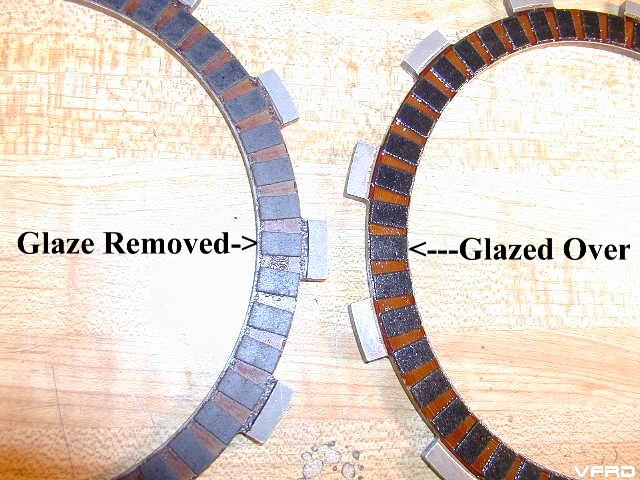
Next check the pressure plates for bluing caused by localized heat...
make sure they are not warped... consult the manual for a thickness
range... now removed the contaminants with Acetone and wire wheeled
them to erased the blue and also to generally scuff up the surface...
you should end up with a dull surface free of Blue marks...
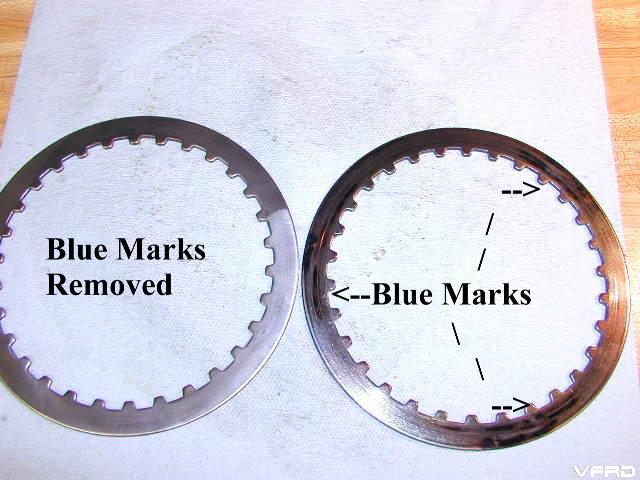
Bike on its side is a simple way to shift the oil level to an angle in order to remove the clutch cover without spillage...
Have a new gasket standing by...
[image: ClutchFix2.JPG]
[image: ClutchFix3.JPG]
4 hours ago, BusyLittleShopI love a good oil thread... a good thread will challenges your technical knowledge and long held beliefs plus you may actually learn something new...
After going all they way through this thread, I have to say I have enjoyed it greatly! 400,000 mi bikes and real oil analysis.....and someone who did experience clutch slippage and fixed it by going back. I think I am really going to enjoy this forum....where do I contribute ?
14 minutes ago, BusyLittleShopWe don't hear it because no one complains about clutch slip on a new bike...
but on about the 27K to 57K range is when containments may build up to
point where the clutch begins to loose its grip... this is usually discovered bythe owner during WFO (Wide Fooking Open)throttle like at a track day...
If you wish high mileage clutch life then you have to invest is some
good old sweat equity... because at the first sign of slip it doesn't
automatically mean your clutch is tired and worn out or that your
clutch plates are wore too thin because you can Mic them to
determine serviceability and within the factory specifications...Under scrutiny you'll find that your slip was due to normal
glazing and contaminates...Deglazing clutch plates ain't nothing new... no sir... back in the 70s
it use to be part of every savvy rider's maintenance plan... and for
some reason that all change during the 90s... why fix what you can buy
new is the what you hear now a days... but if your interested in
making your clutch bite good as new then roll up your sleeves and read
on...Inspect the friction plates for glazing... make sure you have plenty
of material to work with... your shop manual states clutch thickness
in thousands of an inch or mm...First removed the contaminants with Acetone... pick a hard surface to lay
over a 600 grit black dry emery paper... rotate the clutch plate in a
circle... you're just busting the glaze... don't get carried away
remove too much material... You should end up with a friction plate
looks dull like a new one as opposed to a shinny glazed one... recheck
thickness...
Next check the pressure plates for bluing caused by localized heat...
make sure they are not warped... consult the manual for a thickness
range... now removed the contaminants with Acetone and wire wheeled
them to erased the blue and also to generally scuff up the surface...
you should end up with a dull surface free of Blue marks...
Bike on its side is a simple way to shift the oil level to an angle in order to remove the clutch cover without spillage...
Have a new gasket standing by...[image: ClutchFix2.JPG]
[image: ClutchFix3.JPG]
Let me clarify what I meant by "newer"... Most of the slipping clutch, auto oil issues I've ever been aware of have revolved around stuff from the early 80s or older. I haven't run across many references to the same kind of "oil related" slipping clutch issues on bikes made later, especially after around 2000... a few years after the industry had to figure out good alternatives to asbestos. I'm saying my theory is that friction materials have improved to the point where they just aren't as sensitive to these issues as they once were.
So if I understand your take on it correctly... to paraphrase, you're saying that oil brand/grade has never really been that big a factor in clutch slipping and it was just something the marketing departments jumped on so they could sell some "motorcycle specific" oil? Seems plausible, though I'm not sure our ideas are entirely mutually exclusive.
I briefly considered deglazing clutch plates on an old XS650 a few years ago... They were still in spec, but I opted for new, mostly because it seemed likely that materials had improved since 1977. As for my VFR, the improvement in feel from running the 6th gen master with the 5th gen slave hasn't worn off yet... gotta keep the improvements incremental to keep the smile on my face.
2 hours ago, MarveliciousSo if I understand your take on it correctly... to paraphrase, you're saying that oil brand/grade has never really been that big a factor in clutch slipping and it was just something the marketing departments jumped on so they could sell some "motorcycle specific" oil? Seems plausible, though I'm not sure our ideas are entirely mutually exclusive.
We can share our takes thanks to the net and VFRD...
The holy trinity of science is 1)Reason 2)Observation 3)Experience...
employing those tools we observe that the primary cause clutch slip
are high mileage... mileage is the constant among all of the clutches
that begin to slip... oil is not a constant... we can't established a
constant when one owner swears so and so oil caused my clutch slip
whereas an other owner equally swears so and so oil never made my
clutch slip... but under close visual scrutiny we see that both
clutches began to slip due to normal glazing and contaminates that
build up over mileage... mileage has always been the constant and
never the brand or type of oil...
4 hours ago, BusyLittleShopWe can share our takes thanks to the net and VFRD...
The holy trinity of science is 1)Reason 2)Observation 3)Experience...
employing those tools we observe that the primary cause clutch slip
are high mileage... mileage is the constant among all of the clutches
that begin to slip... oil is not a constant... we can't established a
constant when one owner swears so and so oil caused my clutch slip
whereas an other owner equally swears so and so oil never made my
clutch slip... but under close visual scrutiny we see that both
clutches began to slip due to normal glazing and contaminates that
build up over mileage... mileage has always been the constant and
never the brand or type of oil...
I definitely agree up to a point... there are so many variables involved beyond just oil that any evidence is essentially anecdotal unless you have access to dealership service records. Since I don't have access to that info, it leaves me giving at least a touch of credence to anecdotal evidence. Even just given what we have to work with here on VFRD there's a pretty big mileage range, you mention clutch slipping starting around 27k, and I suspect we can find members here who've run over 100k without ever touching their clutch. Does oil account for the difference, or is it riding style or any of a hundred other factors? Basically, we don't have enough clean data for science, so we fall back on speculation.
Specifically, I'm speculating that clutch material has gotten better. I'm also willing to accept the speculation that mileage is probably a bigger factor than oil. Just to further muddy the waters, I suspect that there probably are some legitimate cases of oil causing a slipping motorcycle clutch, but that they're probably mostly related to "miracle" oils like the old PTFE formula Slick 50 from back in the day.
My personal VFR expertise is limited to a sample size of exactly one VFR, and I really only have knowledge of what it has been through in the miles I've owned it. Everything else is just people talking on the internet, which is all this is to anyone else. It's an oil thread... why spoil the fun by bringing science into it. 😆
Mileage does NOT cause clutch wear & neither does your oil. Imagine a relaxed rider on a bike that covers 200 miles a day in a relatively flat part of the world with little traffic & open roads. There is potentially 6 up shifts from a stop then a stop at the end.
Now take an aggressive rider in a hilly area covering 50 miles a day. There's potentially thousands of shifts per day, with clutch slip for aggressive launches. Now WHO will wear their clutch out first ?
The Slippiest oil will cause the most clutch slip, thats a given. Manufacturers design their engines & clutches to work well with a certain type of lubricant. But due to advances in oil technology or more likely the expense of selling new bikes with the best oil, they don't. So if the bike came with dino oil from the factory then its good enough if not over worked. If you choose to use super slippy synthetic oil, which potentially is better for your bearings, cams & general engine wear. If that means your clutch is less efficient in gripping & thus wears out quicker then that may be a price worth paying!
As always YMMV
All I know for sure is that, for some reason Amsoil makes all three VFR's I've owned shift better than other brands. I don't care why, just use it for that reason. Years of oil threads here and elsewhere have concluded that no particular oil has ever caused an engine failure or been proven to shorten the engine life of a VFR. If I'm wrong, the details would be interesting to read about.
Oil is like beer. Everyone has their favorite.......; )
3 hours ago, BentOil is like beer. Everyone has their favorite.......; )
ETC :D
27 minutes ago, SamuelxETC 😄
Great ads... terrible beer!
6 hours ago, BentOil is like beer. Everyone has their favorite.......; )
What's the best beer? :beer:
😎
Don't run your engine on beer it's not as good as oil 😀😜
...also, don't drink motor oil. It's not as good as beer!
BusyLittleShop, 9/27/2019 at 3:16 PMI love a good oil thread... a good thread will challenges your technical knowledge and long held beliefs plus you may actually learn something new...
Hey Larry!
There you go using all them damn facts again! You know facts have no meaning these days! LOL
I use the 5-30 full syn Mobil 1 you recommend in all my bikes including my 02 VFR that I've put an easy 106,000 grandpa type miles on. In fact I Never get out of second gear( at least doing wheelies, get'en old).
You'all got to remember that newer members haven't had the chance to beat that dead horse yet related to oil use!
BLS, I'm glad to see your still trying to help educate our members!!!
Marvelicious, 9/28/2019 at 11:57 AMGreat ads... terrible beer!
Horrible, horrible stuff. I had a friend who was a beer distributor before the "Taste Great, Less Filling" commercials started. He said the beer
sold like crazy after the commercials started. Who says marketing doesn't work.
5 minutes ago, FJ12RyderHorrible, horrible stuff. I had a friend who was a beer distributor before the "Taste Great, Less Filling" commercials started. He said the beer
sold like crazy after the commercials started. Who says marketing doesn't work.
Certainly not the beer companies or the oil companies!
shop put in Maxima Extra 10w-40
This works, its dark enuff like a good used oil..
[image: image.thumb.png.50105daf6372d68f45f50b7cedafff9e.png]
[post text not recovered]
[image: Knipsel.JPG.bb33054ff5d00c5ae1ad5a71628694b3.JPG]
Both? With a choice of three?? :tongue:
MOTUL 5100 10-40 for me, even if it says CASTROL in big letters "on the outside" :goofy:
[image: 15.thumb.jpg.70e6a0f8f5c8c246fb0c72397dc40ad8.jpg]
Baileyrock, 9/29/2019 at 8:46 AMHey Larry!
There you go using all them damn facts again! You know facts have no meaning these days! LOL
I use the 5-30 full syn Mobil 1 you recommend in all my bikes including my 02 VFR that I've put an easy 106,000 grandpa type miles on. In fact I Never get out of second gear( at least doing wheelies, get'en old).
You'all got to remember that newer members haven't had the chance to beat that dead horse yet related to oil use!
BLS, I'm glad to see your still trying to help educate our members!!!
You're welcome Bailey... I'm glad you're keeping the knees in the breeze... cheers...
[image: BaileyRock.jpg]
With a ST1300, his knees will be getting no breeze,
merely the heat from the tranverse V4 on his inside leg..... :goofy:
Back on the clutch slip thing. I’ve had this twice on my bike both times the clutch springs were below spec at 35K & 55K miles. The second set were “heavy duty” springs. As I had a couple of spare low mileage clutch packs I swapped both plates & springs the second time.
Dutchy, 9/30/2019 at 8:39 AM[image: 15.thumb.jpg.70e6a0f8f5c8c246fb0c72397dc40ad8.jpg]
Would you please stop posting pornography like that!
My wallet wont take the strain of me buying one and every time I see the Castrol racing Green model, I really, really want one! 😭
Dutchy, 9/30/2019 at 2:59 PMWith a ST1300, his knees will be getting no breeze,
merely the heat from the tranverse V4 on his inside leg..... :goofy:
That is a fact, the ST cooks me in summer riding as no air hits me at all around lower body. I need to get one of the Viffers back out for summer riding!
My latest MBD infliction
[image: IMG-20191008-WA0025.thumb.jpeg.7ad1df569e73add65c7500accd909f38.jpeg]
Likes "mono".....
[image: PSX_20191011_203110.thumb.jpg.b2289f47085ba27ac092e1024c27e00d.jpg]
It says so on the 50's drain plug :tongue:
[image: IMG-20191010-WA0038.thumb.jpeg.ff1eb0043b4b2081e62c1d003e29d252.jpeg]
18 hours ago, BaileyrockThat is a fact, the ST cooks me in summer riding as no air hits me at all around lower body. I need to get one of the Viffers back out for summer riding!
Damn! Someone told me you were kidnapped and the ransom wasn't paid.....
End of thread · 61 posts recovered Wayback Machine snapshot 24 Feb 2020