Hi everyone, I thought I would ask this question on this forum since someone might have firsthand knowledge on the subject. Does anyone know what the optimal material for cylinder walls on this bike would be? I’m looking towards long term longevity as it won’t be a race bike. I was looking to do machining and engine work on the upper crankcase to install 81mm 12:3:1 pistons. I know Honda uses mmc liners that are then cast in the manufacturing of the block. I feel though that technology has to have progressed and this might be considered old school technology. I mean c’mon now it’s 2021. I was thinking some sort of aluminum alloy with resistance to high heat and wear would be a good start. Thermal conductivity is important for long life. I was also thinking of diamond like coatings but I don’t think they stand up to high levels of heat for long. The pistons I’m using have an average weight of 240 grams a piece so if anything they should perform better that the oem ones especially in long term. Thanks in advance folks.
Picking new cylinder wall material need help
36 posts Started 19 Feb 2021 Last recovered post 23 Mar 2021 Wayback Machine snapshot 12 May 2021
I guess I'm in the minority here, but I have to ask. Why? Why must everyone change everything? Can't you just ride the bike and enjoy it? Not trying to be mean or a smartass. I just don't get it. Isn't the vfr is a great bike as is? To be clear, you are not rebuilding a blown engine, you are pulling a perfectly good one out, putting a few thousand bucks into it, then putting it back in?
No, it’s fine I take constructive criticism just fine. I actually chuckled when I saw your comment. And I was actually going to use an eBay motor so you can rest assured knowing I’m not taking my wondrous 8th gen apart. I love that thing too damn much. I guess you can call it inspiration. I looked at my bike and thought one day. What if Honda made a real 1000 cc “sport” bike around 440 lbs wet. Not a repliracer. They would have the market in their hands most of the people I see ride bikes just ride for fun with their friends and they always go for something cool. And I know that if Honda made a street bike like that it would be awesome. And since they refuse to make it, I will be the one to make it and it will be perfect just for me.
Oh and I apologize. To answer your other question is that everyone is different. Everyone has a different meaning for the word perfect and everyone has different preferences. Everyone is also physically different so what might be comfy for you might be painful for someone else. Whatever you might like I might not. I was originally going to get a 16 aprilia rsv4 but then I would lose that lovely Honda reliability. I’ve put 8000 miles on my interceptor in a little over a year and all I’ve done was do oil changes. Yet it keeps running like a Swiss watch.
Factory surface is as near perfect as you can get. Stable expansion with warm-up. Durable with longevity. Good thermal conductivity.
Any changes you may want is going to change these properties. Go over possibilities out there and make spreadsheet comparing all pros and cons compared to OEM. With hard-data, we'd have something to discuss.
Other thing to consider is compatibility with rings and pistons. Since sliding surfaces has been reversed from traditional alloy pistons sliding in iron/steel bore, you'll want to ensure pistons are iron coated to last in alloy bores. Definitely want to use chrome rings. Mahle, KB and Wossner are extremely familiar with making pistons like this. European cars have had alloy blocks since '80s.
There are many ways to use alloy liners. Porsche's method in '80s is Nikasil coating which puts hard layer of silicon-carbide crystal on surface. For less stringent non-racing applications, they use Alusil. Which is hyper-eutectic alloy with hard silicon crystals embedded. A precise etching/lapping process is used on final-finishing to remove the aluminium from between crystal to leave just hard silicon on surface.
In end, you're really at mercy of machine-shop fitting your pistons. No one has manufacturing capabilities rivaling Honda factory, so you'll have to take huge step backwards in technology. Most machine shops can only bore and install steel/cast-iron liners. Which is fine if you've got basic 2618 or 4032 pistons.
I'd like to imagine plasma-transferred wire arc (PTWA) technology (like Ford is using in their Mustangs) someday, somehow "trickling down" to the aftermarket world because PTWA gives very good performance and wear to a cylinder liner.
20 minutes ago, DannoXYZAlusil
22 minutes ago, DannoXYZ... Alusil. Which is hyper-eutectic alloy with hard silicon crystals embedded. A precise etching/lapping process is used on final-finishing to remove the aluminium from between crystal to leave just hard silicon on surface....
Danno you meant that silicone precipitation formed within aluminum-silicon hyper-eutectic alloy matrix is being exposed by chemical etching to form hard porous bearing surface, capable of holding lubricant? 😍
To handle the rigors of racing Honda's RC45 employs cylinder sleeves
made of aluminum power impregnated with Argil alumina and graphite...
(note Argil is a composite material of silicon, iron, copper and magnesium)
Stock Honda cylinders whether VFR800 or RC45 will meet and exceed our
mileage expectations... expect to see over 300K plus miles on 30 grade oil...
[image: RC45CompositeSleeves.jpg]
Magneto, 2/19/2021 at 12:44 PMDanno you meant that silicone precipitation formed within aluminum-silicon hyper-eutectic alloy matrix is being exposed by chemical etching to form hard porous bearing surface, capable of holding lubricant? 😍
Yes, this is process initially used for Chevy Vega's Reynolds A-390 aluminium blocks from mid-'70s. That had 17% silicon while Porsche's Alusil has 21%. The silicon-faced bores when prepped properly is extremely durable. I've rebuilt many Porsche Alusil engines with +200k-miles that had perfect bores. Just needed some clean-up of ridge on top, install new rings in and that's it! Mercedes and BMW makes extensive use of Alusil blocks. https://www.enginebuildermag.com/2016/04/honing-aluminum-blocks
BMW went to Alusil after their Nikasil engines faced untimely demise from higher sulfur content in U.S. petrol. Nikasil is trademarked by Mahle, so NiCom is used in U.S. Very popular coating for off-road 2T crowd. https://www.uschrome.com/nicom-nikasil-cylinder-coating-and-repair
In OP's case, regardless of technologies available, he's going to be very limited due to bore-size. Most likely all of original MMC liners will be removed with that much boring. He'll be limited to using wet-sleeves. For daily-use, I'd recommend ductile-iron sleeves, racing should use chromoly steel sleeves. Darton's MID sleeves were designed for this type of massive over-boring. The sleeves touch on sides, have interlocking top-flanges and reinforcement ridges in middle to increase stability when all of original cylinders are milled away. https://dartonsleeves.com/products/sleeves/mid-sleeves/honda-acura-mid/
[image: C23C168D-5199-4A2E-A735-DA5D8B4A9472.png.aae2727708e8da39a40d29485ddc6db6.png]
Example of this is Porsche's 944 Turbo. Due to lack of factory support, aftermarket tuners have developed hybrid engine builds using Chevy small-block pistons and Mitsubishi 4G63 rods (Starion/Eclipse). "Downgrading" from alloy liners to steel sleeves has not caused any issues, and opened up much more opportunities. Taking stock 221-bhp engine to +650-bhp is simply unheard of in many markets. They've taken over Porsche club-racing as best-value-for-performance model from previous 914/6. Easily beating up on high-end 911 models. With completely mild-mannered daily driving behavior as well. 🙂 http://www.refresh951.com/EngineBuild31.htm
Very interesting. Unfortunately, I showed my wife (CEO) and now I’ll never be allowed a new bike!
My wife (Bank of Mary / War Dept.} is wise too...
New bike is chiefly a product of growing tired of the old bike instead of replacing a worn out bike...
Two Wheel Ordeal
https://c1.staticflickr.com/9/8728/17257358129_ed08516cb1_o.jpg
https://c1.staticflickr.com/9/8784/16821079034_c45d15939c_o.jpg
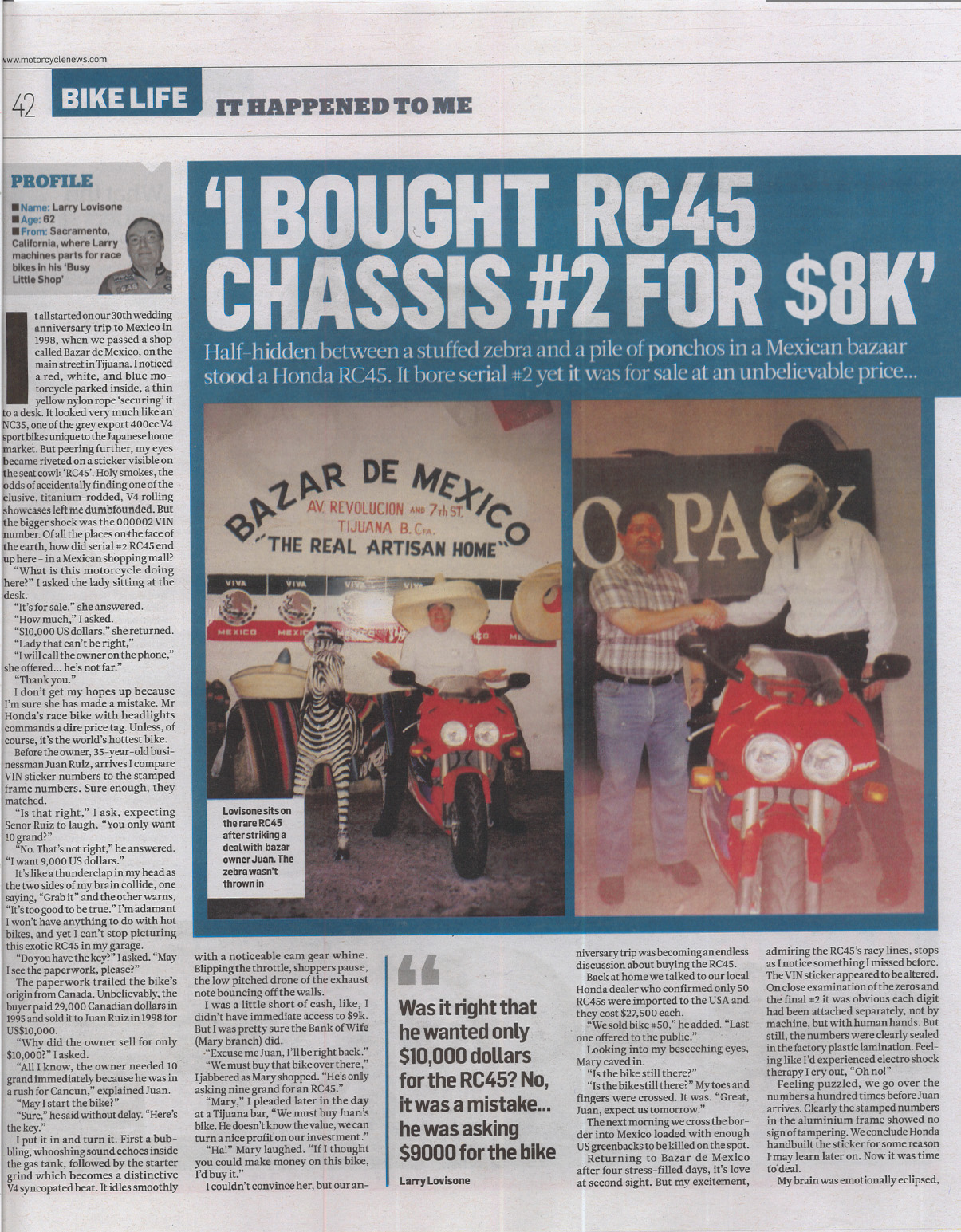
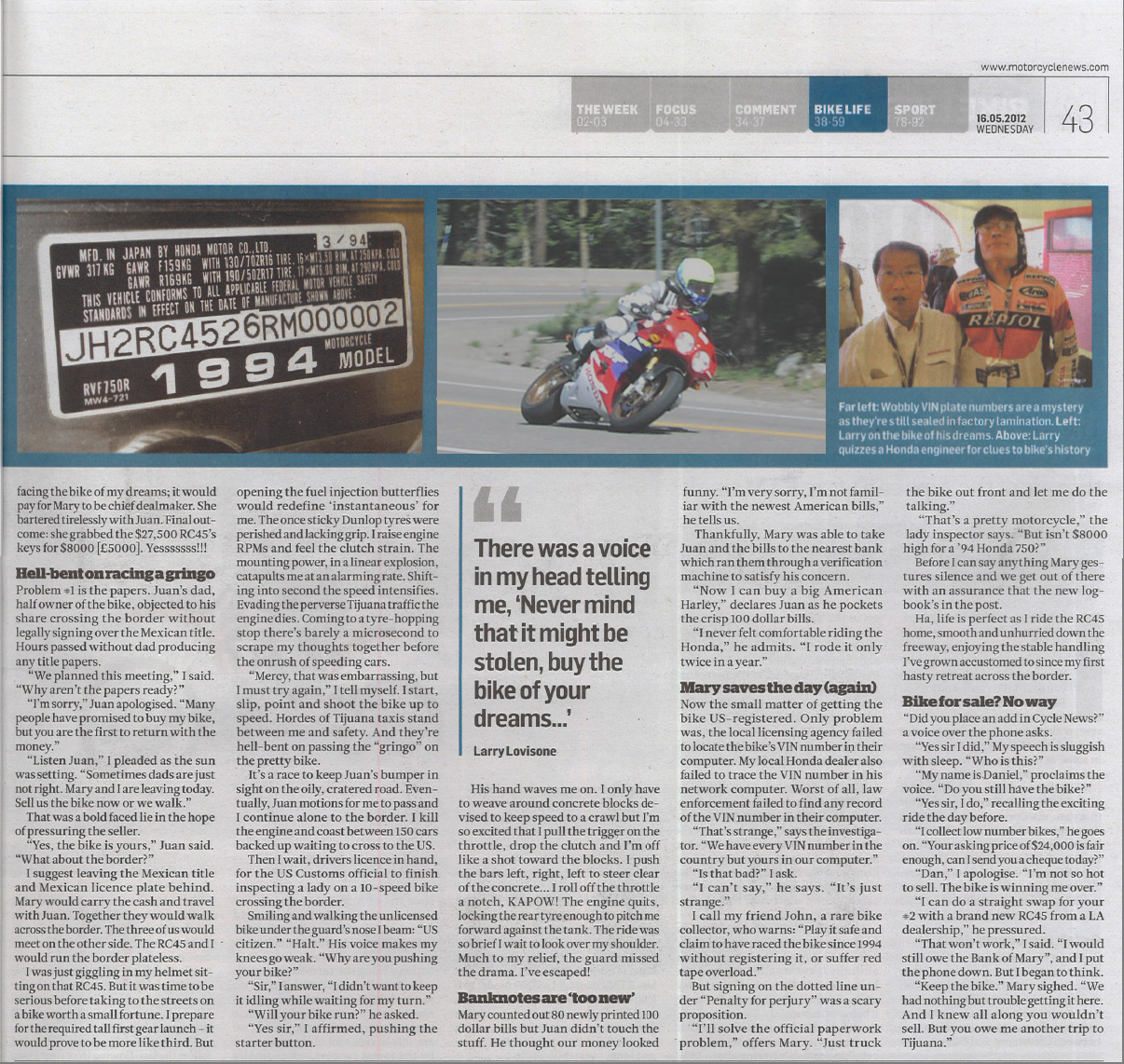
944 Porsches are my weakness.....argh. Lucky for me I love riding my VFR so much that it keeps me from other distractions.
15 hours ago, BusyLittleShopMy wife (Bank of Mary / War Dept.} is wise too...
New bike is chiefly a product of growing tired of the old bike instead of replacing a worn out bike...
Two Wheel Ordeal
https://c1.staticflickr.com/9/8728/17257358129_ed08516cb1_o.jpg
https://c1.staticflickr.com/9/8784/16821079034_c45d15939c_o.jpg
Thank you for sharing that article. I was glued to it, until the end.
I know your bike, Im guessing you have spent twice that on all the bits over the years.
I bought my 1999 in 2000 for $8,000, and have prob spent a least another $8,000 on bits over the years
Alrighty guys so I bought a spare crank case I’ll let you guys know which route I went with in the future as things progress. Also I’m going to see if I can use the 81mm pistons used in the new cbr1000rr-r sp. I already ordered one and I’m going to see if I can find some new rods to use and I think the wrist pins in the Honda cbr piston are 18mm.
[image: 177098DC-A135-444C-A672-91DCE0310CDF.jpeg]
[image: F48A126E-C98E-4010-9D94-B4FD78F42E6B.jpeg]
That is new - yes? I haven't looked - but that must be a nice chunk of $. That shot gives VTEC owners a good look at where the spool valve lives - right in the base of the V. They never see it unless they remove the throttle body.
You might want to check out HighSideNZ's thread from circa 2015. He successfully overbored his 5th gen block to 825cc and also did a cam re-grind. It might be interesting to compare notes with him to see how he approached it. The whole thread was captivating. I haven't seen him post in a while but I think he checks in every so often. Super nice guy - helped me out with a project - without him I could not have competed it. Maybe shoot him a PM with what you're up to. Just a thot . . .
I actually got it for 200 bucks used. Someone crashed one and it was on eBay. I snatched it up once I saw that the price for a new one is 1800 usd on partzilla. I think I’m going to convert it to a closed deck so I can bore it out to 81mm.
Used or not, it's a beautiful hunk of aluminum. I used to love to look at my VF-500F's exposed engine when I was but a pup.
Vfr800witdawaffle, 3/11/2021 at 8:32 AMI actually got it for 200 bucks used. Someone crashed one and it was on eBay. I snatched it up once I saw that the price for a new one is 1800 usd on partzilla. I think I’m going to convert it to a closed deck so I can bore it out to 81mm.
Yeah, boring out to 81 won't leave much of original cylinder in place to support dry-sleeves. So you'll want to go with wet-sleeves that also convert to closed-deck at same time. Top flange touch each other as well as outer block for support. Good enough for 260-bhp/ltr engines, so you should have plenty of overhead. There's actually a step on outer-block to support under flange. I prefer to have sleeve's flange 0.0015" above deck for additional head-clamping. Also make sure deck-plate is used for boring. Honda B16/B18 engines have same 81mm bore and many are upgraded using wet-sleeves, so there's many shops that can handle this.
[image: 951engineBlock2.thumb.jpg.bd5eeb402fcd95a88adaa8def4fa1001.jpg][image: 951block-MIDsleeves2.thumb.jpg.10b719172a4b7c03c8c2bd94fe7719dc.jpg]
That was a steal - looks brand new. Once to fruition and I suspect that some clutch upgrades may well end up being in the mix. Very much looking forward to seeing more updates. :lurk:
2 hours ago, DannoXYZYeah, boring out to 81 won't leave much of original cylinder in place to support dry-sleeves. So you'll want to go with wet-sleeves that also convert to closed-deck at same time. Top flange touch each other as well as outer block for support. Good enough for 260-bhp/ltr engines, so you should have plenty of overhead. There's actually a step on outer-block to support under flange. I prefer to have sleeve's flange 0.0015" above deck for additional head-clamping. Also make sure deck-plate is used for boring. Honda B16/B18 engines have same 81mm bore and many are upgraded using wet-sleeves, so there's many shops that can handle this.
[image: 951engineBlock2.thumb.jpg.bd5eeb402fcd95a88adaa8def4fa1001.jpg][image: 951block-MIDsleeves2.thumb.jpg.10b719172a4b7c03c8c2bd94fe7719dc.jpg]
Modern machining methods really are impressive. I half expected to see a jet of oil spraying on it while working as happens in some CNC processes. I should study on it more as I don't know as much as I'd like to.
Yeah, modern machining is extremely advanced. Speeds for these cuts in alloy are slow compared to high-speed drilling and milling bits in steel, so not much heat is generated. Alloy block and chips also carry away heat quickly. Coatings on tool-bits have improved tremendously as well. AlTiN and TiAlCN coatings are extremely hard with low-friction to reduce heat. And they may actually shatter off cutting-bits if hit with coolant/lube due to thermal shock. Final honing/cross-hatching operation in steel sleeves using diamond-hones will require lube.
Here's beginning-to-end sleeving operation on Honda engine. What surprises me is how wet-sleeves are only slip-fit, not even interference-fit like dry-sleeves. These sleeves have 100kpsi strength, or about 3x more than old-style cast-iron dry-sleeves.
I used to do lots more old-style dry-sleeving using cast-iron liners inside bored-out alloy cylinders. But that gets too weak for larger bores due to thinnest of original and inserted sleeves. Even though total thickness may be 4.0mm, they have only strength of their 2.0mm individual layers. It's load-in-series equation like stacking 2 springs on top of each other or chains. Each layer still have to face same max-load.
So guys the cbr1000rr-r piston came in and I got some photos and weighed it. I’m going to get a better scale as I don’t want to go around balancing the darn crank and I’m also going to see if I can have the oiling holes made a bit bigger at at a good machine shop.
I also weighed the pins and the cbr pin is only a couple grams heavier. It’s also beefier looking. The interceptor pin is 17mm in diameter and longer while the cbr is 18mm. I’m going to have to use a different rod. I’m going to look at oem steel offerings from other manufacturers including Honda. Trying to keep costs down and I will not be using titanium. Titanium rods don’t last as long as steel rods when it comes to putting down hundreds of thousands of miles.
Ambitious project, first person I've come across to try it on the 8th gen. Your biggest headache will be compression ratios.
The stock MMC is the best possible liner, for wear & longevity, nothing else comes close. Unfortunately like other alloy based solutions, you need a thick alloy wall the contain the forces involved.
The open deck cylinders have a stock OD of 88mm with a 72mm bore. Giving 8mm wall thickness. The MMC's are 2.5mm at their thickest point, thus you need to bore to 79mm to completely remove them. If you intend to bore for 81mm pistons then you may run into issues around the bottoms of the cylinders, due to the staggered layout, the lower cylinders are partially bored through the structural walls. A large bore may cross or expose/cut off oil ways. The only suitable liner would be a 2mm walled iron liner due to the loss of alloy from the bore. And as was previously noted, changing to closed deck solution is probably the best option to ensure bore stability & to get a flush fit & avoid liner slip. If you can get them you may be able to repurpose VF1000R liners. IIRC the stock bore is 77mm with either 4 or 5mm wall & a closed deck lip.
Re piston wrist pin, the 1K one is stronger than it needs to be due to the higher rpm of the 1K, so you should be able to lose the extra couple of grams & get the complete piston to the same weight as the stock one.
I will wait with anticipation of your progress. I've been planning the same thing for years & never had the time & funds to do it.
81mm bore with 2mm dry sleeves give only 1.5mm of original cylinder left. That's not enough to hold liners and deal with lateral piston forces. I tried as thin as this on 6500rpm engine and liner & cylinders cracked.
You'll want at least 3mm of each if going with dry-sleeves.
Going with offset crank or piston-pins would help reduce lateral forces on cylinder walls....
@Mohawk Thank you for the reply as I forgot to measure the piston height from the center of the wrist pin hole! I remember looking at them side to side and I think even though the new cbr piston has a compression ratio of 13:1 the cbr uses a longer rod by a few mm. If I get custom rods with the same rod length as the vfr, compression ratios should be similar from the old piston to the new one.
16 hours ago, Vfr800witdawaffleI also weighed the pins and the cbr pin is only a couple grams heavier. It’s also beefier looking. The interceptor pin is 17mm in diameter and longer while the cbr is 18mm. I’m going to have to use a different rod. I’m going to look at oem steel offerings from other manufacturers including Honda. Trying to keep costs down and I will not be using titanium. Titanium rods don’t last as long as steel rods when it comes to putting down hundreds of thousands of miles.
As mohawk mentioned, CBR pin is much stronger than needed for your application. It's 25% stronger than VFR pin. You can taper-bore inside to get identical weight and it would still be more than enough.
Then again, you're still looking for rods...
Vfr800witdawaffle, 3/21/2021 at 11:00 AM@Mohawk Thank you for the reply as I forgot to measure the piston height from the center of the wrist pin hole! I remember looking at them side to side and I think even though the new cbr piston has a compression ratio of 13:1 the cbr uses a longer rod by a few mm. If I get custom rods with the same rod length as the vfr, compression ratios should be similar from the old piston to the new one.
it's just not compression-height of piston that matters, but combustion-chamber volume of head. Larger displacement for same head volume would result in higher compression. I seem to remember 14.0-14.4cc somewhere. Subtract volume of piston above deck to arrive at actual head cc and use new displacement to calculate static compression.
So distance from the hole to the top of the pistons measure 14.6mm for the vfr and 15.8 for the cbr. Respectively the holes are 17 vs 18mm. That means piston height is 23.1 for the vfr and 24.8 for the cbr. So my guesstimations are off I’ll need a shorter rod going forward to lower compression. My target is going to be 12:1. Worst comes to worst I’ll back off on timing when tuning.
@DannoXYZ Thank you that makes a lot of sense. I’m going to be asking a lot of questions to all types of people going forward with this as this is my first custom engine build. On another note I notice the valve recesses on the cbr piston are much more prominent where as the vfr piston is flatter. I think the volumes above deck height might be similar even though the new piston is wider.
I also weighed the vfr rod and they are pretty beefy at 290 grams.
there are at least 2 dozen ways this project could go BANG !
I'm finding this a very interesting project - looking forward to seeing how it works out. :fing02:
You need to compare valve spacing & angles. The CBR probably uses larger valves, and they are likely at a smaller included angle, so the VFR valves may contact on their lower lips.
IIRC the VFR rod is 4" or 101.6mm c2c. I have the data somewhere but from memory IIRC the RC45 rods are significantly shorter. I dug out the numbers below.
>>>
Custom rids may be your only answer. If going with the CBR1K pistons. The older 1K had 78mm bore which would give you more space to play with, plus they use the same piston pin diameter as the VFR. You might look at the CRF250 big bore pistons too. Only the top half of the VFR cylinder is unsupported with the lower half passing through the crankcase. A 2mm walled iron liner would be strong enough if fitted with a closed deck as only approx 22mm is above the crankcase base & below the deck lip, assuming 3mm deck lip thickness. I'd completely mill away the open deck portion of the remaining cylinder walks once they have been centrally bored for the liners. This will improve cooling, having the coolant in direct contact with the liner. Have fun.
Yes, included valve-angle is 23-degrees on VFR and 9-degrees on CBR1000RR-R, so piston & combustion-chambers are configured differently.
1. First and most important point-of-reference are squish-zones on piston-tops between each set of intake & exhaust valves (blue). As piston rises, it squeezes mixture towards centre of chamber and spark-plug. At higher-revs, this squish action is extremely turbulent and helps fully atomize and blend air-fuel mixture. This removes lean & rich spots and promotes efficient and fast combustion with resistance to knock/detonation. Clearance to head at this squish-zone needs to be around 1mm for optimum effect. Which happens to be thickness of headgasket, so you'll want to get rod-length to place piston's squish area flush with top of deck.
[image: uc?export=download&id=1pAF0eC1nnOX9YXO47]
2. Starting around 2000, Toyota's 1ZZ engine showed additional angled squish-zones for more focused squirting of mixture towards spark-plug (green). This created even better mixture swirl and improved combustion on high-compression engines. Also made less crescent-shaped combustion-chamber and more centralized mixture (similar effect as hemi-heads in '60s). You'll need to mill head to provide clearance for this angled squish-zone where there is currently flat metal outside of current bore. I recommend CNC process so you can make same cuts on all combustion-chambers on all cylinders.
[image: uc?export=download&id=1iWqwmIGZmXW6Ci2SE]
3. you'll want to clay piston-tops and spin engine 720-degrees. Slice through clay and measure clearance between piston-top and valve. Angle of valve won't match pistons and will be tightest at outside edges of each valve. You'll want 2mm minimum clearance here.
[image: uc?export=download&id=1EoTI67VBTrGdGTo0R]
[image: uc?export=download&id=1xcvosEFTNslHPLuXU]
4. with modern machinery and cutters, there's A LOT more that can be done to improve flow through head. Used to be that 5 or 7-angle valve-seats were better than factory 3-angles. But today, we can use fully-radiused smooth seats for best flow with back-cut valves. And install copper-beryllium seats for much better heat-transfer than OEM seats. You've got extra space with larger bore, so might as well install slightly larger Inconel exhaust and stainless intake valves. Removing ledge at valve-pockets and unshrouding valve at outsides really improves flow.
[image: uc?export=download&id=1bSojGCWJXcWSh1Hor]
Final combustion-chamber volume should be higher than CBR1000RR-R and give you less than 13;1. You can measure final head+piston CC using pipette.
End of thread · 36 posts recovered Wayback Machine snapshot 12 May 2021