Well, I've got one dead 194 bulb behind both the speedo and tach, so they both have been sort of dim at night.
I'm lazy enough that I was in no rush to dig in and replace it, but since I have the instrument panel out in the middle of repairs from the crash, I should take care of it.
I just figured that I've had better luck with led's in two of my cars and they use less wattage compared to the regular lights.
I'm not going blue, but I'll probably go bright white.
yeah i went blue led's in my 5th gen dash, after the LDC backlight kept blowing (well twice in 10 years!), left the FI and indicators as they were as they were not a problem to me.
Well, if you gona do it, make sure that you pick the ones with diffuser at the top. If you don't you will have some very bright spots shining through. Those things are BRIIIIGHT! And if you try to use dremel to create said diffuser after you've soldered them in, they will come out along with the track of the PCB. Ask me how I know...
P.S.
I'm not sure about lower wattage. Same voltage, same resistance (achieved by using extra resistor) = same wattage. No?
While I have the Meters out of the bike, I'm going to change the bulbs for LED's
I found the printed copy of KPerham's led list, which seems to have been lost.
I notice that he says not to use LEDs for the FI light and the turn signal indicators.
Did this ever get sorted out??
Also does using a non-load sensitive flasher solve the problem.
You doing a Fifth Gen? On mine, the signal indicators and the FI indicator all stayed on at less than full brightness. I guess enough power goes through to light the led, but not enough to illuminate an incandescent bulb under normal conditions?
I have a relay to allow normal flash rate, but if course it is separate from the FI. So I'd say the relay is not at all a factor.
The "inverted cone" led bulbs I use don't have any hot spots in my display.
I got the LED's that diffuse as well. From memory I got 8 for about $10, only need 5 for this job. They've been in for 20,000km with no probs. That bright blue at the bottom is a gear indicator, since replaced with an Acumen.
I don't have any experience with installing LED's on bikes but can offer one suggestion that might come in handy if they're too bright, which happens often when I'm dealing with audio equipment, especially with the blue LED's.
Fingernail polish works great to manage the intensity of LED's and even to change the color slightly. A little deep-red polish applied to an over-bright blue LED dims it and makes it a much more pleasant bluish-purple color. There's also gray polish to dim the light without changing the color, useful for red and green ones. Just dab on a coat, let it dry thoroughly and test it. If it's not enough, put on another coat but ONLY after the first coat is completely dry. If it's too much it comes off easily with, what else, fingernail polish remover, or acetone.
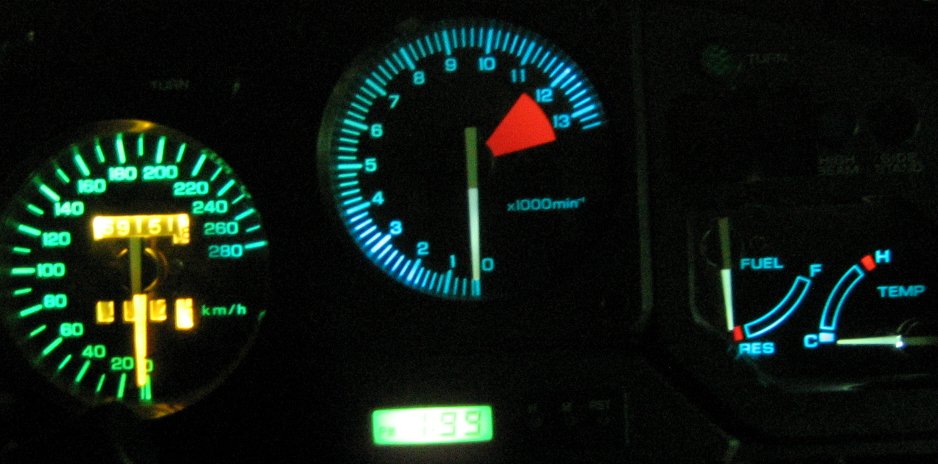
I used the inverted cone single LEDs in blue for my dash. Not too bright at nighttime at all, and zero spotlighting of the gauge face.
The tack and speedo needles turn a purplish colour and are a tiny bit harder to see than before, when they were orange, but really its no big deal to me, you're shifting by ear anyhow, and usually one can judge their speed pretty well, and it only takes about 10% more thought process to see the purplish needles at night and interpret them anyhow.
The gauges are brighter than the cheap camera makes them look (link):
Well, if you gona do it, make sure that you pick the ones with diffuser at the top. If you don't you will have some very bright spots shining through. Those things are BRIIIIGHT! And if you try to use dremel to create said diffuser after you've soldered them in, they will come out along with the track of the PCB. Ask me how I know...
P.S.
I'm not sure about lower wattage. Same voltage, same resistance (achieved by using extra resistor) = same wattage. No?
Well I've used some 4 led, side firing ones in my cars and they worked well, very bright, but even lighting.
I'm trying to find them again, but so far no luck.
As for lower wattage, I don't use load resistors or the LEDS that have them. Mostly because as KPerham said, it just defeats the purpose.
Now for the FI light and/or the turnsignals, I'm surprised there is that much voltage in what should be a switched circuit.
I wonder if it is some sort of back current, given the crappy grounds of the 5th gen.
The only reason you need a resistor is for turn signals because of the flasher relay circuit. Because an LED uses such low power it is similar to a blown bulb - which gives you the fast flash.
I'm thinking if a fella wanted to use white LEDs, maybe the "cool white" ones might be easier on the eyes at night??
When you often ride at night you better stay away from high kelvin white or anything blueish as your eyes are most sensitive to those colours. As a result your pupils will have a smaller aperture and that results in less night vision.
I'm thinking if a fella wanted to use white LEDs, maybe the "cool white" ones might be easier on the eyes at night??
When you often ride at night you better stay away from high kelvin white or anything blueish as your eyes are most sensitive to those colours. As a result your pupils will have a smaller aperture and that results in less night vision.
Except those LEDS will be shining through the stock gauge faces and changing colour anyhow due to the natural tint of the gauge faces, numbers, etc.
Stock gauge face is green numbers. LCD would show whatever color bulb you use. I went with blue. It's crisp, but not too bright as to ruin night vision. I guess you could try red if you're concerned.
My flashers were already cycling fast because I have LED's in the back, and I'm adding flush mounted led lights upfront, so I also grabbed one of these.
![[image: WLED-G_mm.jpg]](http://www.superbrightleds.com/images/specs/car/WLED-G_mm.jpg)
![[image: cool_vs_warm.jpg]](http://www.superbrightleds.com/images/graphics/cool_vs_warm.jpg)